Enforcement moved into exactly this market.
Why now
The record-keeping is the case. In 2025 the agencies stopped treating unsupported ad claims as a paperwork problem.
FTC v. NextMed
A telehealth GLP-1 marketer was charged in part over a weight-loss claim it had no records to support. The FTC's core allegation was the missing substantiation itself. The final order landed in December 2025. The lesson brands took: the missing record was the case.
The telehealth letter wave
FDA warned dozens of telehealth companies over compounded GLP-1 marketing, targeting sameness claims, safety and effectiveness claims for unapproved drugs, and ads that obscured who compounds the product. FTC on the ad and FDA on the drug now move together.
On a national campaign, the per-violation math is existential.
Add the private referee brands hit first: a challenge at the National Advertising Division inverts the burden. Once you are challenged, you produce the substantiation, fast and organized, on a clock as short as 20 business days. A standing, current file is the difference between a two-day response and a fire drill.
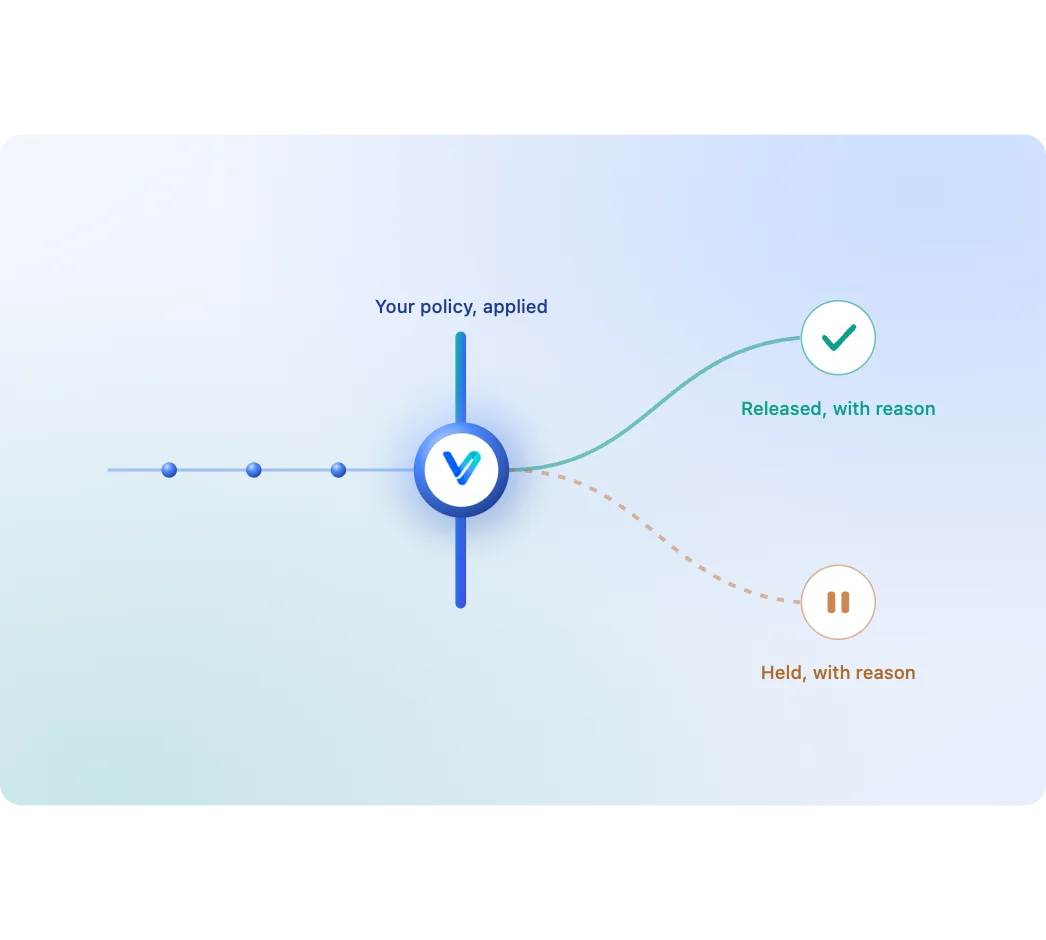
Substantiation as a living system, not a memo.
A legal substantiation review is a snapshot: it grades your claims once, hands you a memo, and starts going out of date the day it lands. But the rule is not a snapshot.
The claim register
Every objective claim you run, held as a governed record: exact wording, the channels it runs on, its first-run date, the evidence bound behind it, and a dated history. The history is the product. It shows substantiation existed before the claim ran, and every day since, which a static memo can never show.
This is the FTC continue-to-support duty, running as a feed. When a document expires, a supplier lands on an FDA list, or a snapshot goes stale, the claim resting on it flips to needs attention the same day, with the suggested action.
The substantiation binder
One button, per claim or the whole register: a dated file with the claim text, run dates, every evidence item with its hash and as-of date, and the full monitoring history. Built for a NAD SWIFT clock and an FTC inquiry, so day one of a challenge is assembly-free.
Publish a white-labeled proof page for your brand, and give each claim a short citation link. Your ad's fine print carries the link, and the reader sees exactly what documentation is on file behind that sentence, dated. An ad that footnotes itself: see what is on file beats trust me.
Veritura already watches everything your evidence points to: a document expires, a supplier lands on an FDA list, a snapshot goes stale. A rot alert is that monitoring, applied to the claim resting on it.
Alerts
BlueRiver API Co · the published verify link for LOT-BR-0816 did not answer on three attempts. A corrected source route has been requested.
MON-DEMO-18·1 supplier · 1 lot · 1 order
Sterility scope gap on an open lot
Keystone Peptide Labs · LOT-KP-2407 carries no sterility or endotoxin result. Missing evidence is not a failed test; the lot stays in review until it lands.
MON-DEMO-21·1 supplier · 1 lot
Public-source snapshot refreshed
openFDA enforcement and recall records re-captured for 4 suppliers. No match in the captured sources. Disposition unchanged.
Qualification element falls due
Aurora Pharma Supply · ongoing review is due July 30, 2026. Five of six elements remain on file with current dates.
A monitoring signal maps a captured public record to the suppliers, lots, and orders it touches. It never changes a disposition on its own, and no match in a captured source is not proof of absence.
Each feature is the operational form of a rule you already owe.
The honest core is the rewriter. Take "rigorously tested" and get back the version you can prove, "testing documentation on file and independently reviewed for every lot," plus the evidence that makes it checkable. A smaller claim you can back beats a bigger one that draws an inquiry.
How a claim is classified
Wording against evidence type, before anything gets bound.
Veritura scans the copy for objective claims and classifies each by the type of evidence it would need. Each label is the Veritura action to take. It is never a verdict that a claim is legal or compliant.
Checkable
A claim you could back with documentation on file.
The wording implies more than documentation can show, so a smaller checkable version is offered.
Cannot be backed
No documentation evidence supports the claim as a product-quality, safety, efficacy, sameness, or FDA-approval assertion. Veritura will not substantiate this claim.
Puffery like "feel your best" carries no substantiation duty, so it is not flagged.
What the map returns
What each objective claim needs, and who supplies the evidence, with the governing rule referenced beside it.
Disclosures your ad needs
Triggered by the elements in your ad and grouped by ad element, each referenced to the rule that requires it. Confirm the exact wording and placement with your counsel.
Everything the ad needs to be backed, and who supplies it: the claim, the evidence needed, who provides it, and whether Veritura can provide it.
Routes to your counsel
The cannot-back and route-out items, with why and the governing rule. These sit outside documentation evidence: Veritura surfaces the rule but cannot substantiate them.
This is an evidence-and-disclosure map, not a compliance determination. It surfaces the applicable rule and what your evidence supports; it never tells you a claim is legal or compliant. Confirm with your counsel.
Who provides the evidence
- Veritura documentation and verification
- Pharmacy (503A/503B)
- Accredited testing lab
- Clinical study or RCT literature
- Brand business records
- Legal or regulatory counsel
- Brand engineering and privacy
Ad elements that trigger a disclosure
- Testimonial or endorsement
- Influencer or paid creator
- Before and after imagery
- Subscription or auto-renewal
- Free offer
- Savings or comparative price
- Health or efficacy claim
- Compounded medication
- Ad pixels or tracking
- Paid telehealth ads
- Veritura seal or artifact
One brand, a group of brands, or a whole network.
Self-serve for a single brand or an MSO managing several. Larger networks are a conversation. Every plan is the same living register, binder, and public pages, and the boundary holds on all of them: documentation evidence, never legal advice or a claim of compliance.
Brand
One brand's claim register: the living register, rot alerts, the one-button substantiation binder, and white-labeled public claim pages. Add a second brand any time at the same per-brand rate, or move up to the MSO platform.
The multi-brand bundle for a group operator: manage up to ten brands' registers under one account, each with its own binder and public pages. Built for MSOs and marketing teams running several brands at once.
Enterprise
For larger networks: more than ten brands, volume terms, and a shared register across the whole portfolio, with SSO available through a scoped implementation agreement. We scope it with you.
These plans keep every claim continuously substantiated for a fraction of that, and they never assert a claim is legal, compliant, or FDA-approved.
We manage the evidence. Your counsel practices the law.
We do
- Hold each claim's documentation evidence as a dated, hashed record.
- Classify wording by the type of evidence it needs.
- Suggest checkable, documentation-level rewrites.
- Watch the bound evidence and flag a claim the day it changes.
- Produce a standing substantiation file on demand.
We do not
- Give legal advice.
- Tell you a claim is legal, compliant, or FDA-approved.
- Test physical product.
- Certify quality or safety.
- Decide what the law requires.
Veritura manages documentation evidence. It is not a law firm, and the product is a gift to your counsel, not a replacement.
Documentation evidence, not legal advice. Every register, binder, and public page carries that boundary on its face. Invite your outside counsel into a read-only view of the register and binder, so their review gets faster and they stay in the loop.
Documentation evidence, not legal advice. We never assert a claim is compliant. Veritura holds each claim's evidence with dates and hashes, watches it, and produces it on demand; it does not determine that any claim is legal, compliant, or FDA-approved. What the law requires stays with your counsel.
Your lawyer tells you whether a claim was substantiated. Veritura keeps it substantiated.
A single campaign substantiation review produces a static memo that starts rotting the day it is delivered. A subscription that keeps every claim continuously substantiated, producible in one click, and auto-flagged when the facts change costs less than one campaign's review.