Upstream of your quality system. Before anything is accepted.
Upstream of the quality management system (QMS), the ERP and the laboratory information system (LIMS). Those systems keep what a team has already accepted; packet review decides what the packet actually supports before it is accepted.
- The supplier sends the packet
Through its standing link from the pharmacy (one link per supplier, its door), with no account, no login and no cost, or by email to the workspace's own address. Most risk starts here: a seller named as the maker, a lapsed accreditation, a certificate with no tie to the lot.
- Veritura reads and checks it
Every certificate faces up to 20 named checks. Every credential says how it was verified and when. The file itself is read for 17 document-integrity signals. The result says what is present, what conflicts and what could not be verified.
- A person decides
Qualified, qualified with written conditions, or not qualified, signed by a named person. Qualified is refused while a gap is open.
- The system of record stores the decision
The signed decision is what the QMS or ERP keeps. The original documents stay on file in Veritura, as received, with their fingerprints.
FDA warning letterMay 1, 2026
… identified your firm, “…,” as the manufacturer of API rather than (b)(4), the firm from which you purchased …
Six dated elements. One living file per supplier.
One living file per supplier, with six elements, each dated and shown as current, due or overdue.
| Element | What is asked | How it is verified |
|---|---|---|
| Manufacturer identity | Who made the substance, and where. | Read from the certificate. A seller printed under a seller label is never counted as the maker. |
| Accreditation | The testing laboratory's accreditation, such as ISO/IEC 17025. | The certificate is read: the accrediting body, the effective and expiry dates it states, and its scope matched to the tests each certificate of analysis reports, a test outside the scope named. Renewal due 30 days out; expired after, which holds. |
| FDA registration | The maker's FDA establishment registration. | Searched in FDA's registry: registered to manufacture passes, with its FEI; registered only to relabel or repack does not. |
| Quality agreement | The agreement between the pharmacy and the supplier. | On file and dated, with the date it falls due. |
| Documentation specifications | The panels each certificate from this supplier must carry. | Every certificate on file checked against them. A certificate missing a panel counts as partial, and the missing panel is named. |
| Ongoing monitoring | The supplier, the maker and the laboratory against public enforcement records. | Re-matched against openFDA enforcement records at check time and on an hourly cycle, with a review cadence and the date of the last review giving the file one status: current, due or overdue. |
Every open gap carries a named owner and a due date, shows Overdue past it, and keeps its reassignment history.
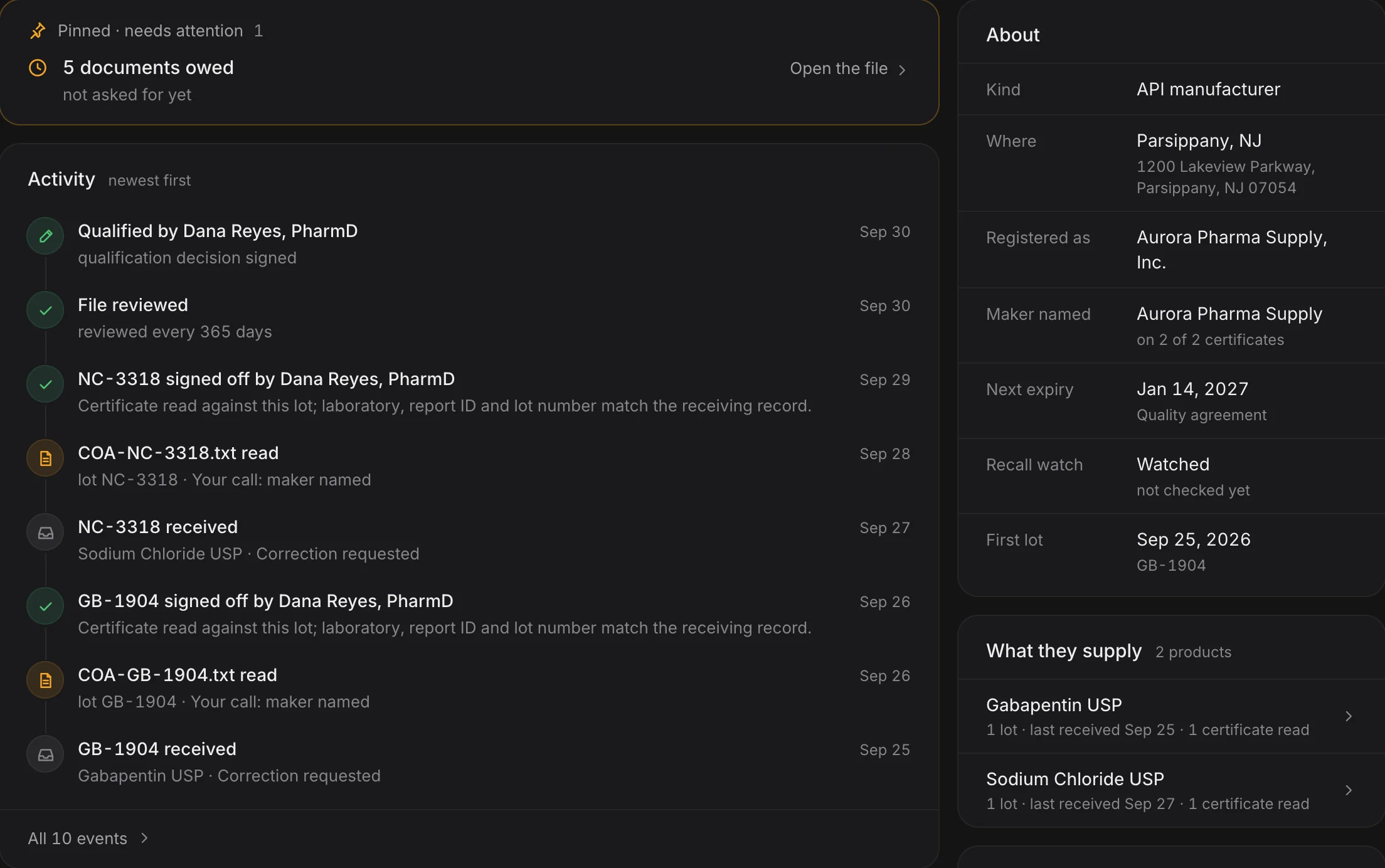
Up to twenty named checks per certificate. Each naming its standard.
Against up to 20 named checks in four groups, each naming the standard it rests on. Which apply depends on the document: on 26 published bulk-substance certificates, 11 to 13 applied, 12 on the median one.
| Group | The checks | What they rest on |
|---|---|---|
| The certificate itself8 checks |
| 21 U.S.C. 353a(b)(1)(A)(iii); ICH Q7 11.41 to 11.44 and 17.63 |
| The substance4 checks |
| 21 U.S.C. 353a(b)(1)(A)(i) and (ii); FDA's 503A lists as printed May 14, 2026; FDA's establishment registry |
| Published limits4 checks |
| USP <85>, <1111>, <61>, <467>, <232>; ICH Q3C(R9); ICH Q3D(R2) |
| Outside sources4 checks |
| openFDA enforcement and FDA warning letters; FDA GSRS; the issuing laboratory's recorded reply |
When the pharmacy records its route and dose, the endotoxin line reads, for example, K / M = 5 EU/kg/hr / 0.028571 mg/kg/hr = 175 EU/mg, and the certificate is held to that number rather than the one it printed.
A methanol or lead result can sit inside the supplier's own printed limit and still fail ICH Q3C or ICH Q3D. Both are checked, and a check that cannot run says what it needs instead of passing.
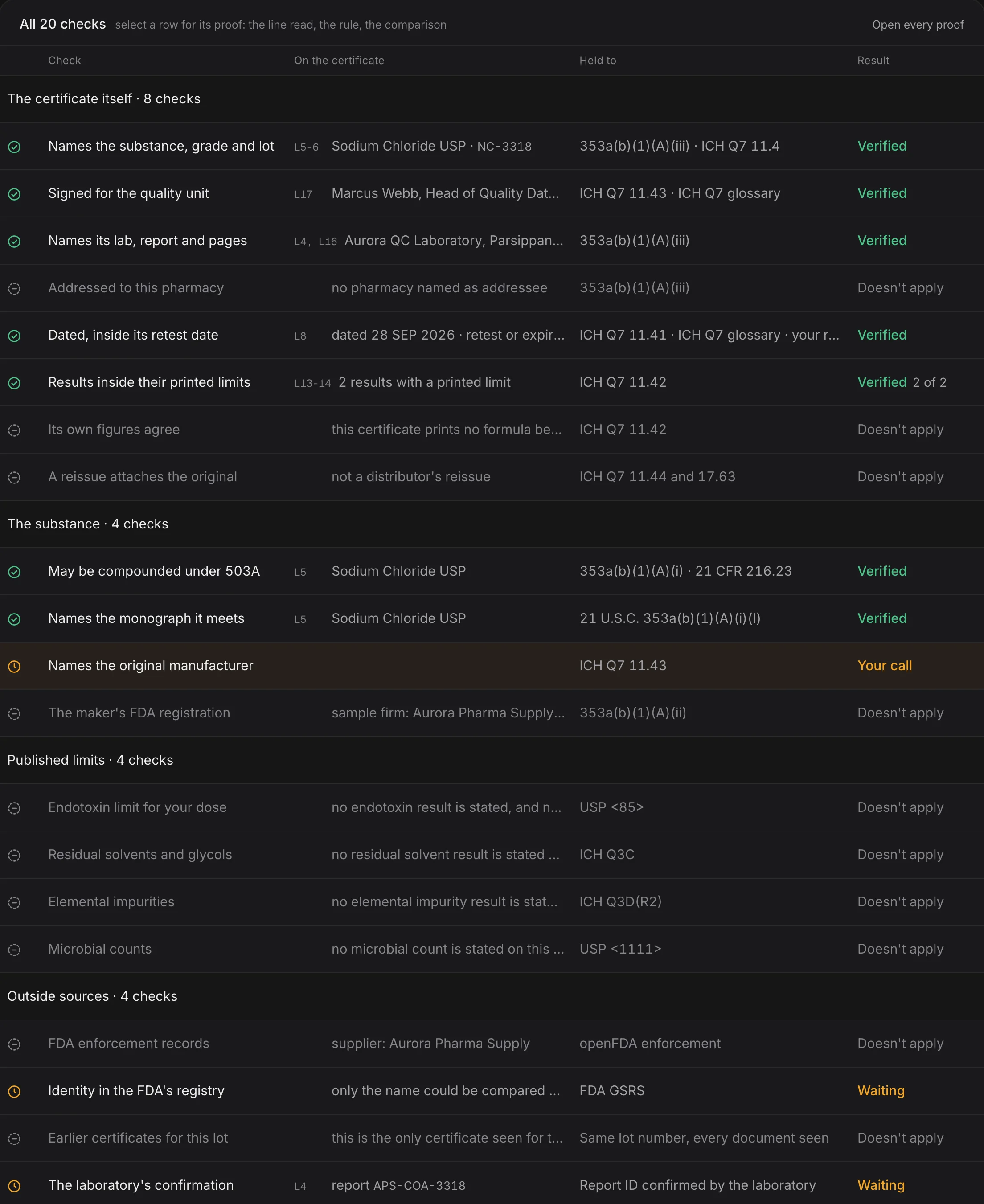
Every item says how it was verified. And when.
Every item says how it was verified and when. Verified is never a state on its own.
The verified file goes further than the six elements: 37 items in five groups. Who they are (8), accreditation (8), FDA and enforcement history (8), quality evidence (9), and the records the law asks for (4), from state license and pharmacist in charge to sterility, endotoxin, cold chain and 503A eligibility.
| How an item was verified | What that means |
|---|---|
| Matched at the source | A lookup ran against the issuer's public record, captured and dated. |
| Confirmed by the issuer | The issuer confirmed in writing, and the reply is kept. |
| Checked at the source by a person | A named person opened the issuer's own record on a date and recorded what it said. |
| Read from the issuer's document | Number, holder, dates and scope read from the document, with the holder matched to this firm. |
| Computed | The document's figures checked against a limit computed from the law or a standard, or against its own figures and the other documents. |
| Claimed | A person typed it. Nothing was checked, and the file says so. |
Negative results are results: not found, name differs, expired, contradicted. A finding such as a recall, a warning letter, a Form 483 or an exclusion counts as verified information and is listed first. Completeness is the share of applicable items verified and still fresh. It is never a rating of the firm.
Lookups run automatically only where a source's terms allow it, such as FDA, openFDA, the NPI registry and the OIG exclusion list. LegitScript, NABP, most state boards and ACHC are checked by a named person, with a capture.
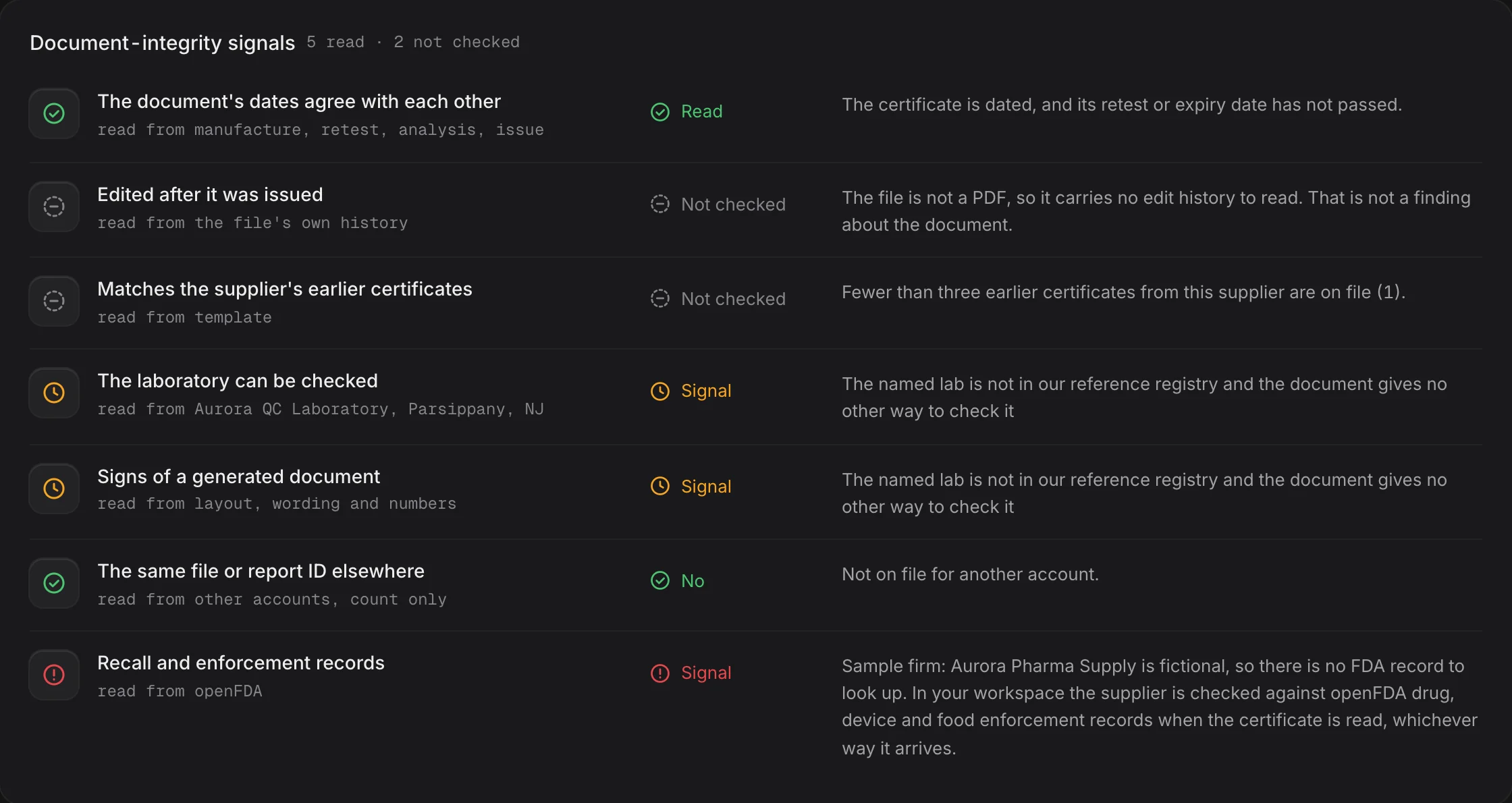
The document is a witness. Seventeen signals read it.
The document is read as a witness: 17 document-integrity signals, 7 in the file and 10 across your records, beside seven findings from the PDF's own metadata, thirteen signs of a generated document, and a comparison with the supplier's own past paperwork.
| What is read | What it can raise |
|---|---|
| The PDF's own bytes | Created after the date it claims; modified after creation with a re-save; a creation date in the future; an image editor as the producer; an incremental edit stack; a creator and producer that disagree; chromatography claimed with no trace attached. |
| Signs of a generated document | A content-credentials (C2PA) AI assertion; language-model boilerplate; an unfilled template placeholder; a sample disclaimer; impossible, placeholder or malformed phone numbers; a ZIP code in the wrong state; an accreditation number in the wrong format; an unregistered lab with no anchor; uniformly round values; inconsistent units; contradictory sterility statements. |
| The supplier's own history | Eleven structural features compared with the supplier's earlier documents on file: field order, label vocabulary, header, footer, date style, units style, line shape, lab name, phone, address and email domain. |
| Reuse | The same file, report ID or lot where it should not be, across the workspace. Strong identifiers are also compared across every Veritura account, and a workspace sees only a count of the others, never their names, files or lots. |
Document-integrity findings speak in signals for a person, never in verdicts, and never call a document forged, fake or fraudulent. Two signals hold the lot on their own: a high metadata contradiction, and a document whose own content credentials say it was generated by AI.
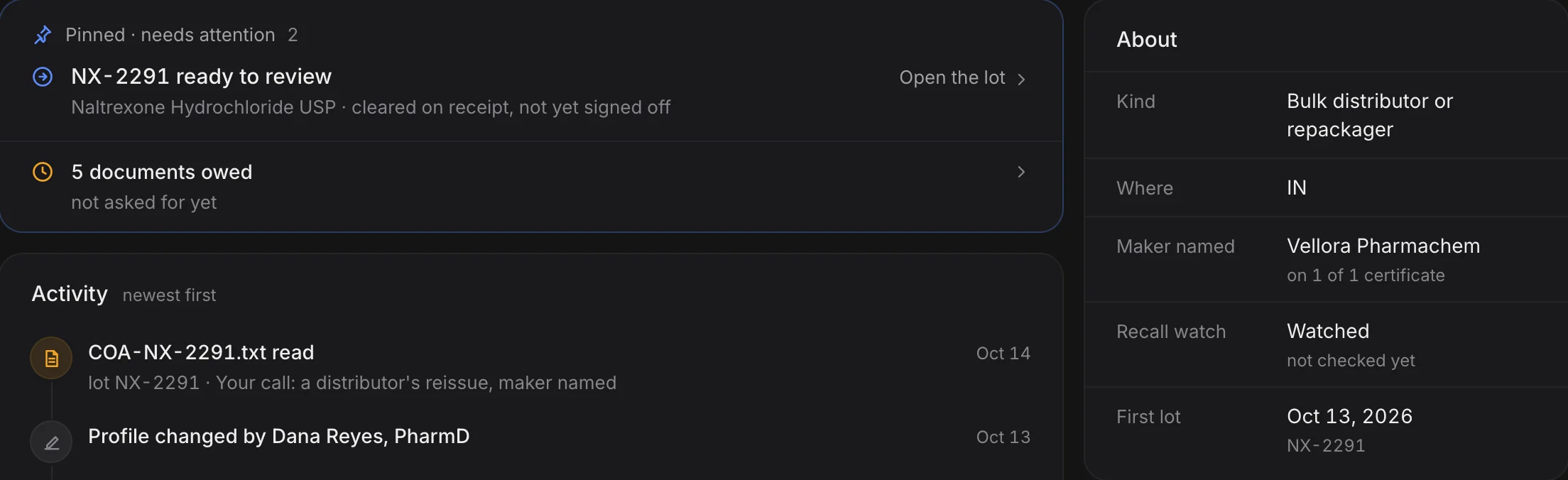
An owner, a date, a drafted request. For every gap.
Each gap gets an owner, a due date and a drafted request. The supplier answers through one standing link.
- Requests are drafted from what the review left open, in the supplier's terms, with no typing. By default Vera, the AI desk assistant, drafts and a person sends; she never makes a first contact or a release on her own.
- The supplier answers through its door, with no account and no cost. The reply it sees is facts: received, read, and which asked items it satisfies. Never a grade, and never a document-integrity finding.
- A document answered through the door files itself to the lot, and the review runs again.
- A supplier can keep every pharmacy's door in one free supplier account.
- Qualification ends in one of three outcomes, signed by a named person: qualified, qualified with written conditions, or not qualified. An unsigned decision reads recorded and never signed, so it does not stand.
Narrow words only. Documentation reviewed, nothing more.
Only what the documents support, in narrow words.
A partner may describe a packet as documentation reviewed once a completed review exists. The words stay narrow: documentation read and checked, with no product approval and no safety or quality certification, and never a statement about the product itself.
| May say | Never says |
|---|---|
| Documentation read and checked by Veritura. | Any word of approval, certification or safety about the supplier or the product. |
| The certificate for lot BM-5520 was read and cited to its lines. | That the substance was tested, or that it is pure. |
| This supplier publishes its verified file, findings first. | A rank, a score or a badge for the supplier. |
A pharmacy or supplier may publish its verified file. It is published whole, findings first. A finding the firm answers stays on the file, marked retired, with its date. No one can pay to change what a file says.
Where packet review stops.
- It reads documents and public records. It does not test material, inspect a facility or audit a supplier on site.
- A clean packet is not a supplier approval, and a completeness figure is not a rating of the firm.
- No match is a fact about the sources that answered. Absence of a public-source match is not proof of absence.
- A document-integrity signal is a prompt for a person, never proof that a document was altered.
Review one supplier packet with us.
Bring a packet you already hold. We read it on a call: every certificate checked, every credential's route stated, every gap given an owner.