PlatformPlatform overviewCOA reviewSupplier qualificationSupplier follow-up (Vera)Mock inspections (Cato)Patient traceabilityRelease workflowsChain of custodySupplier document collectionAPIPricing
SolutionsCompounding pharmacies503B outsourcing facilitiesClinicsMed spasTelehealth platformsConsultantsSolutions overview
ResourcesMethodologyOrder-level COA traceabilitySupplier packet diligenceResource libraryPublic toolsIntelligenceTrust Center
CompanyAbout VerituraWhy independentPartnersFor counselContact
Log inBook a demo

Receipt: Material qualification records for one lot, dated, on one page.

Every source named. Nothing kept.

One dated receipt to file with the lot.

Before a bulk substance goes into a preparation, the answers sit in at least six places: FDA's lists, its establishment registry, its warning letters, import alerts and recalls, the shortage list, the COA itself and USP's dating table. The receipt asks each one for the substance, the manufacturer the COA names and the lot, and prints every answer with the record it came from and the day it was checked.

No account. Nothing you type or upload is kept. It answers in records; it does not say whether to use the lot.

A substance, a manufacturer, a lot. Every answer dated.

The substance and the manufacturer as the COA prints them, and the lot number. The rest is optional. Do not enter a patient's name or a prescription number.

Add the COA optional; reviewed here and not kept
Potency factor optional; from the COA's assay
Beyond-use date limit optional; from USP's table

Nothing you type or upload is kept. Veritura reads documents. It does not test material.

Six records, one page. Each with its source and its date.

Only public records and the COA you give it. Each line on the receipt names the one it came from.

RecordWhat the receipt shows
The substance and section 503AThe three routes of 21 U.S.C. 353a(b)(1)(A)(i): a USP or NF monograph title in FDA's substance registry, a marketed product in Drugs@FDA, or a place on 21 CFR 216.23(a); FDA's 503A categories as printed; and 21 CFR 216.24.
The manufacturer on the COAIts registration in FDA's establishment registry, and FDA import alerts, warning letters and recalls under its name. Warning letters and recalls count as recent only within 24 months; older ones are shown as history.
The 503B routesFDA's 503B bulks list and its drug shortage list, for an outsourcing facility (21 U.S.C. 353b(a)(2)(A)).
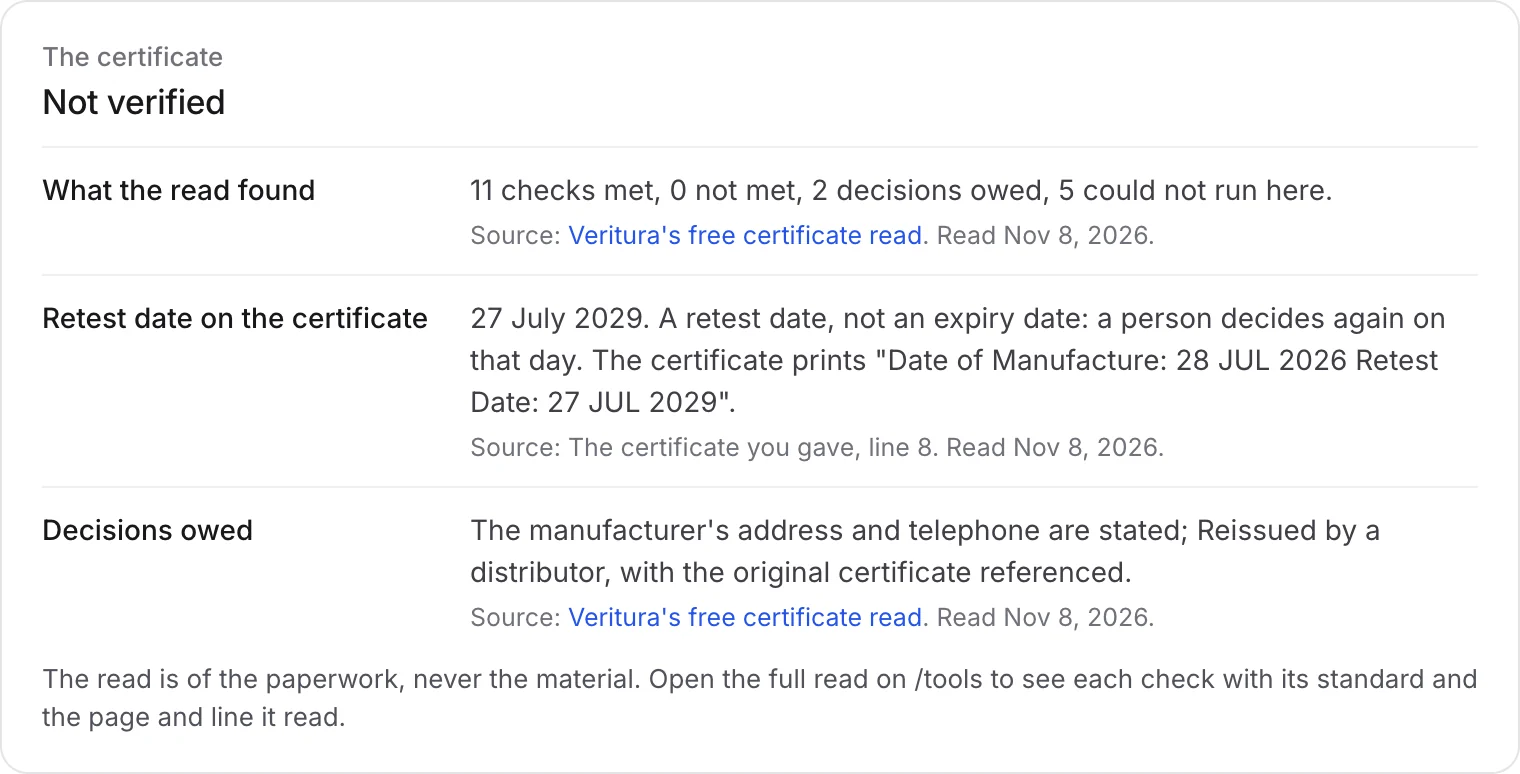
The COAWhen you add it, the free review's own counts: the checks met, not met, decisions owed and not run, and the lot's expiry or retest date as the COA prints it, with its page and line. What a valid certificate carries.
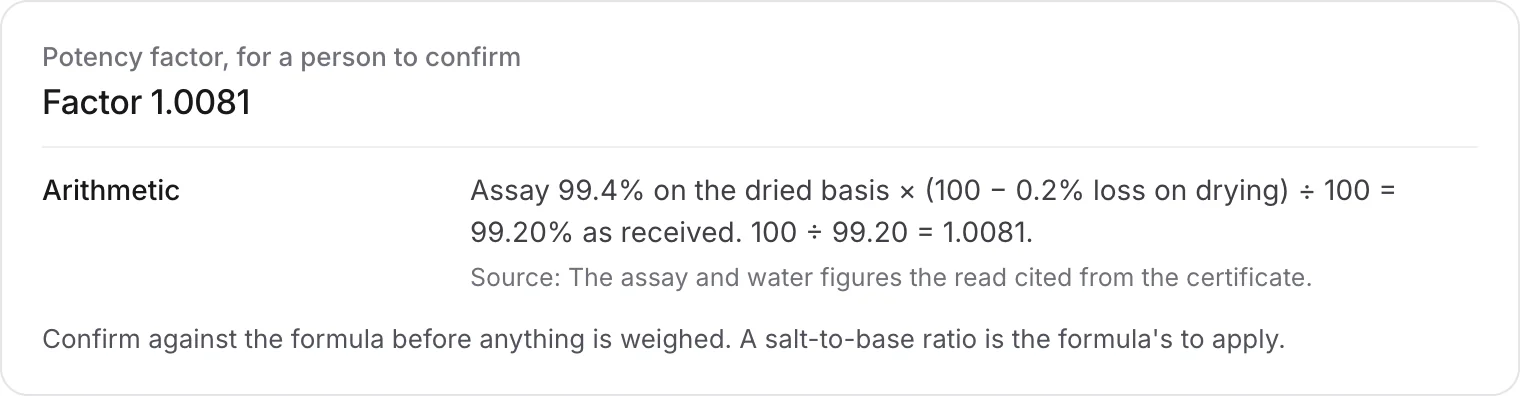
The potency factorWorked out from the COA's assay and its water or loss on drying, with the arithmetic, for a person to confirm before weighing.
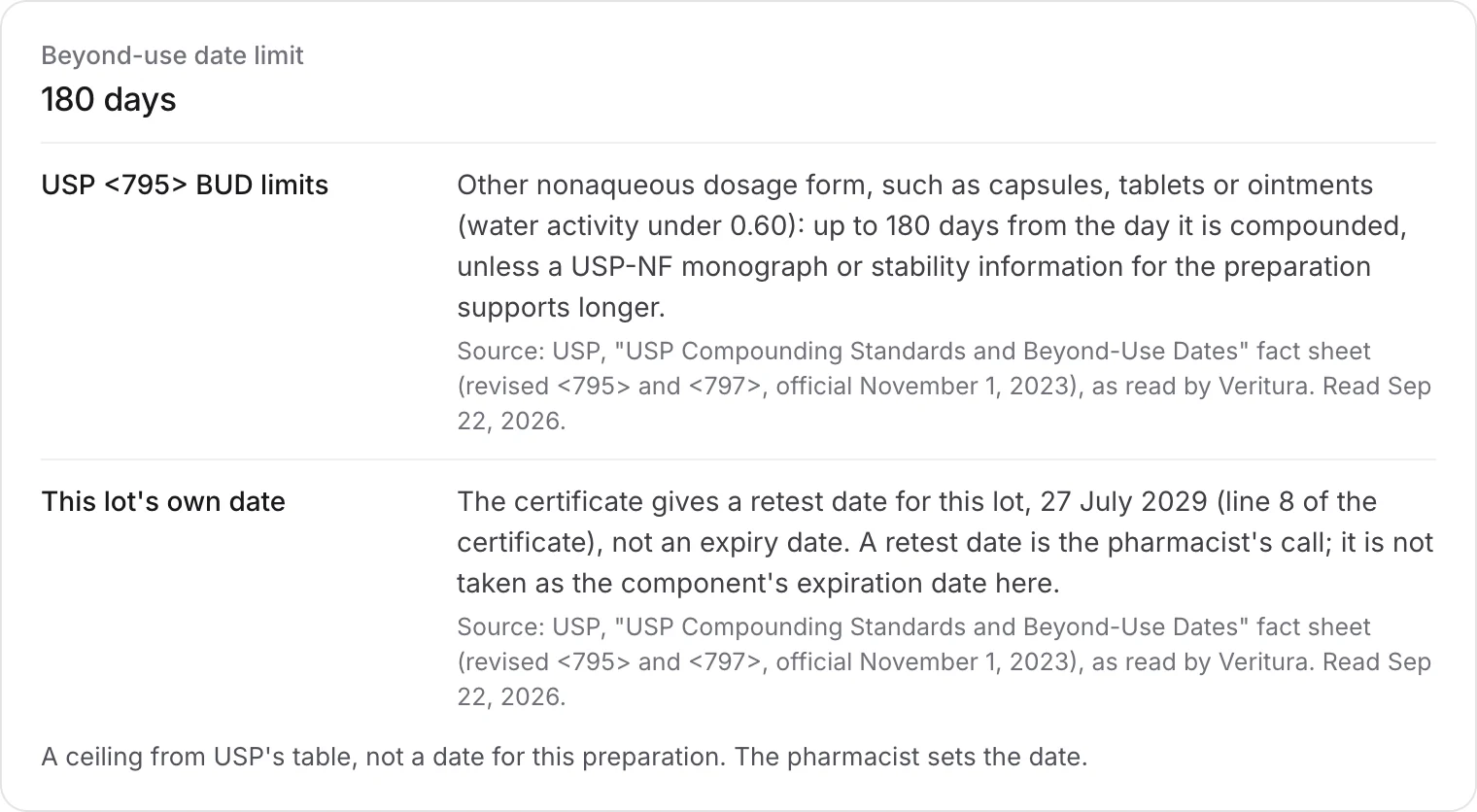
The beyond-use date limitThe ceiling USP's table gives for the preparation, and the lot's own date when it is earlier.
The certificate's section of a receipt for pyridoxine hydrochloride lot TP-3311: not verified; what the free read found, 11 checks met, 0 not met, 2 decisions owed and 5 that could not run here; the retest date as printed, 27 July 2029, from line 8; and the 2 decisions owed, the manufacturer's address and telephone and the distributor's reference to the original certificate
When the COA is added, the review's own counts and the lot's date join the receipt, each with its line.
The potency factor on the same receipt, for a person to confirm: factor 1.0081, from an assay of 99.4% on the dried basis and 0.2% loss on drying: 99.4 × (100 − 0.2) ÷ 100 = 99.20% as received, and 100 ÷ 99.20 = 1.0081, with the note to confirm against the formula before anything is weighed
The potency factor worked out from the COA's own figures, with the arithmetic, for a person to confirm.
The beyond-use date limit on the same receipt: 180 days for an other nonaqueous dosage form such as capsules, tablets or ointments under USP <795>, unless a monograph or stability information supports longer; and this lot's own date, a retest date of 27 July 2029 from line 8, not an expiry date; a ceiling from USP's table, not a date for this preparation
The ceiling from USP's table for the preparation you describe, beside the lot's own date.

Records, not a ruling. The pharmacist decides.

It never says to use the lot. It shows what each record says on the day it was checked, and where a record was not asked or did not answer, it says so.

A name match is not identity. FDA's records are searched by the name you type. Every match says to confirm it is the same firm.

A route is one condition. A recorded route through section 503A leaves the rest of the section: a registered manufacturer, a valid certificate of analysis for each bulk substance, and the conditions on the preparation.

Nothing is kept. No substance, manufacturer, lot or file is stored. One row counts that a receipt was made, with none of them in it.

Veritura reads documents. It does not test material, grade a medicine or rule on what a pharmacy may compound.

FDA's 503A list, checked daily.

Every name in 21 CFR 216.23 and FDA's three categories, as printed, with each change dated and an email watch.