Run the checks yourself, before you talk to anyone.
Five tools that need no account. Each one answers a narrow question against a dated public source, and each one states what its answer does not mean.
Five tools that need no account. Each one answers a narrow question against a dated public source, and each one states what its answer does not mean.
Five tools, one narrow question each.
01
Each tool answers one narrow question against a dated public source or a document you supply. Every answer carries the search that produced it, the source URL, and the capture date, and every answer states what it does not mean: a name that does not match is not evidence of a problem, and a name that does match is not a finding against anyone. That is the same rule the workspace runs on.
Each row carries the search that produced it, the source URL, and the capture date, so anything you find can be cited to the person who asks how you know.
Discover Methodology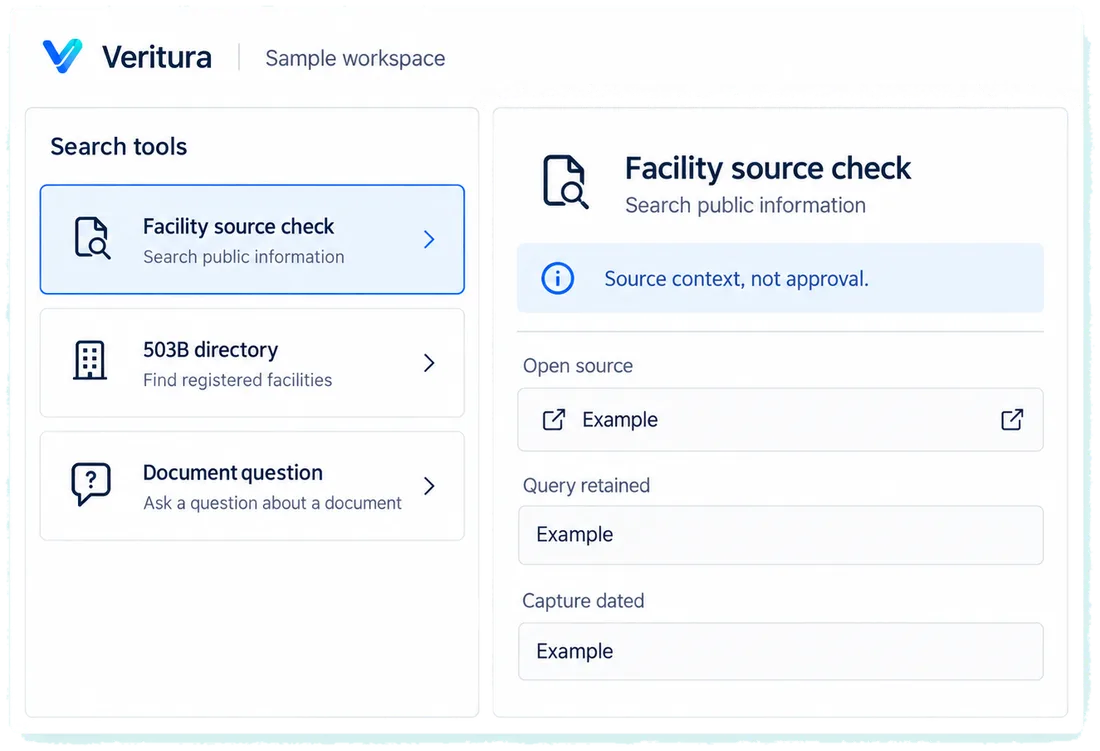
02
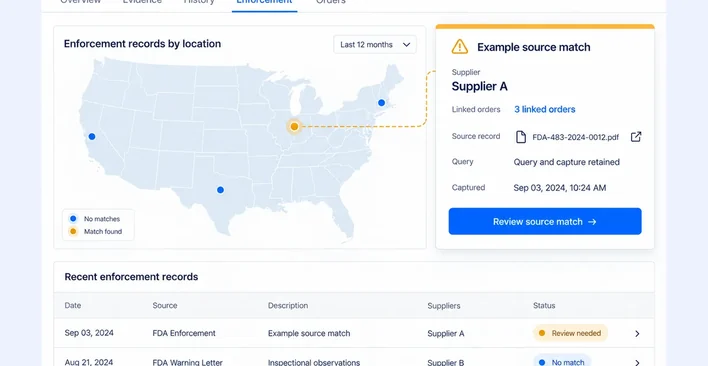
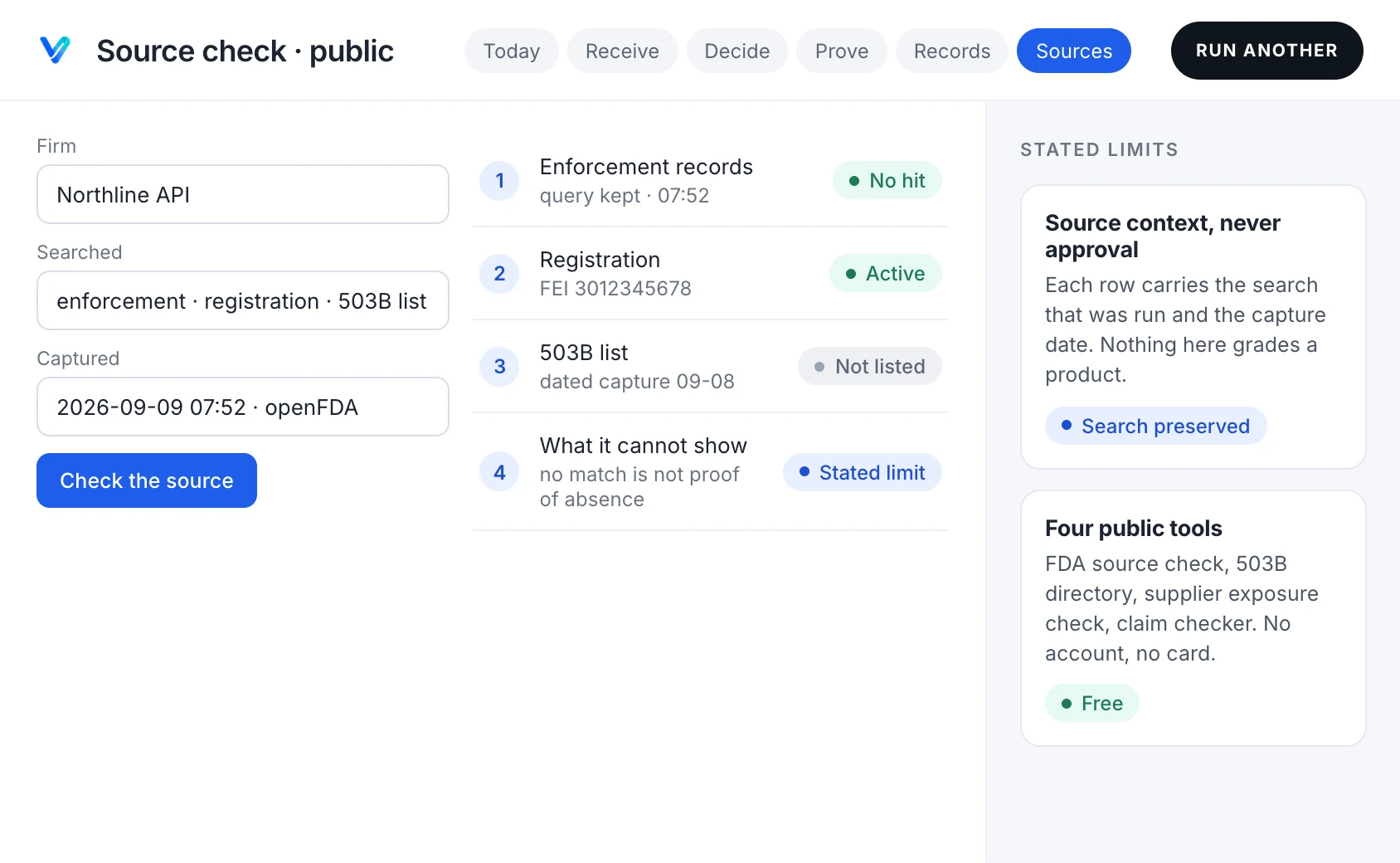
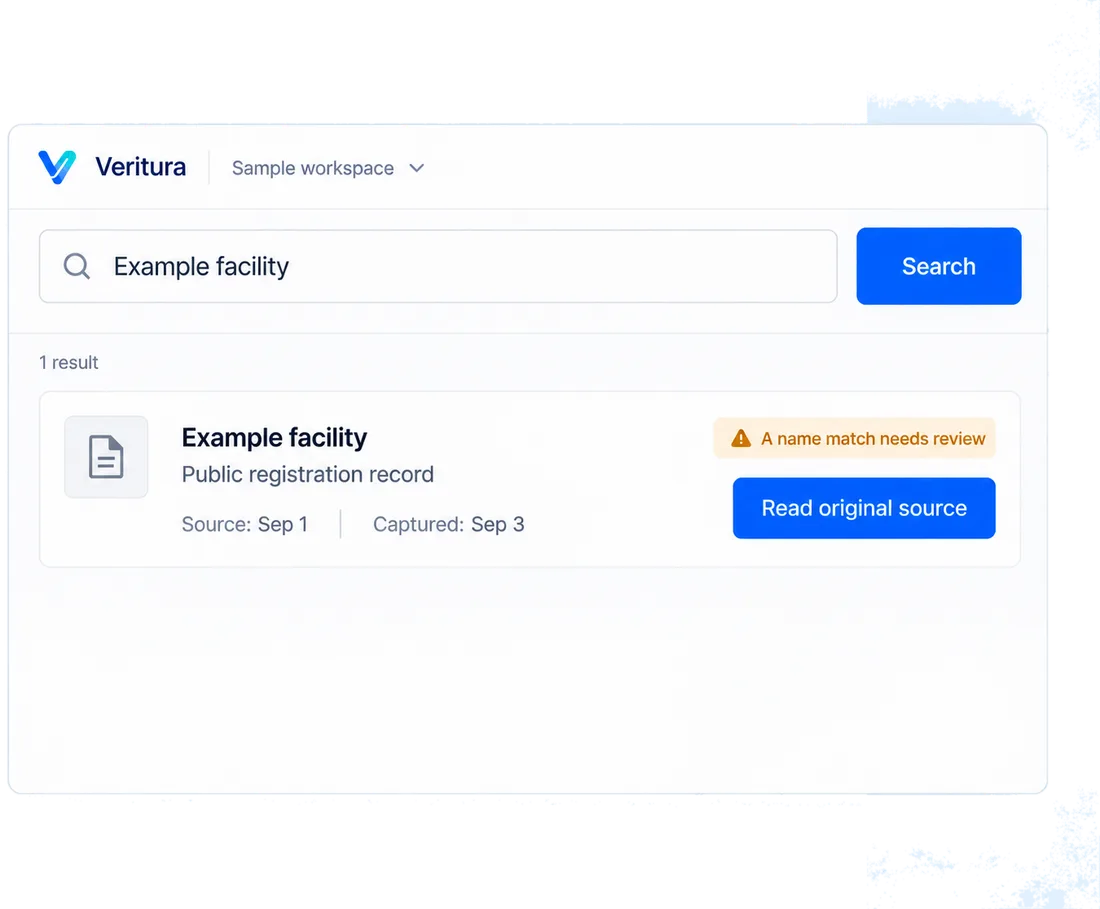
Search name-based openFDA enforcement and registration signals and dated 503B snapshot signals for a firm or facility. It takes a firm or facility name and returns matching rows, each with the search that produced it, the source URL, and the capture date. Source context, never supplier approval: a match is a signal to read, not a verdict.
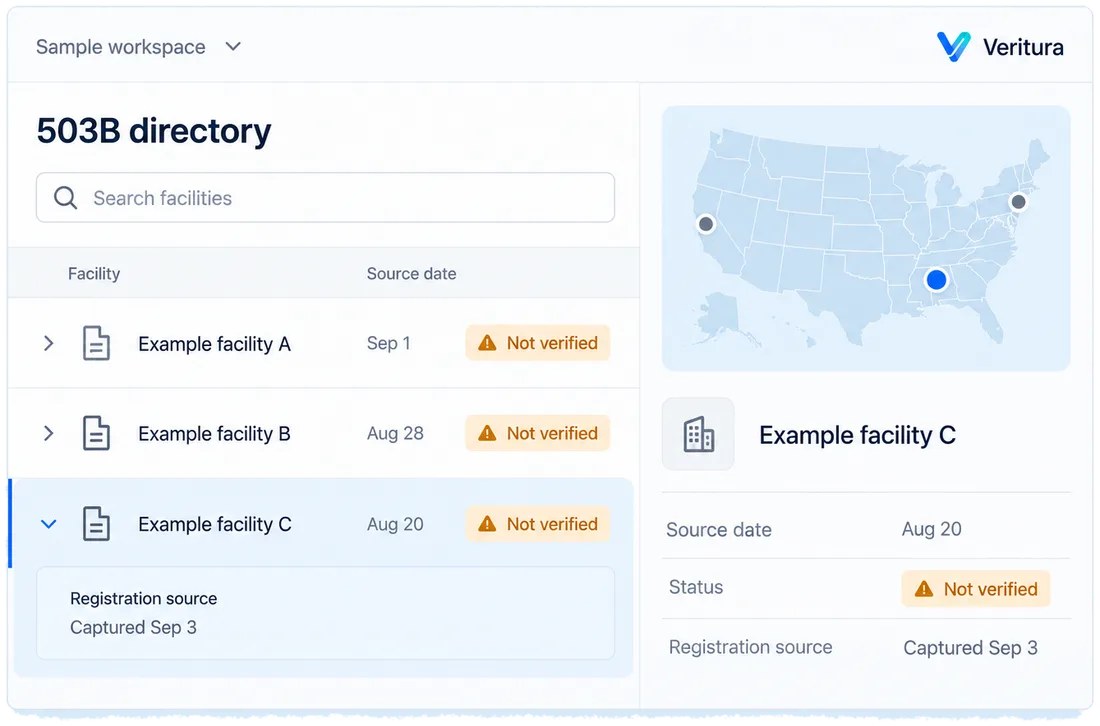
The directory is a dated public-record view of registration standing, shown with both dates so a reader never mistakes a capture for a live confirmation.
03
Browse FDA-registered outsourcing-facility profiles from a dated capture of the agency's list, shown with both the source date and the capture date rather than a live-sounding stamp. A profile is a public-record view of a facility's registration standing on that date, and it says nothing about any product the facility makes.
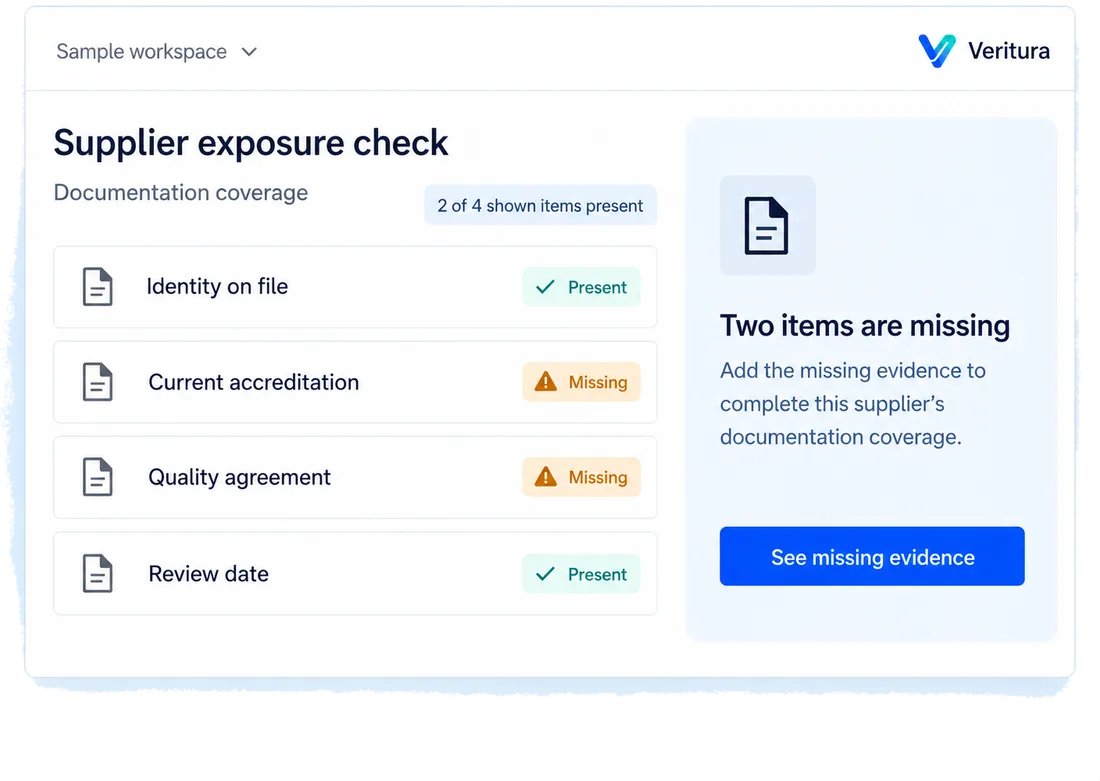
The self-check asks for what you hold in the shape an inspector asks for it, which is the fastest way to see where a folder falls short of a living file.
04
A documentation-exposure self-check for a team evaluating its current supplier process. It asks what you hold on each source today, in the shape a state-board inspector asks for it, and shows where the file you keep would fall short of a living six-element record, so you know what to fix before someone else finds it.
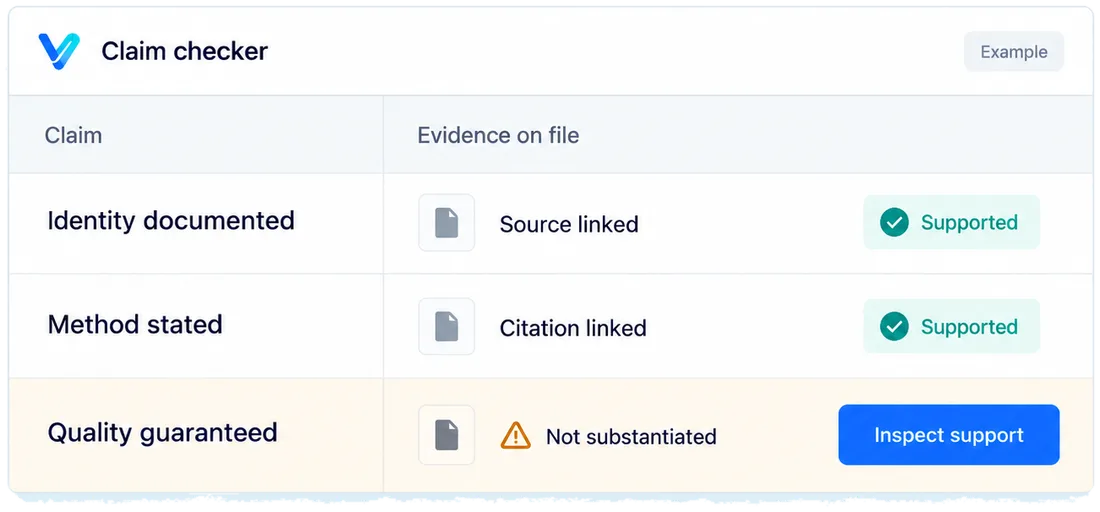
Mapping a claim to its evidence, or to its absence, is the substantiation question in the form the regulator asks it, before the claim runs.
05
Map a public-facing advertising claim to the evidence that does or does not support it. Under the prior-substantiation doctrine you need a reasonable basis for an objective claim before it runs; this tool shows which document on file would be that basis, which claims have none, and what a supplier would have to send to close the gap.
Seal verification reports exactly what a unit is, and says that it confirms the provenance of the paperwork rather than the physical product.
What changes
Five narrow questions against dated public sources, with no account and no card.
The search, the URL, and the capture date travel with each row.
A match is a signal to read, never a finding against anyone.
Built to the same rule as the workspace.
openFDA, the FDA registration snapshot, and the 503B facility list, each shown with its source date and its capture date.
The query that produced each row, and the URL it came from, kept with the answer.
What the answer does not mean, printed beside it, every time.
Nothing to sign up for, nothing stored about you.
The complete text, for the reader who wants the whole story before a call.
Each tool answers one narrow question against a dated public source or a document you supply.
Search name-based openFDA and dated 503B snapshot signals for a firm or facility.
What it takesA firm or facility name.
What it returnsMatching openFDA enforcement and registration rows, each with the search that produced it, the source URL, and the capture date.
What it does not meanSource context, never supplier approval. A name that does not match is not evidence of a problem, and a name that does match is not a finding about any particular lot.
Browse FDA-registered outsourcing-facility profiles from a dated capture.
What it takesA facility name, a state, or a browse.
What it returnsA profile per registered facility with its registration context. FDA's list current as of June 23, 2026, captured June 30, 2026.
What it does not meanNot found in the snapshot never means not registered. It means the name did not match the captured list.
A documentation-exposure self-check for a team evaluating its current supplier process.
What it takesSix questions about how your team handles supplier paperwork today.
What it returnsWhere the gaps sit in your current process, and which of them show up first at inspection or in a dispute.
What it does not meanA self-assessment of process, not an assessment of any supplier. It reviews no documents and reaches no conclusion about a vendor.
Map a public-facing advertising claim to the evidence that does or does not support it.
What it takesThe claim, as written, and where it appears.
What it returnsThe claim classified, the disclosure elements it implicates, and what evidence would have to exist to support it.
What it does not meanA Veritura action, never a compliance verdict. It does not say a claim is legal, and it is not legal advice.
Confirm the state of a seal serial and open the customer-safe record behind it.
What it takesA serial in the shape VS-XXXX-XXXX, typed or scanned from the label.
What it returnsWhether the serial resolves, the lot it is bound to, and the customer-safe record: completeness in plain words, the origin of each line, and any published notice on that lot.
What it does not meanA resolving serial establishes that the record exists and is bound to that lot. It is a paperwork read, never a statement that the medicine is safe, effective, or approved.
The customer-safe record for an illustrative order and lot, rendered here from sample data.
What it takesNothing. It is a worked example.
What it returnsThe card a patient opens after a scan: the completeness band in words, the reported values as the certificate documents them, and the limits on the face of it.
What it does not meanSample data, not a live account. No real order, patient, or supplier appears in it.
Every tool above reads public records or documents you supply. None of them tests a product, approves a supplier, or determines that anything is safe, effective, legal, or FDA-approved.
Veritura reads and connects the paperwork behind an order. It never tests, grades, or endorses the medicine itself, and it never releases anything on its own.

No. Each answers one narrow question against a dated public source or a document you supply, with the search, the URL, and the capture date kept.
No. A name that does not match is not evidence of a problem, and a name that does match is not a finding against anyone. Every answer states what it does not mean.
The same rule and the same sources, one question at a time. The workspace runs them together on every packet and keeps the record.
Still have questions? Talk to a person.