Inspection readiness: Supplier follow-up, drafted while you are closed.
By default she drafts. A person sends.
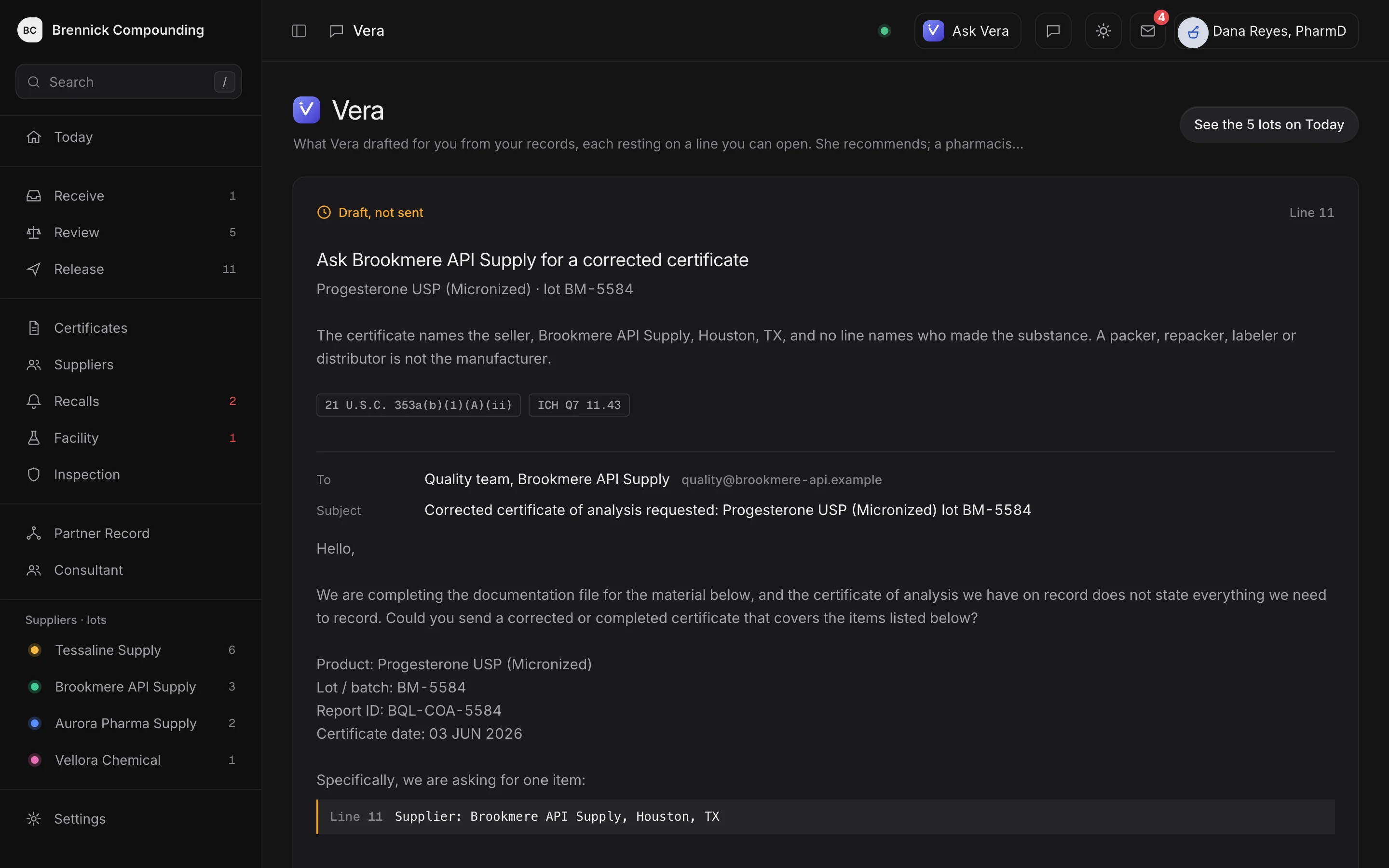
Vera's page: each draft rests on a line of a document, and waits for a person. Brennick Compounding is a sample pharmacy; its suppliers, people, lots and figures are invented.
Each request quotes the line it rests on. A person decides.
Vera, Veritura's assistant, does the supplier follow-up: she reviews each COA that arrives, drafts the request for what is missing and follows up once. She works from your own records. By default she drafts, and a person sends.
Watch Vera work a night.
A COA arrives at 2:09 am. Vera reviews it line by line, finds the discrepancy, drafts the request and lines up the Passports, the signed traceability record each order gets. A person sends and signs.
Five jobs a night. All on your own records.
Each one leaves a receipt on the ledger, her verbatim record.
Reviews every COA that arrivesEmail-in, door link, upload or folder, each run through the same named checks, up to 20.
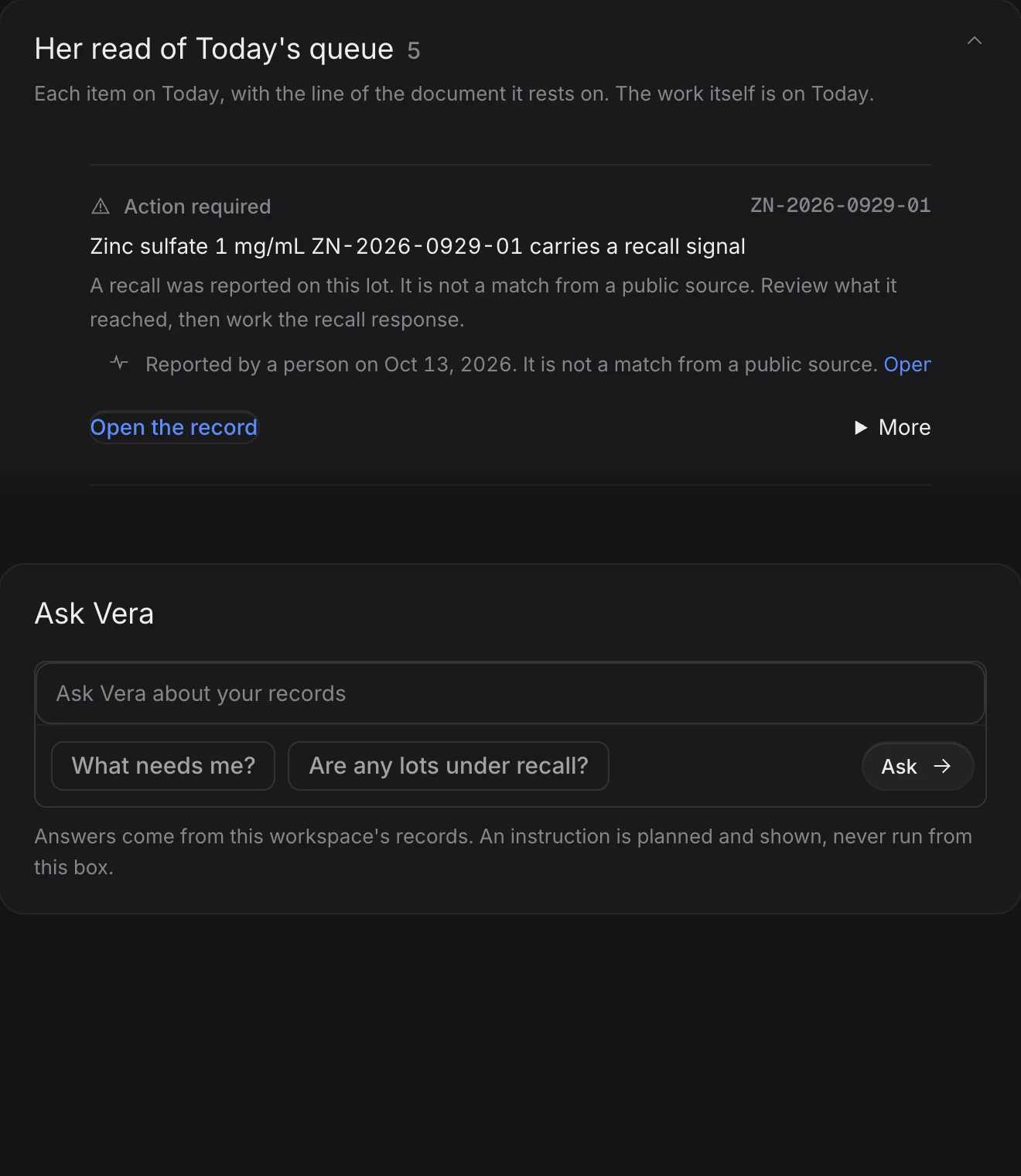
The workspace's own email-in address, upload, a whole folder, or a supplier's door link: one standing link per supplier.
Identity, dates, signatures, the limits that apply and FDA's registries, as in any review.
A COA that lands overnight is on its lot, evaluated and checked, before anyone unlocks the door.
Drafts what is missingA request built only from the COA's real discrepancies, each ask quoting its line.
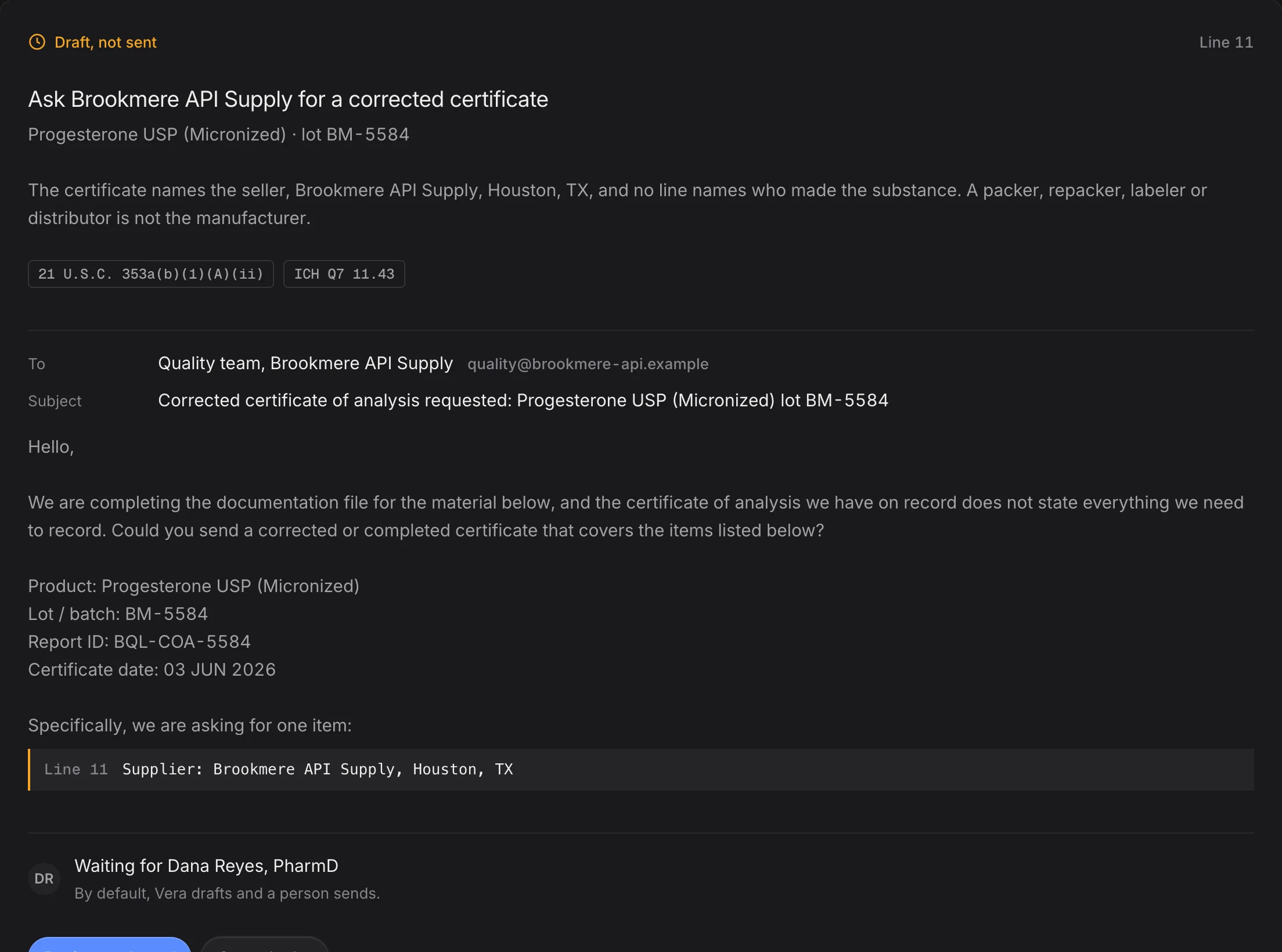
The corrected-COA request comes from the COA's real discrepancies and nothing else. Nobody types it.
In the supplier's terms, with the door link the supplier answers through.
To send it, or to open it in their own mail.
Follows up once, then files the answerOne reminder after 4 quiet days by default. She stops when a reply lands.
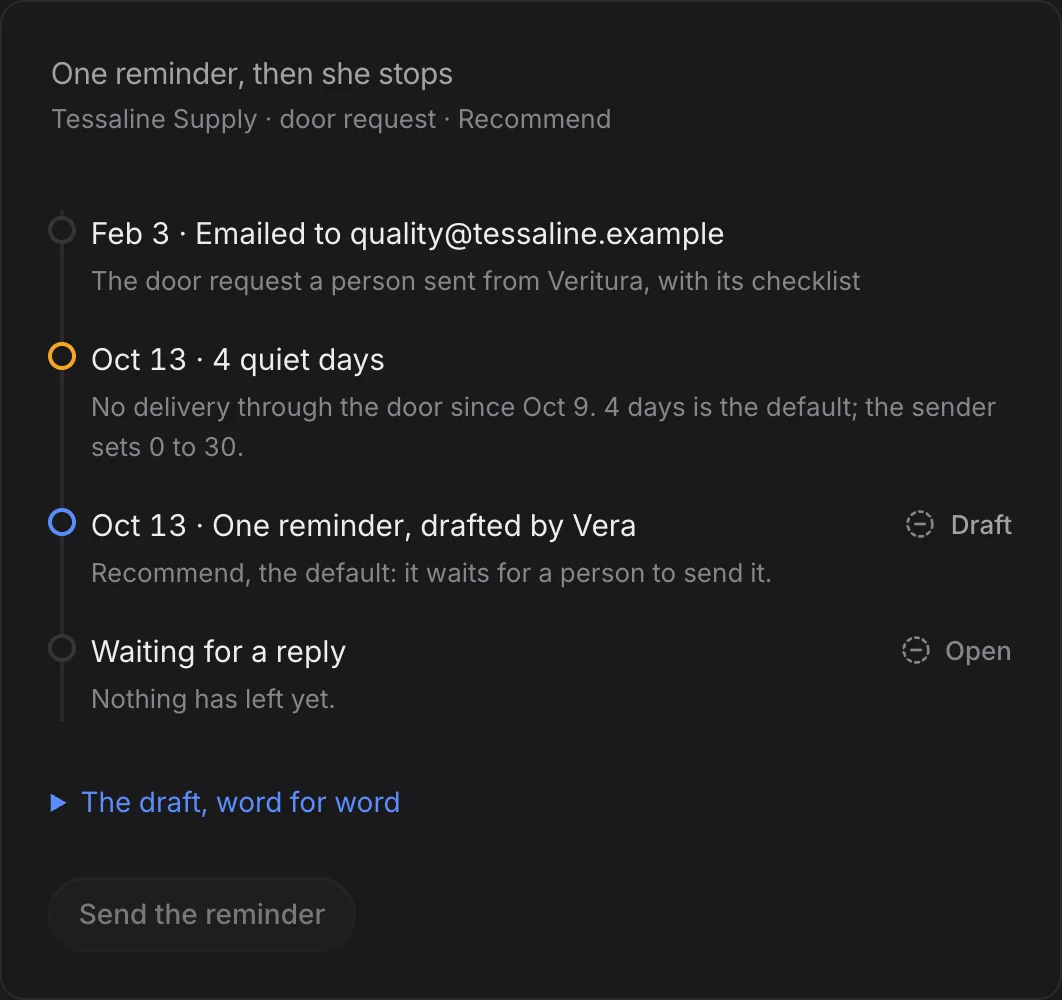
After 4 days with no reply by default. The sender can set anything from 0 to 30 days.
A document answered through the door lands on its lot, and the review runs again.
The original is kept and the reply is added beside it.
Briefs you in the morningEvery lot that needs a person, each finding quoted from its page and line.
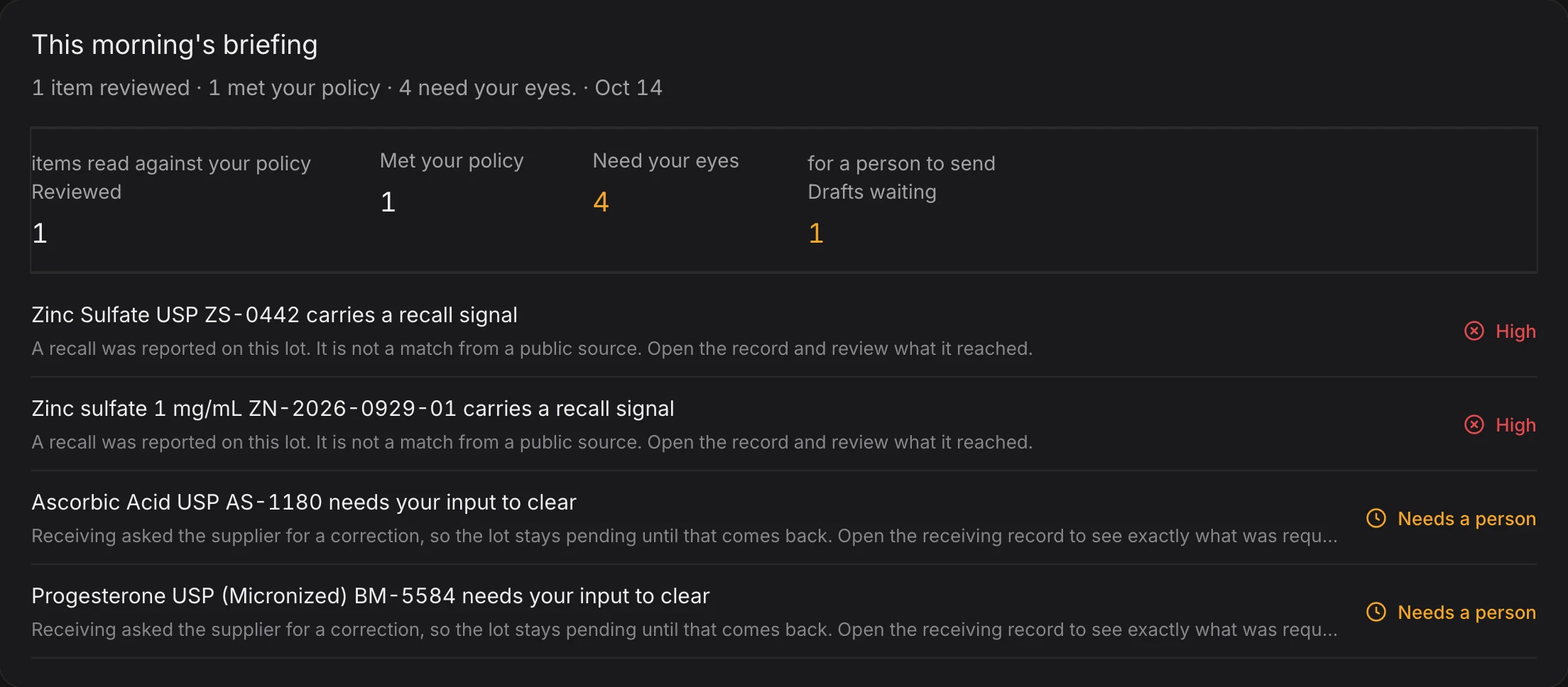
Each finding with the document it came from. An absence is stated as an absence.
Give her an instruction and she shows you the plan. Nothing runs until you agree.
Agree or overrule her; an overrule needs a reason.
Stages the release for one signaturePassports lined up from orders on file, the charge stated before anyone signs.
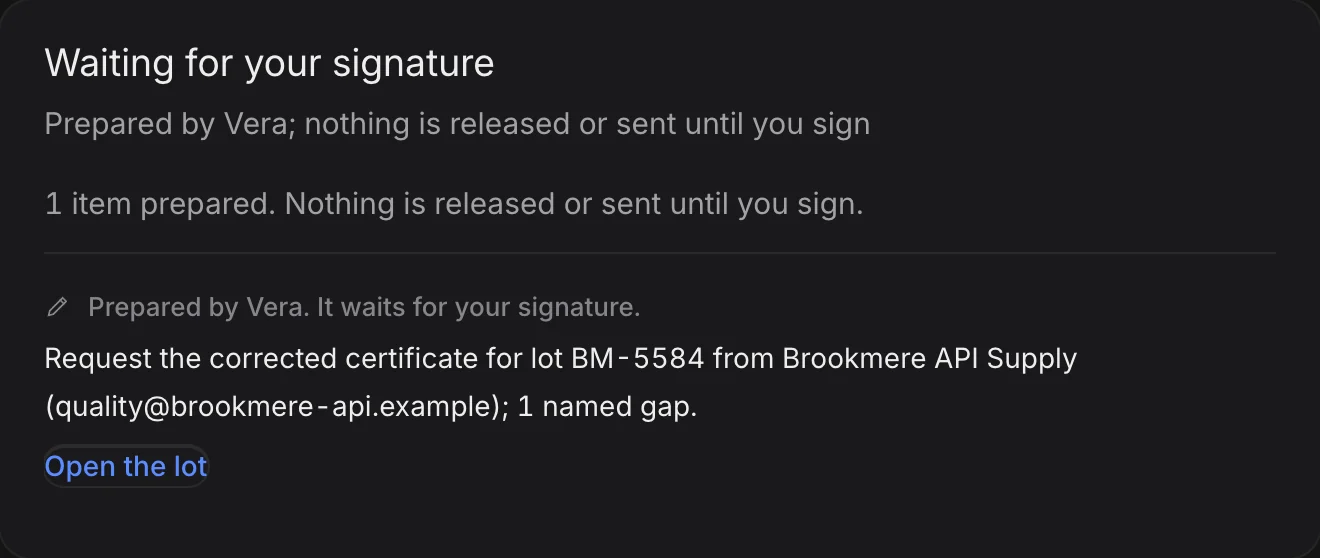
When an order's lot has been reviewed and cleared, she lines up the Passports it needs.
A batch is staged as a plan, with the exact charge stated before anyone signs.
Every release she stages waits for a person, at every batch size.
The record decides the verdict. The model only writes the words.
So the same record always gets the same verdict.
You set the dial. Every action leaves a receipt.
Vera has a dial you set, and a ledger that records every action with who, when and why.
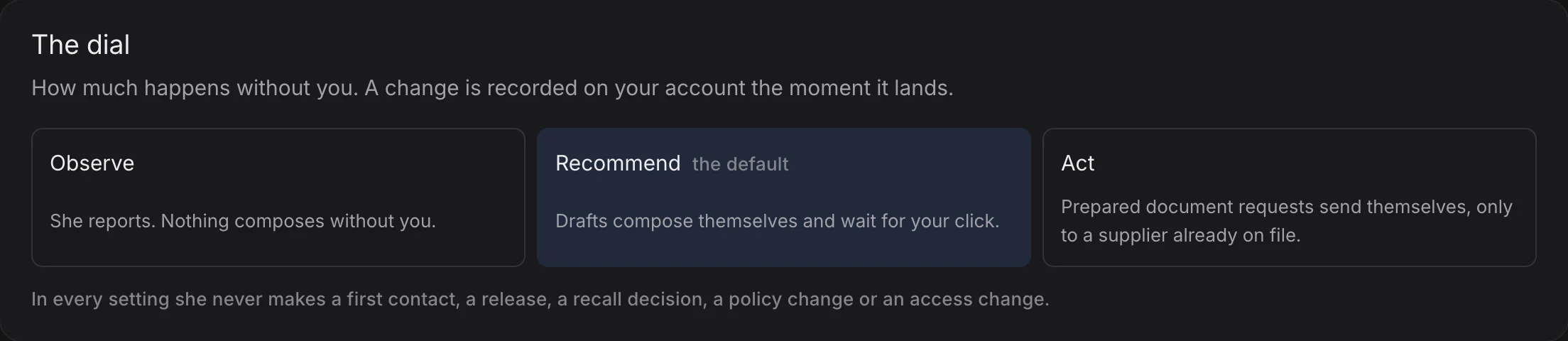
You decide how much happens without you.
Three settings, a default that sends nothing on its own, and one narrow kind of work that can ever send by itself. A change is recorded on your account the moment it lands.
- Observe: she reports, and nothing composes
- Recommend, the default: drafts wait for your click
- Act: prepared document requests send, only to suppliers already on file
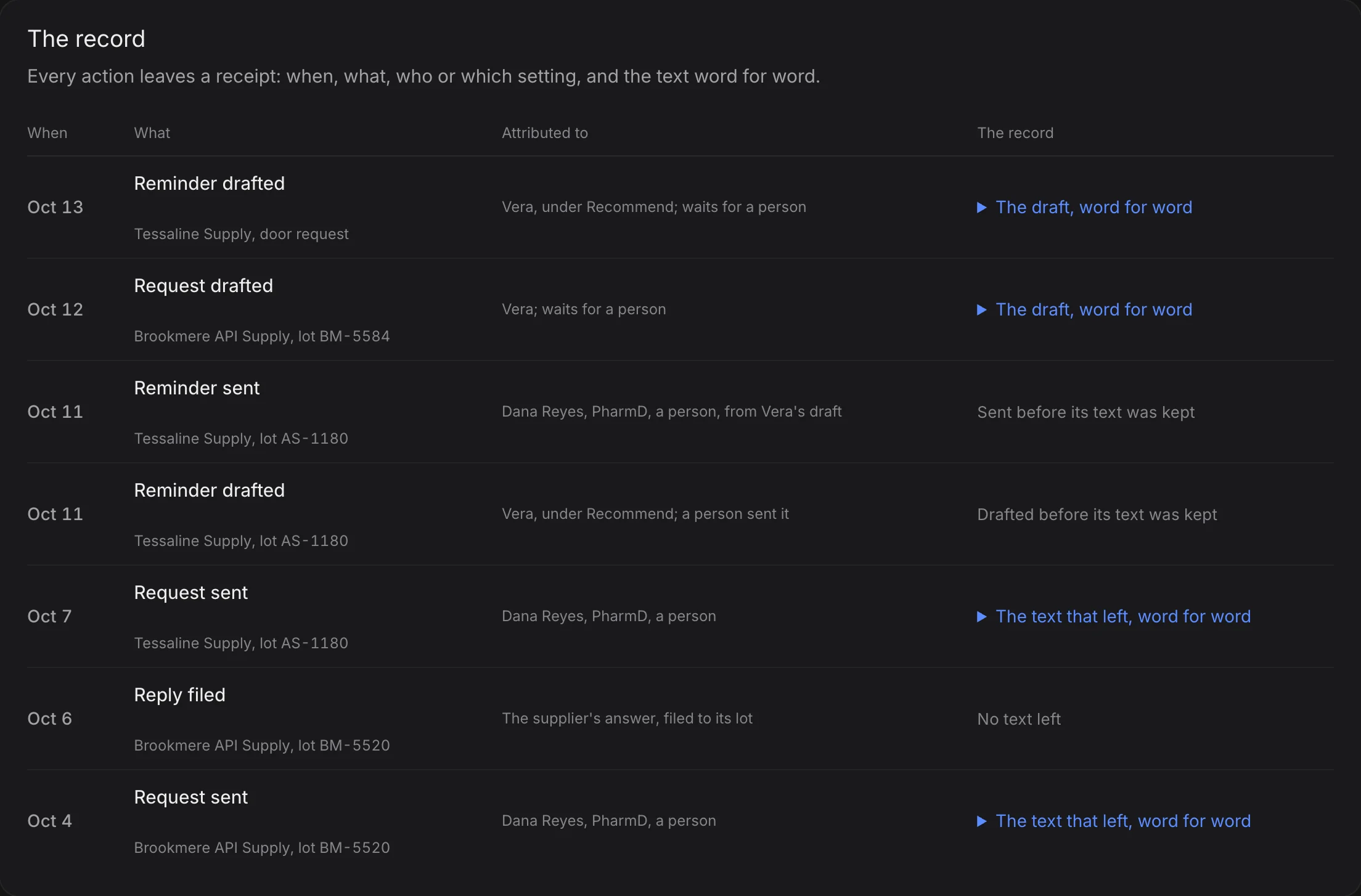
A verbatim ledger, not a summary.
An assistant you cannot audit is one you cannot use in a regulated operation. Vera's ledger is the verbatim record, not a summary of one, so anyone can follow a night months later.
- Attributed to a person or a setting
- The text that left, stored word for word
- Every finding cited to its page and line
- Rulings kept, an overrule with its reason
A briefing, not an inbox. For each person on the desk.
Vera prepares the work, and a person decides it.
Starts the day with a briefing: every lot that needs a person, and releases staged for one signature.
Stops writing supplier requests from memory. Each is drafted from the discrepancies and quotes its line.
Stops retyping COAs. Whatever arrives is evaluated, checked and filed to its lot before the shift.
With Cato, for mock inspections: Cato finds it, Vera drafts it, you sign it.
Eight things she will never do. No setting changes that.
Not even Act, the dial's top setting, crosses them. An assistant that names the exact line it stops at is one a regulated operation can put on the desk.
Every release takes your signature.
First contact is yours.
The judgment stays with you.
She reads it, never edits it.
Roles and keys sit outside her reach.
She reports what the records say.
The act is yours.
Every action lands on the ledger.
The full detail.
Every setting, every line she stops at, and what she reviews.
How a record is kept, in the Trust CenterThe autonomy dial, setting by setting 3 settings
- Observe
- Report only: nothing composes without you. She watches, narrates and points at what is due.
- Recommend, the default
- Due work composes itself, from requests and responses to staged releases, and nothing leaves the workspace without your click.
- Act
- Everything in Recommend, plus prepared document requests send themselves, but only to a supplier whose email is already on file from an earlier request. An unanswered one gets one reminder, and then she stops.
- In every setting
- She never makes a first contact, a release, a recall decision, a policy change or an access change. Those are a person's acts, written into the product.
- Changing the dial
- Change it any time; the change is recorded on your account the moment it lands.
What happens without a click by setting
- Requests, responses and releases are drafted
- Observe: no, she reports. Recommend: yes, and they wait for you. Act: yes.
- A prepared document request is sent
- Observe: never. Recommend: never. Act: yes, to a supplier already on file.
- One reminder on a request a person sent
- Yes, after 4 days by default, in every setting.
- A first message to a new address
- Never, in every setting.
- A release, a recall decision, a policy or access change
- Never, in every setting.
The eight lines, in full 8 lines
- Release anything
- Every release of product evidence takes your signature, at every batch size, with the charge stated before you sign.
- Write to a stranger
- The first message to any outside address is a person's act. Her autonomy starts after that, with the one follow-up.
- Declare or dismiss a recall
- She surfaces the signal and shows how it matched. The judgment stays with you.
- Change your policy
- Your release policy is what authorises her. She reads it; she cannot edit it.
- Change who has access
- Roles, invitations, credentials and keys sit outside anything you can type to her.
- Claim an outcome
- No approvals, no certifications, no safety verdicts. She reports what the records say, and what they do not.
- Do the physical work
- The media fill, the cleaning, the garbing, the count. The record of it is hers; the act is yours.
- Hide any of it
- Every action lands on a ledger with who, when and why, and anything that left the building is stored word for word.
What Vera reviews, and where her drafts go
- Where COAs come from
- The workspace's own email-in address, each supplier's door link, upload, or a whole folder dropped at once. Each one is reviewed on its own line.
- What each one is checked against
- The same named checks as any review, up to 20: identity, dates, signatures, the limits that apply and FDA's registries. Every value is kept with the page and line it came from.
- Where a draft waits
- On the lot, for a person to send it, or to open it in their own mail and send it from there. Asking for exactly what is missing is what brings the right document back the first time.
- When a reply lands
- If the new document closes the gap, the lot moves. If it opens a new one, the review says so. The original is never overwritten; the reply is added beside it.
- What a staged release needs
- An order on file and a lot that has been reviewed and cleared. Nothing leaves a lot until a named person has reviewed it.
How her words and verdicts are made
- Numbers
- Every number she states comes from the record.
- Findings
- Every finding she raises on a document opens on its page and line, and an absence is stated as one.
- Verdicts and holds
- A language model gives her the words; the verdicts and holds come from the record and fixed rules, so the same record always gets the same verdict.
- The ledger
- Every send names the person, or the setting, that authorised it. The stored text is the text that left the building, not a paraphrase of it. When a person agrees with her or overrules her, the ruling is kept, and an overrule carries its reason.
By default Vera drafts and a person sends; she never makes a first contact or a release on her own.
Questions, answered plainly.
Only if you move the dial to Act, and then only a prepared document request to a supplier whose email is already on file from an earlier request. In Observe and in Recommend, the default, nothing she drafts leaves the workspace without a person's click.
No. Every release she stages waits for a person's signature, at every batch size, with the charge stated first. Underneath that, nothing leaves a lot until a named person has reviewed it.
A request a person sends gets one reminder if no reply lands in 4 days; the sender can choose anything from 0 to 30 days. She stops the moment a reply arrives, and the reminder is stored word for word on the ledger.
Her morning briefing lists every lot that needs a person, each finding with its page and line quoted. Every line opens the ledger entry behind it: who authorised it, the exact text that was sent and what still needs your name.
Overrule her. Your ruling is kept and the overrule carries a reason. She states numbers only from the record, and an instruction you give her is planned and shown to you before anything runs.
Cato finds it, Vera drafts it, you sign it. When Cato's mock inspection raises an observation she can answer, she drafts the response beside it, waiting for your name and your date.
Still have questions? Talk to a person.