Three kinds of record. Each issued by its owner.
Veritura records reach counsel in three ways. Each is read-only, each is issued by the party that owns it, not by Veritura, and each can be withdrawn by that owner.
- A lot or order record from a pharmacy
The review of a supplier's certificate, the lot's decision and who made it, an Evidence Passport for a dispensed order, or a Sourcing Decision Receipt: a signed, patient-free page for one order reference that composes the FDA source screen, the supplier qualification file, the certificate check, the lot watch and the signed policy decision on file when it was issued.
- A claim register shared by a brand
A read-only view of one brand's advertising claims, each with the evidence bound behind it, its dates and hashes, and its dated history, plus a downloadable substantiation binder.
- An inspection records room
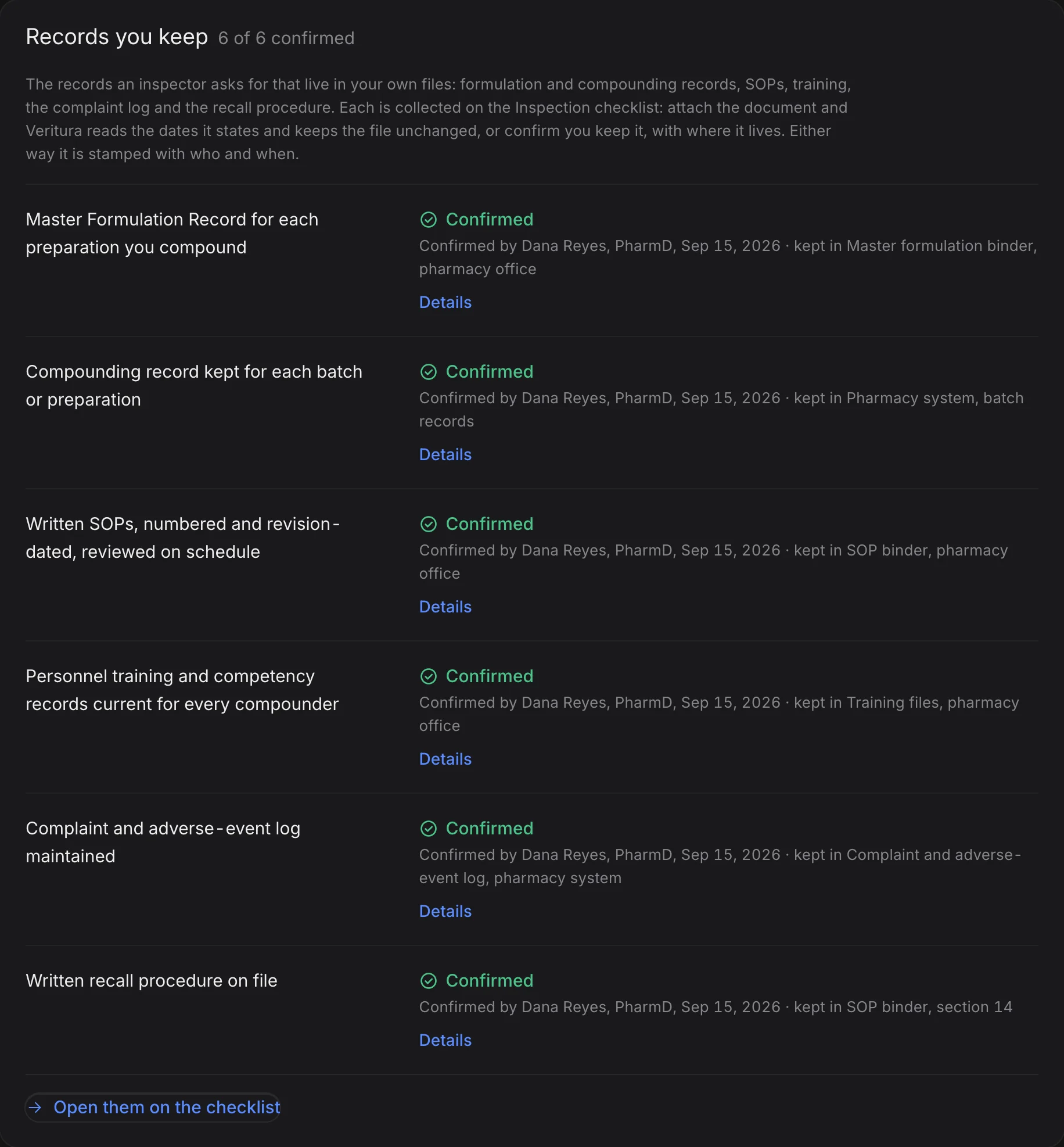
A read-only link a pharmacy opens for an inspector or reviewer. It stops answering once the pharmacy closes it. Its packet lists what is missing first, then every request, the lots and certificates, the supplier files and the originals kept.
Four headings, and exactly what each means.
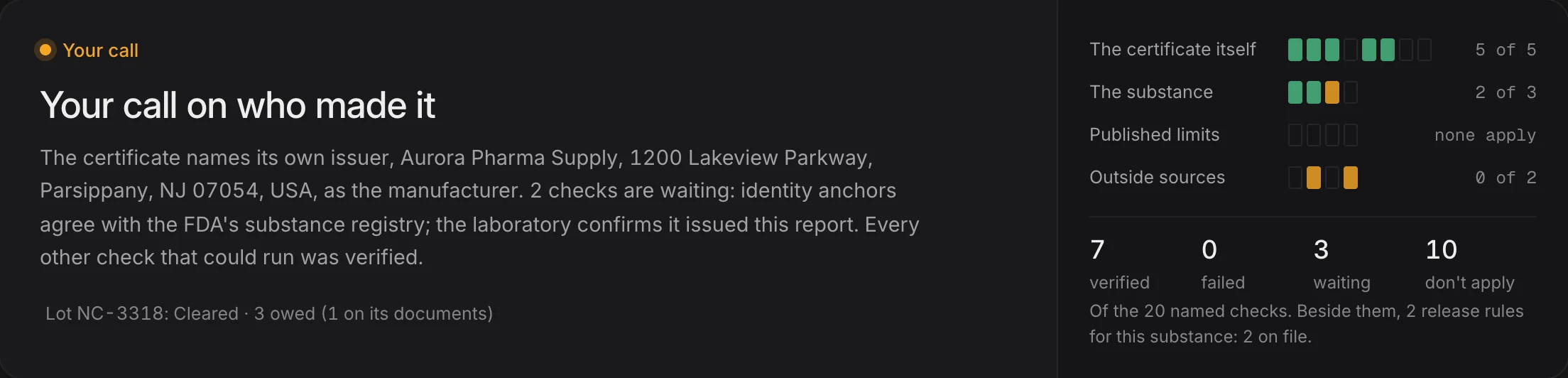
Every certificate review opens with one of four headings, and the heading means exactly this:
| Verified | Every check that could run passed. |
|---|---|
| Verified where checked | What could not run is named and not counted as passed. |
| Your call | Nothing failed; some checks need the pharmacist's decision. |
| Not verified | “N of M checks not met”, each one named, with what failed, why, and what would close it. |
Under the heading sit up to 20 checks in four groups. Which apply depends on the document: on 26 published bulk-substance certificates, 11 to 13 applied, 12 on the median one.
- The certificate itself (8). Names the substance and lot; issued by a named laboratory with a report ID; signed for the quality unit by a named person; dated, in a possible order, and inside its retest or expiry date; every result inside its own printed limit; its own figures agree; addressed to this pharmacy; a distributor's reissue points to the original.
- The substance (4). May be compounded under 503A; states the USP or NF monograph it meets, where one exists; names the original manufacturer and its address; that manufacturer is registered with FDA to manufacture.
- Published limits (4). Residual solvents inside ICH Q3C; elemental impurities inside ICH Q3D; microbial counts inside USP <1111>; an endotoxin limit no looser than USP <85> allows for the recorded dose.
- Outside sources (4). No recent FDA enforcement record matches the supplier; the laboratory confirms it issued the report; the certificate agrees with every earlier certificate for the lot; the identity matches FDA's substance registry.
Every value relied on is cited to the page and line it was printed on, with the line quoted word for word. A field the certificate does not state is shown as not stated, never guessed. A document that cannot be read is reported as “Not verified. The document could not be read, so no check ran.”
Every check names its source.
Each check names its source. Where a source is a capture rather than a live lookup, the date of the capture is on the record.
| Source | What is checked | How it is dated |
|---|---|---|
| 21 U.S.C. 353a | The three 503A routes; the named manufacturer and its registration; a valid certificate naming the substance and lot. | The statute, cited by section. |
| FDA's 503A lists | 216.23(a), 216.23(b), Category 1 and Category 2, each name as FDA printed it. | As printed May 14, 2026; the date is always shown. |
| ICH Q7 | Quality-unit signature by a named person, the testing laboratory named, the maker's address, a reissue referencing the original. | Cited by section (11.41 to 11.44, 17.63). |
| ICH Q3C and Q3D | Residual solvents and elemental impurities; with a dose recorded, the share of each permitted daily exposure, arithmetic shown. | The guideline revision is cited. |
| USP <85> and <1111> | The endotoxin limit computed as K over M from the route and dose; total aerobic and yeast and mold counts. | Arithmetic shown on the record. |
| FDA establishment registry | Whether the named manufacturer is registered to manufacture, or only to relabel and repack. | Searched at read; the receipt keeps the time. |
| FDA substance registry (GSRS) | Name, UNII, CAS number, formula and molecular weight against FDA's record. | Searched at read. |
| openFDA, warning letters, import alerts | The supplier, maker and laboratory against public enforcement records. | At read; openFDA enforcement again on an hourly monitoring cycle. |
| FDA's 503B list | Registered outsourcing facilities. | A daily capture; its date is kept. |
Veritura does not hold a USP-NF licence and does not check results against a monograph's acceptance criteria. It checks whether a monograph exists and whether the certificate claims to meet it.
Each line says which hand wrote it.
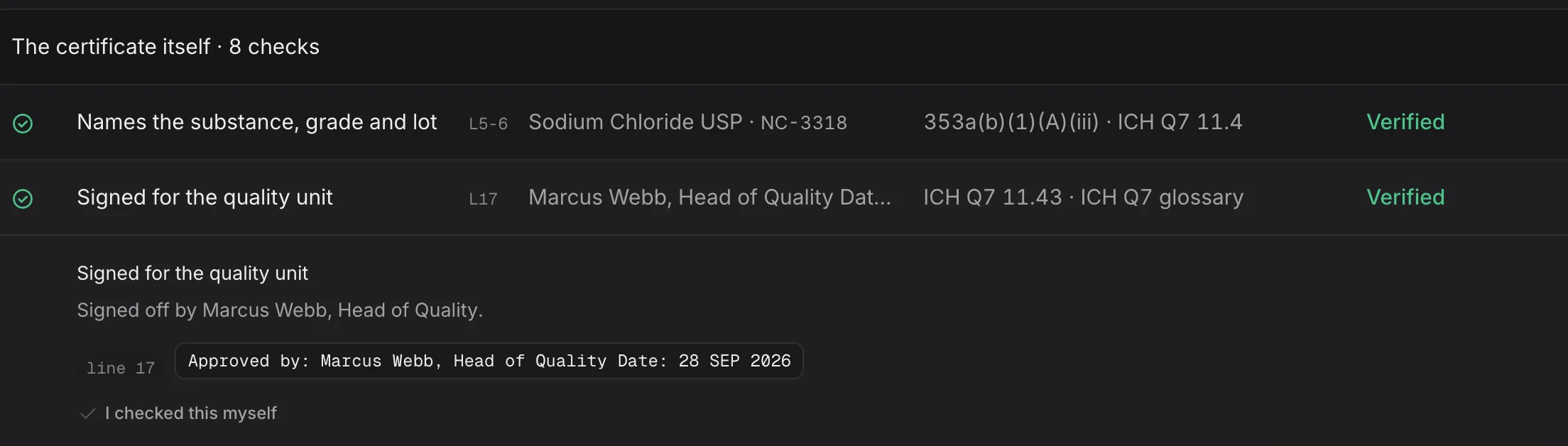
A record mixes facts from different hands. Each item says which hand, so you can weigh it before relying on it.
- Matched at the issuer's public source
- Such as FDA's establishment registry.
- Confirmed by the issuer in writing
- Such as the laboratory's reply to a request.
- Checked at the source by a named person
- With a capture, where a source's terms forbid automation.
- Read from the issuer's own document
- Cited to its page and line.
- Computed against the law or a standard
- With the arithmetic shown.
A statement someone only typed in is shown as Claimed. Negative results are results: not found, name differs, expired and contradicted are recorded, not dropped. Only a recorded reply from the issuing laboratory earns “source-confirmed”.
Every public lookup keeps a receipt: the source address, the query, the time, the result and its limitation. A source that did not answer is never shown as checked, and a clear result is shown only when the sources answered.
Check it without asking us.
A record whose integrity you can only confirm by asking the party that issued it is not much use in a dispute. These are the parts you can check yourself.
- The fingerprint
A public Passport shows its SHA-256 fingerprint and exactly what was hashed: the fields, in that order. Recompute it in your own browser. Change any field and the fingerprint changes.
- The receipt's signature
A Sourcing Decision Receipt is signed, and the signature is re-checked each time the page is opened. If the check fails, the page says so on its face: do not rely on this copy.
- The originals
Every original a decision rested on is kept as received in object storage, never overwritten or deleted, each with its SHA-256 fingerprint, so the file you were given can be compared byte for byte with the one that was read.
- The custody line
Each custody event (released, shipped, received, administered, returned, recalled, reported) carries the hash of the one before it, so a line cannot be tidied afterwards without the break showing.
A name, a time, a fixed meaning.
- A signature carries
- The signer's printed name, the date and time, and a meaning chosen from a fixed list
- Bound to
- The record's hash. Signatures form one chain per workspace, and nothing a decision rested on is ever overwritten or deleted.
- Before anything leaves a lot
- No Passport, no Seal, no shipment, until a named person has recorded what they checked and what they relied on. The server enforces this on every path: the dashboard, the API, order fulfilment, staged batch releases and seals.
- A finding
- Cannot be cleared by a signature
- Release
- By hand, by default. A workspace that saves its Standard or Lenient policy lets a reviewed, cleared lot release its Passports automatically; the person reviews the lot once and does not sign each Passport.
- Automated
- The checks and the policy decisions themselves
Built to the signature elements of 21 CFR Part 11, not a Part 11 attestation: the first signature in each session asks for the signer's password, or their authenticator when it has not been used recently, unless they sign in only with Google or Microsoft and have no authenticator. Veritura states plainly that it is not a SOC 2-certified, HIPAA-covered or validated GxP system.
One brand's register, read-only.
A brand owner can give outside counsel a read-only view of its advertising claim register. It is the same register the brand's marketing and legal teams work from, not a document prepared for you.
- Scoped to one brand
- A counsel link opens one brand's register under one account and nothing else. A group running several brands issues one link per brand.
- The counts first
- The register states how many claims are on file, substantiated, needing attention, in draft and retired, before any claim is read.
- Every claim in full
- The wording as it ran, its channels and first-run date, its status (Draft, Substantiated, Needs attention or Retired), whether it was reframed to documentation language, each evidence record behind it with its as-of date, current state and integrity hash, and its dated history with reasons.
- The binder
- Download the whole register, or one claim, as a dated and hashed substantiation binder.
- Revocable
- The owner can withdraw the link at any time. Revoking is a status change, never a deletion, and only the link's hash is stored.
Every page of that view carries the same boundary: a documentation record only, not legal advice.
What a record does not establish.
- That any product is safe, sterile, effective, pure or appropriate for any use
Veritura reads documents; it does not test material.
- That a document is authentic
A record may show metadata, reuse signals, links and inconsistencies; it cannot prove provenance unless the issuing laboratory confirms it in a recorded reply.
- That a claim is lawful or true beyond the documents cited, or what the law requires of anyone
- That a supplier is approved
A Veritura “Allow” means the documentation met that pharmacy's own policy.
- Anything from silence
Absence of a public-source match is not proof of absence; it is a fact about the sources that answered.
Document-integrity findings speak in signals for a person to weigh. The product never calls a document forged, fake or fraudulent.
Patient data stays with the pharmacy. Except an emailed patient's address, kept for recall notices, and two exceptions the patient chooses.
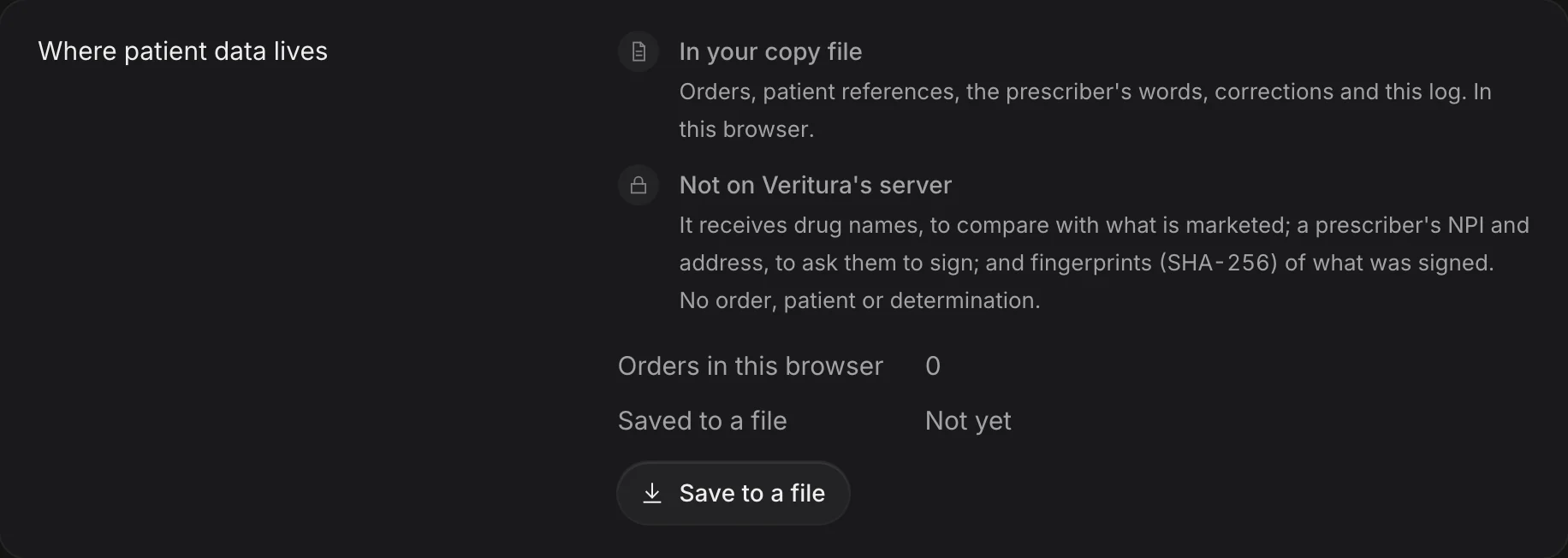
The server never keeps a pharmacy's patients or a prescriber's words: the copy file that holds them stays in the pharmacy's browser and a file it saves. An order is kept only as the reference the pharmacy sends, and a reference that reads like a person's name or date of birth is refused rather than stored. When the pharmacy sends a Passport by email, the patient's address is used to send it and is then kept as a recall contact for that batch: used only for recall or safety notices about that batch, never for marketing and never shared, and deleted a year after the batch's use-by date or at once when the patient opts out from the link every such email carries. A pharmacy's owner can switch patient email off; while it is off, an address is refused and nothing of it is kept.
The other exceptions are the patient's own choices. Saving a unit from its scan page keeps the patient's email, the saved serials and the notice history until the patient deletes them. Asking for recall notices from the link in an earlier Passport email keeps that one address, for that one purpose, until the patient unsubscribes.
Nothing supported disappears.
A record that can be quietly edited is worth nothing to the person reading it. These are the only ways a Veritura record moves.
- Nothing supported is removed
Supported observations are not removed because they are unfavourable. A record is corrected when a factual error or a missing source is shown.
- A newer document sets an older finding aside, never erases it
A person may set an older finding aside, with a written reason, when a newer clean certificate arrives. Both documents and both readings stay on file. A finding a firm answers on its published file stays there, marked retired, with its date.
- Anyone with standing can ask
Users, suppliers, laboratories and other relevant parties may submit a correction, a supplemental document or a response tied to a report ID. Send the report ID, the observation at issue and the document that supports the correction; it is reviewed against the source and the methodology version used.
The Trust Center carries the limitations, the data posture and the methodology in full.