Intelligence: We see what a single packet review cannot.
17 document-integrity signals. Lots re-matched every hour.
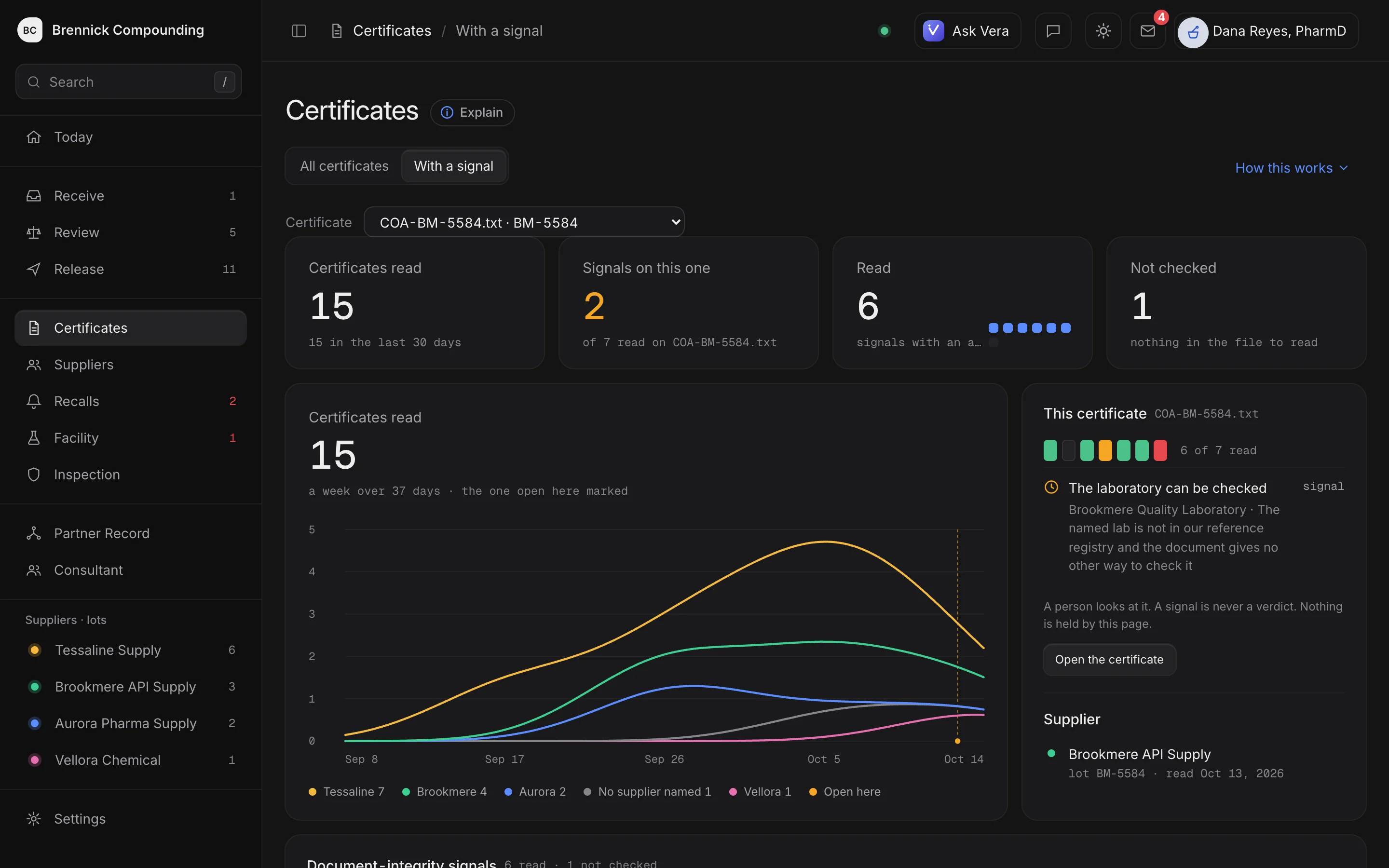
Alone, a certificate can look perfect. Side by side, the repeats show.
Three things no single review can see, because each one looks only at the document in front of it.
The same file, report ID or lot number turning up where it should not.
A supplier's certificate layout that changed overnight, from one lot to the next.
Two certificates for one lot that disagree on the assay, the retest date or the laboratory.
Veritura reads every document as one body of evidence. What it finds is a signal for a person, never an accusation.
Read alone, read together. The same certificate, a different story.
Every document is read beside your workspace, compared by fingerprint across every Veritura account, and its lot re-matched to FDA enforcement records every hour.
Reused paperwork is the tell.
Every document is fingerprinted on arrival, so a second copy is caught the moment it lands, not at the next audit.
The file's hash, its text and visual fingerprints, and the identifiers it carries.
Under another lot, supplier or date, both records are linked when the second copy lands, not at the next audit.
Both records open side by side, for a person to judge.
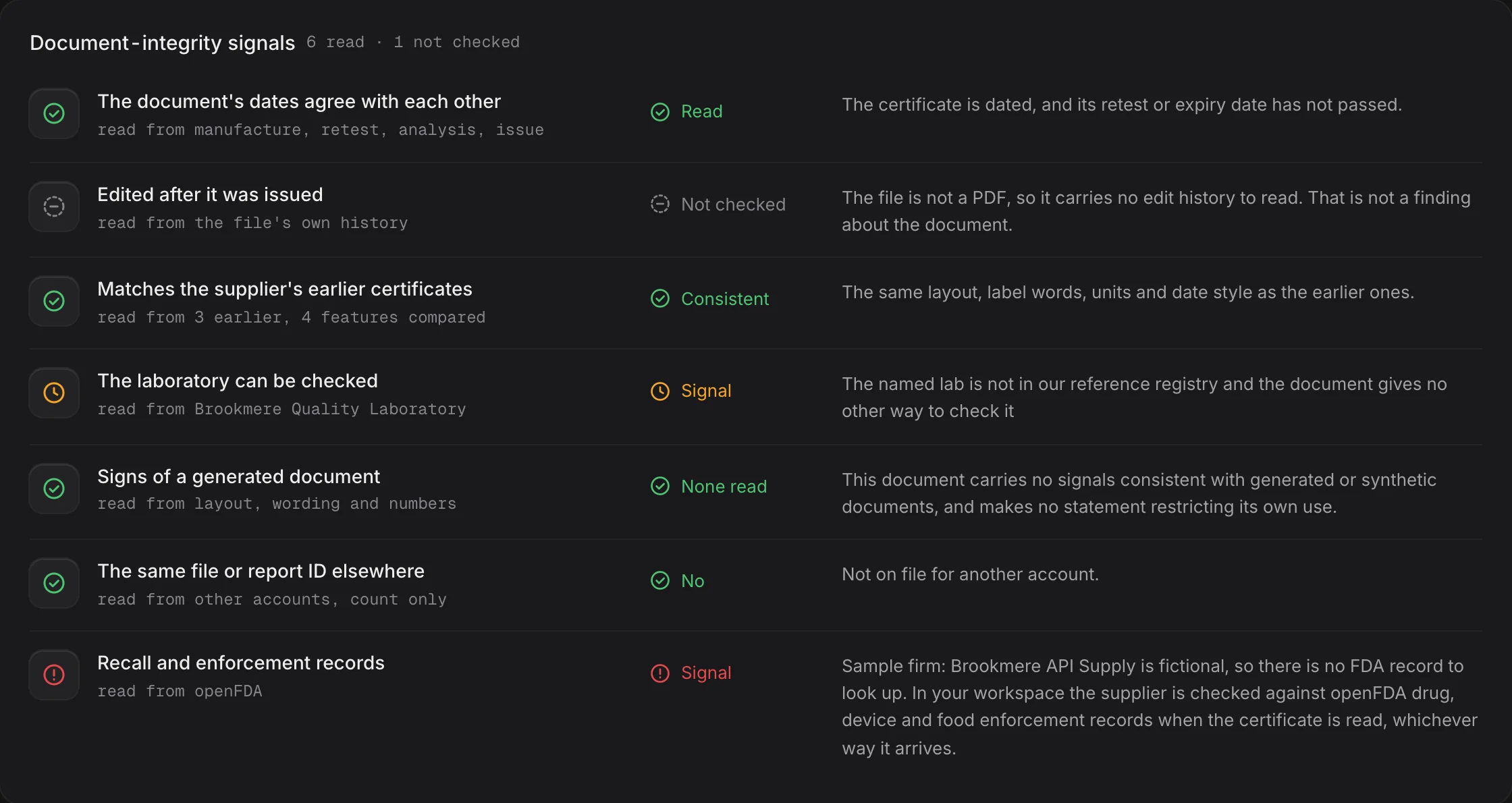
Five views, one body of evidence. Each raised for a person to judge.
Each runs on every document, without anyone asking.
Across every account, counts onlyHow many other accounts hold the same thing. Nothing else.
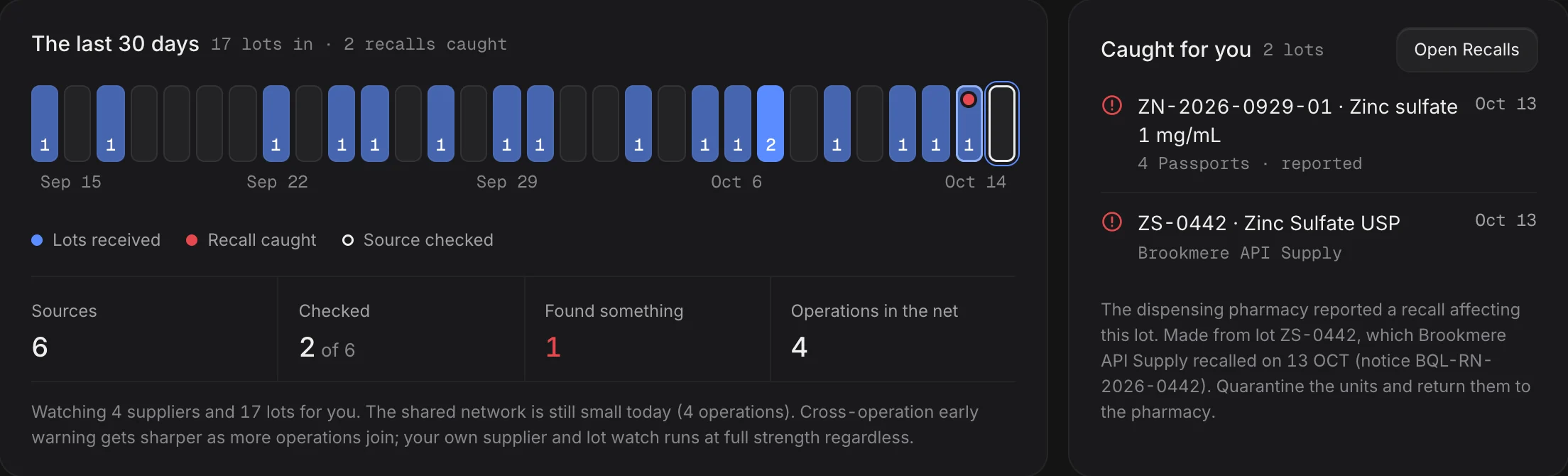
The file hash, visual and text fingerprints, and the laboratory and report identity.
No other party's name, supplier, file, lot or order is ever shown, and nobody sees yours.
A certificate sent to several pharmacies under different lots shows, without exposing any of them.
One lot, two certificatesEvery value that differs named, and neither document accused.
Two certificates for the same lot number that disagree: the assay, the retest date, the laboratory.
The review names the conflict. A person decides which one holds.
On the monitoring cycle; each workspace sees only its own side.
Against the supplier's own historyA new document set against the supplier's earlier ones, across 11 features.
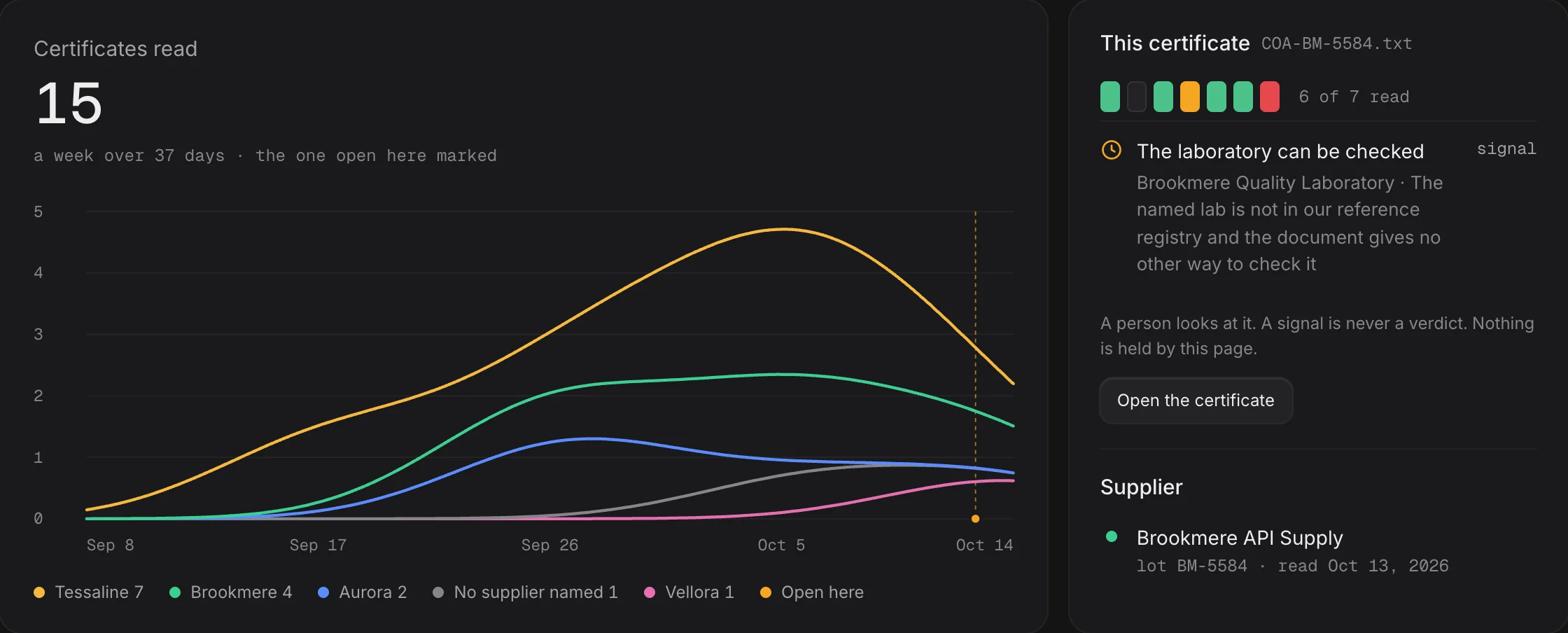
Field order, label vocabulary, header, footer, date and units style, line shape, and the laboratory's details.
A certificate template rarely changes from one lot to the next.
Raised for a person to ask about, with the features that moved.
The public record keeps movingLots and suppliers on file re-matched to FDA enforcement every hour.
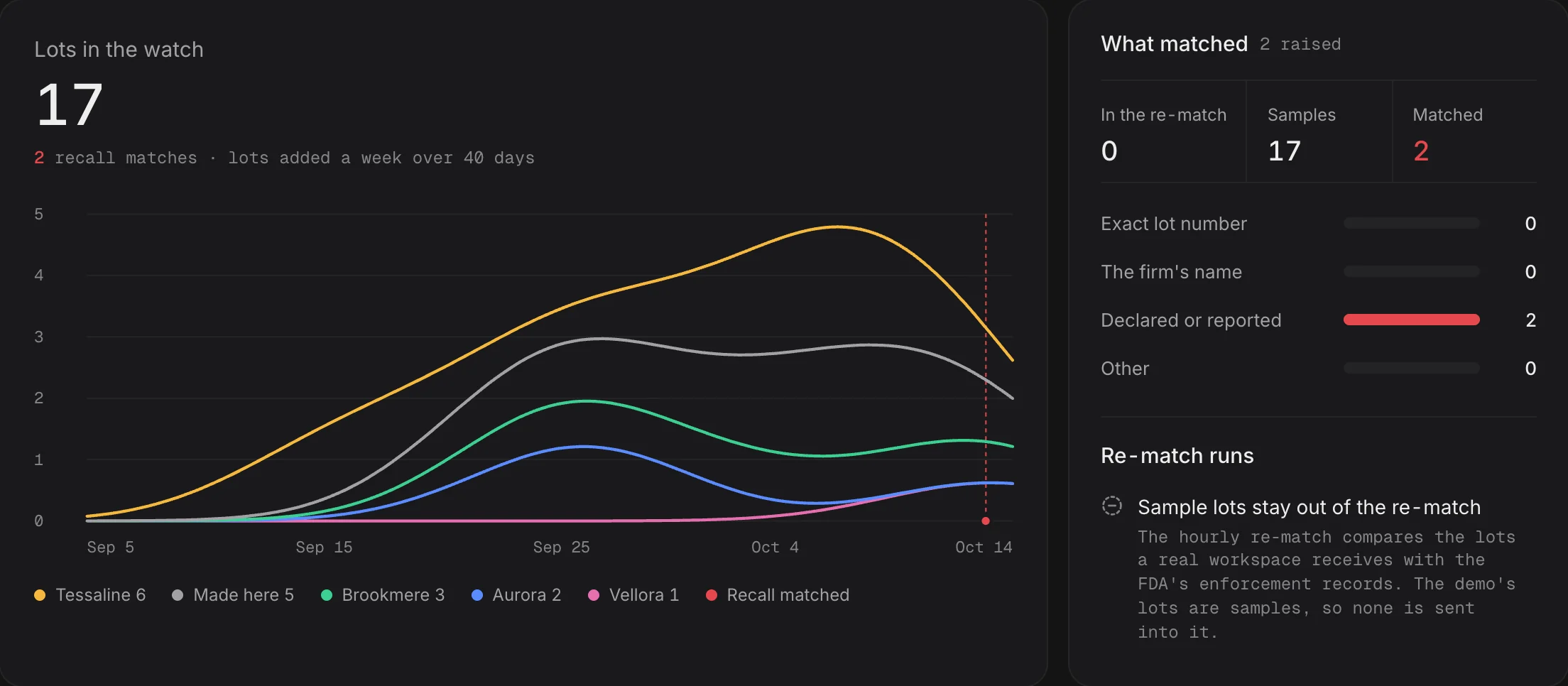
Against openFDA enforcement records, across accounts by lot number.
And marks every Passport minted from it, so the signal reaches what has already gone out.
An identical re-match never reopens a dismissal a person already made.
The file's own bytesSeven findings read from the PDF itself, raised for a person.
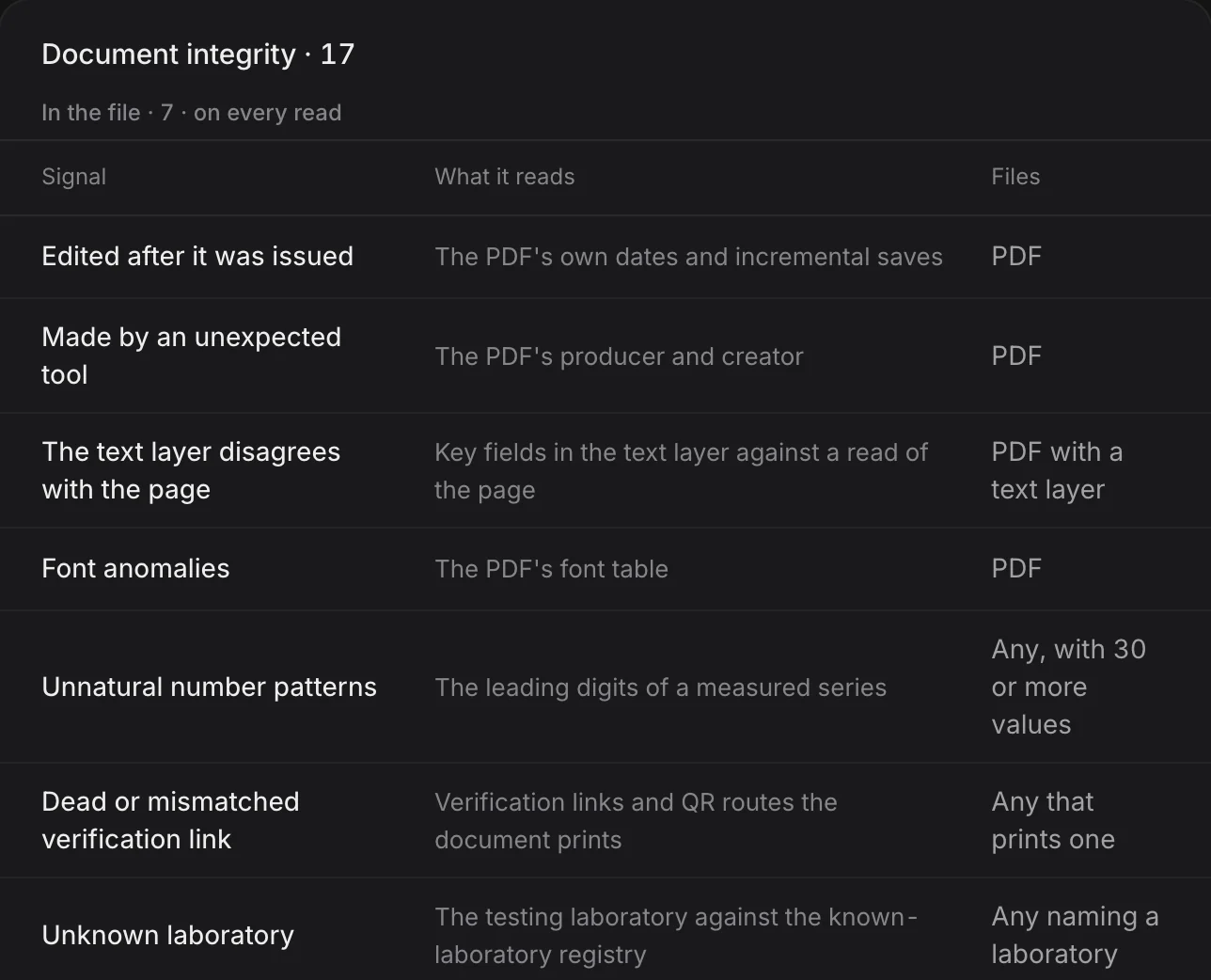
From a file created after the date it claims to an incremental edit stack.
Such as a file created long after the issue date it prints.
It is recorded, not held against the document.
Made, not issued. Thirteen signs Veritura reads for.
A certificate can be generated from nothing, by a template or by a language model. Each sign is raised for a person.
Language-model boilerplate, an unfilled template placeholder, a sample disclaimer left in.
Where a fake slips: an impossible phone number, a ZIP code in the wrong state, a malformed accreditation number.
Uniformly round values, inconsistent units, an unregistered laboratory with no anchor.
A content-credentials manifest that says AI made it holds the lot on its own.
The page shows the results. The file shows how it was made.
Every file goes through the same pass. Each signal fires only where the file allows it: a page for a reused signature, a PDF for its edit history.
A signal is a reason for a person to look, never a verdict. No signal is not proof a document is genuine.
The full detail.
Every signal, every sign of a generated document, and every source a document is read against.
The checks behind every read, in the methodologyThe file itself 7 signals
- PDF edit history
- The file's incremental saves: a document changed after it was issued.
- Producer and creator
- The tool the PDF names as its producer or creator, recorded. The name alone is never raised.
- Font anomaly
- Fonts that change inside a field or a line where a genuine report would not.
- Digit distribution
- The spread of digits across the results, set against what measured values produce.
- Text layer mismatch
- A text layer that says something different from what the page image shows.
- Dead or mismatched verify link
- A verification link printed on the certificate that does not resolve, or resolves to something other than this lot.
- Unknown laboratory
- A testing laboratory that cannot be matched to a known one.
Across your records 10 signals
- Lot collision
- One lot number on documents that should not share it.
- Cross-substance lot collision
- One lot number used for two different substances.
- Report ID collision
- One report or certificate number on two different reports.
- Document hash reuse
- The identical file filed as evidence for something else.
- Signature reuse
- The same signature image found on other documents.
- Stamp reuse
- The same stamp image found on other documents.
- Template mismatch
- A layout that does not match the issuer's known template.
- The same embedded image
- An image embedded in the file that also sits in another record's file.
- The same rendered page
- A page that renders the same as a page already on another record.
- The same picture of the page
- An image or page that looks the same as one already on another record.
FDA records beside the 17
- FDA recall match
- The lot or firm matched in openFDA enforcement records.
- FDA import alert match
- The firm matched in FDA's import alert database.
- FDA registration lookup
- The named manufacturer's status in FDA's establishment registry.
Seven findings from the PDF's own bytes
- Dates
- Created after the date it claims; modified after creation with a re-save; a creation date in the future.
- Tools and edits
- An image-editor producer; an incremental edit stack; a creator and producer that disagree.
- Attachments
- Chromatography claimed with no trace attached.
- What holds the lot
- A high contradiction, such as a file created long after the issue date it prints. The producing tool's name alone is never raised; it is recorded, not held against the document.
Thirteen signs a certificate was made, not issued 13 signs
- What the text gives away
- Language-model boilerplate; an unfilled template placeholder; a sample disclaimer left in; contradictory sterility statements.
- What a real issuer gets right
- An impossible, placeholder or malformed phone number; a ZIP code in the wrong state; an accreditation number in the wrong format.
- What measured data looks like
- Uniformly round values; inconsistent units; an unregistered laboratory with no anchor; a content-credentials manifest that says AI made it, which holds the lot.
- Where they come from
- A certificate can be generated from nothing, by a template or by a language model. Each sign is raised for a person, and one of them holds the lot on its own.
What every document is read against
- Sources
- Your workspace, every Veritura account (counts only), the supplier's own history, openFDA enforcement, FDA warning letters and FDA import alerts. No affiliation or endorsement implied.
- When
- Public sources are consulted at read; openFDA enforcement records again on an hourly cycle.
- A declared recall
- A recall a person declares appears on the scan and Passport pages, attributed to whoever declared it, and emails every patient who saved a unit from the lot and every clinic desk on Veritura holding it.
A signal is a reason for a person to look, never a verdict on a document. No match in a public source is not proof of absence, and nothing leaves a lot until a named person has reviewed it.
Check a record yourself, with no account: verify a Passport or a Seal, or check an advertising claim. See the public tools
Questions, answered plainly.
The same file, report ID or lot number appearing where it should not: under another lot, another supplier, another substance or another date. Both records are linked and raised for a person to review side by side.
No. Strong identifiers are compared across every Veritura account, and each workspace sees only a count of the other accounts involved. No other party's name, supplier, file, lot or order is ever shown, and nobody sees yours.
At read, against openFDA enforcement, FDA warning letters, FDA import alerts, FDA's establishment and substance registries and its 503B list; and openFDA enforcement again every hour for lots and suppliers already on file. No match is a fact about the sources that answered, never a clearance.
No. A signal is a reason for a person to look. Veritura never calls a document forged, fake or fraudulent, and a document with no signal is not thereby proven genuine. Only the issuing laboratory's own recorded reply confirms a report.
Yes. A serial or a scan opens the public record with no account: the certificate's own lines, the supply chain by role and a fingerprint anyone can recompute. It holds no patient identity.
Still have questions? Talk to a person.