A folder answers after the scramble. A record answers before it.
Which customers received this lot, who reviewed the evidence, and what supported the release. A folder helps once you know what to search for; an order-level record answers before the scramble.
| The question | A folder of certificates | An order-level record |
|---|---|---|
| Which orders received lot BM-5520? | Invoices searched by hand. | One search: every batch, order, Passport and clinic that rests on the lot. |
| Who reviewed the evidence? | An initial on a log, if anyone kept one. | A named person, the time, the meaning of their signature and what they relied on. |
| What was the certificate checked against? | Not recorded. | Up to 20 named checks, each naming its standard, each finding cited to its page and line. |
| What can the customer be shown? | The PDF, or nothing. | A Passport built from an allowlist, with internal notes held back. |
| What happens on a recall? | Phone calls from a spreadsheet. | Declared once. Every desk on Veritura holding the lot, and every patient who saved a unit or asked for recall notices, is emailed; every other order returns to the pharmacy as an order list. |
Missing fields do not fail a record automatically. They become explicit gaps, named before anyone relies on the record or a customer sees it.
Twelve fields per released order. Each filled as the work happens.
The minimum operating record for one released order. Each field says what it holds and where Veritura fills it from as the work happens.
| Field | What it holds | How Veritura fills it |
|---|---|---|
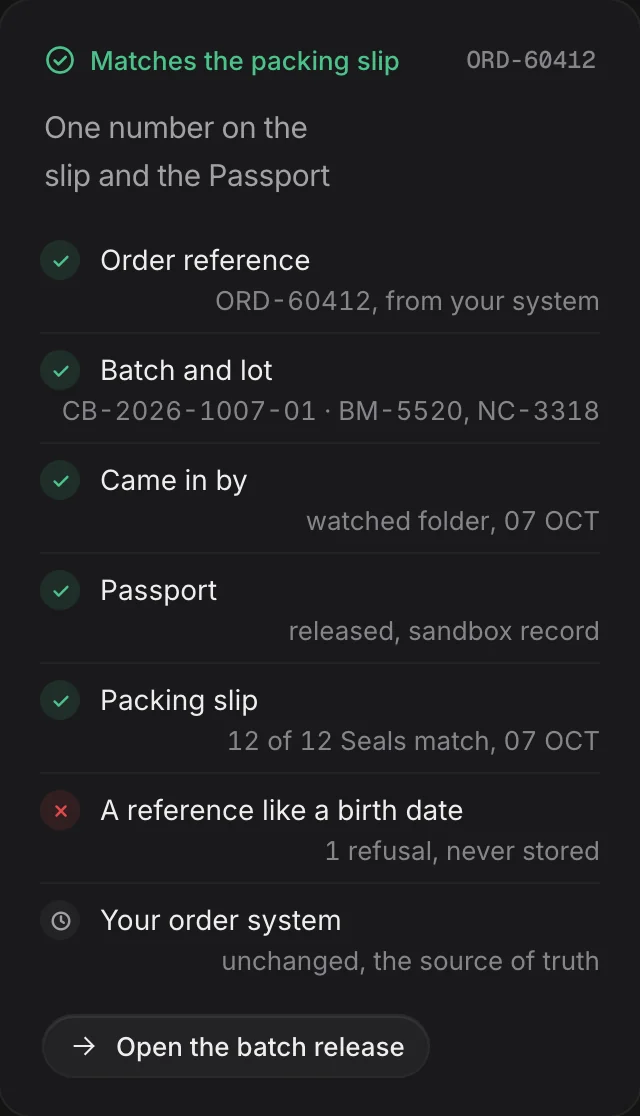
| Order ID | The order, invoice or fulfilment reference. | Carried on the Passport, one Passport per dispensed order. A reference that looks like patient text is refused. |
| Buyer | The clinic, pharmacy, platform or account the order went to. | The shipment's recipient in Custody. Never a patient's name. |
| Product | The preparation or substance the order supplied. | The lot's product and, for a preparation, each ingredient, up to 12. |
| Lot | The batch or supplier lot used for recall and dispute lookup. | Bound to the order at release, with every ingredient lot bound to the preparation. |
| COA | The certificate and report ID behind the lot. | Kept as received with its SHA-256 fingerprint; every value cited to its page and line. |
| Supplier packet | The supplier file behind the lot. | Six dated elements, each current, due or overdue, with an owner and a due date on every gap. |
| Reviewer | The person who reviewed the evidence before release. | A named person's review, required on the server before anything leaves the lot. |
| Decision state | Where the record stands. | One of four verdicts on the evidence, one of four dispositions at receiving, and Allow, Review or Hold under the pharmacy's policy. |
| Evidence rows | What was present, missing, conflicting or could not be verified. | Each check met, not met or not checked, with what failed, why, and how it clears. |
| Customer boundary | What can be shared without leaking internal notes or overclaiming. | The Passport's allowlist: 13 certificate fields, the chain by role, and no score. |
| Audit trail | When the record changed, who changed it and why. | Every action on a ledger with who, when and why; signatures chained per workspace; nothing deleted. |
| Release guard | One production release per order. | One Passport per dispensed order, charged once when selected; scans and reprints add nothing. |
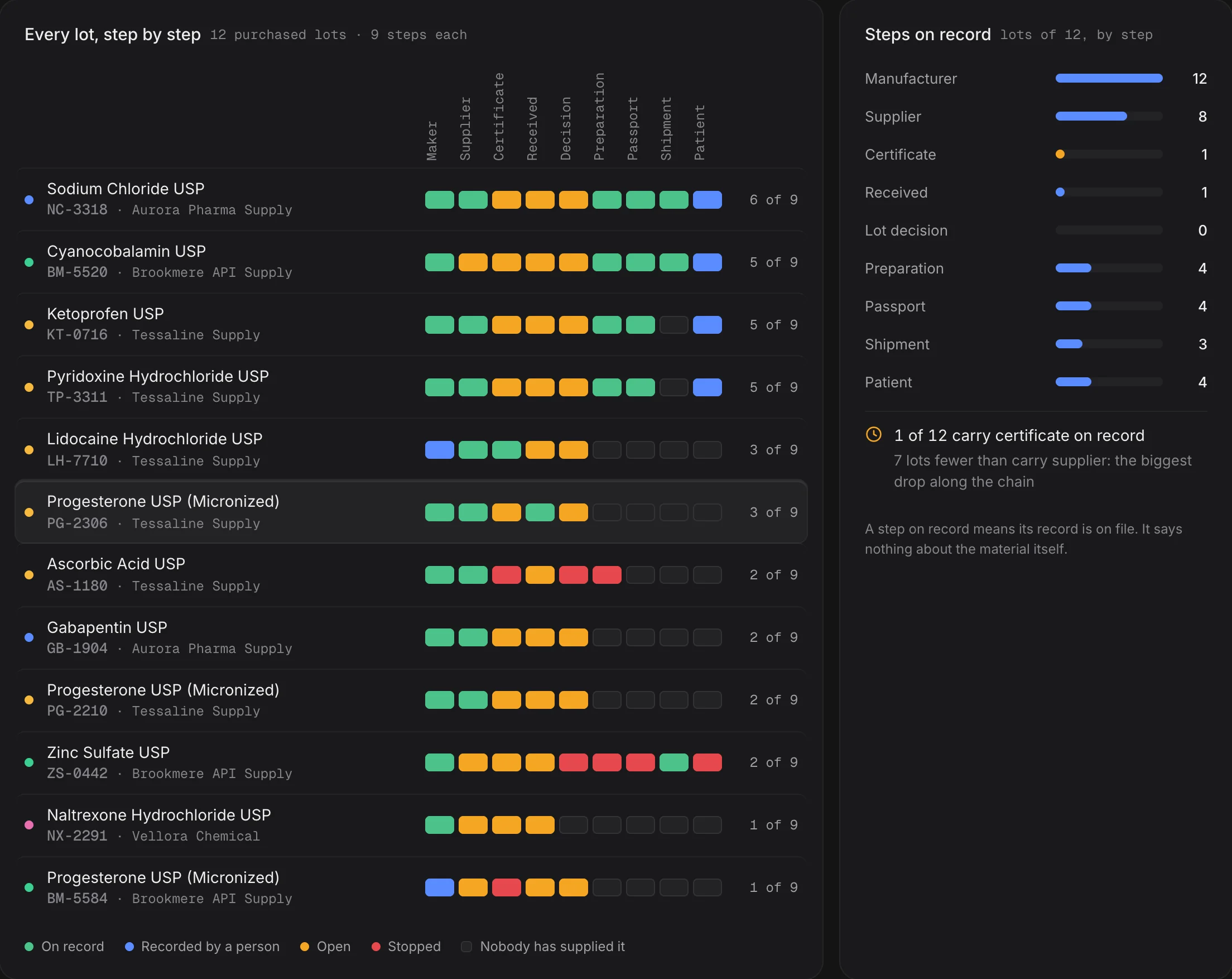
Nine links, maker to patient. Each closed, open or your call.
Nine links. Each is closed, open or the pharmacy's call, and each says what closes it.
- Manufacturer
Named on the certificate and searched in FDA's establishment registry. A firm registered only to relabel or repack does not pass as the maker.
- Supplier
The firm that sold the lot, with its supplier file and every gap's owner.
- Certificate
Read line by line against up to 20 named checks: the statute, FDA's records, the certificate's own numbers and the limits computed for the dose.
- Received
Nine receiving gates and one of four dispositions: release to inventory, quarantine pending evidence, request a supplier correction, or hold for a person.
- Lot decision
A named person's review, signed with a fixed meaning and bound to the record as it stood.
- Preparation
The compounding record and each ingredient lot, with the beyond-use date checked against USP <795> or <797> and every ingredient's own expiry.
- Passport
One per dispensed order, issued only from a reviewed lot.
- Shipment
One code per box and one Seal per unit, written to the custody record.
- Patient
The record opened by scanning the label. No patient identity is held on it.
Five steps, written as they happen. Nothing assembled after.
Five steps. Because the record is written as each one happens, nothing has to be assembled after the fact.
- Intake
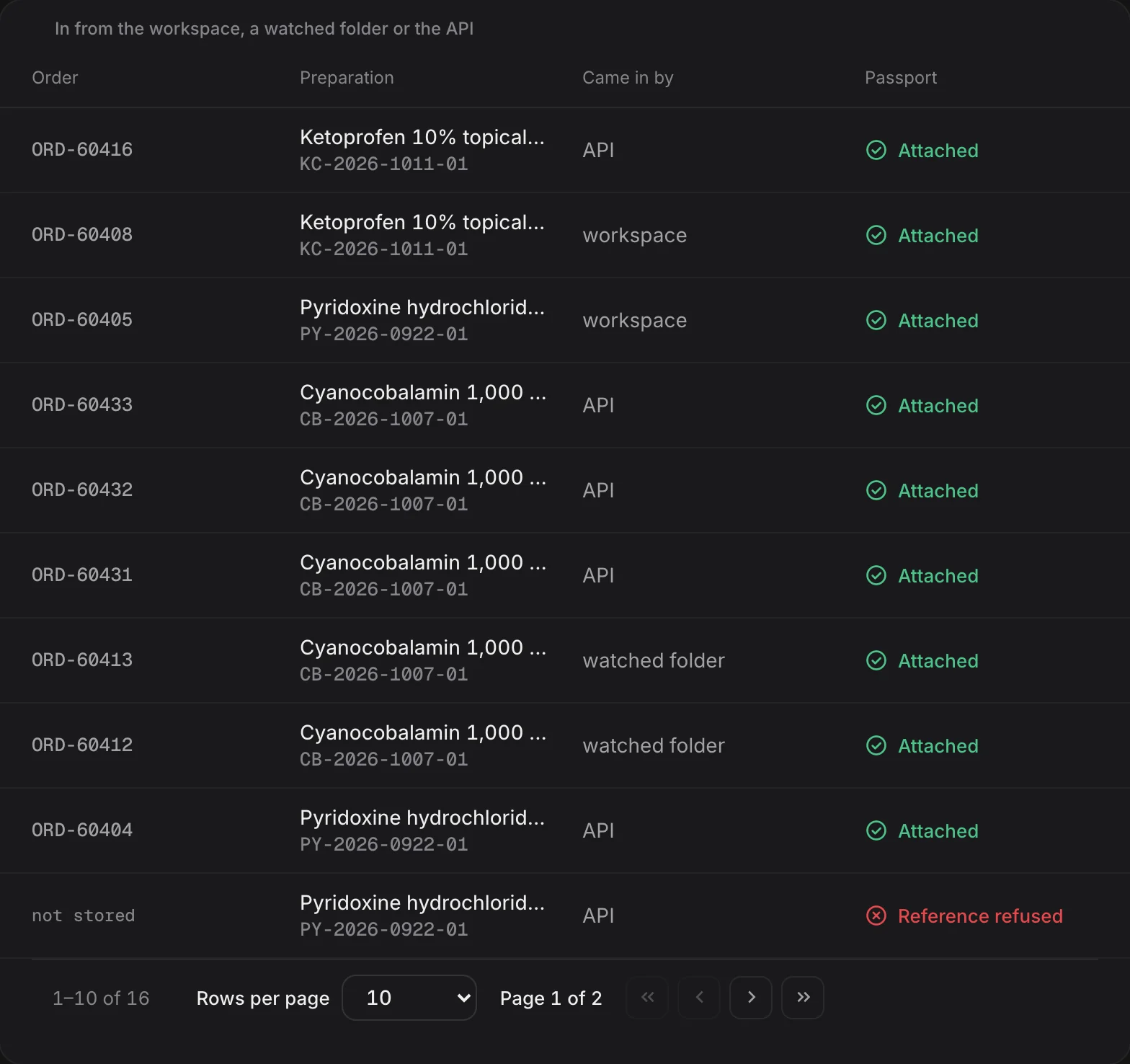
Documents arrive by upload, by the workspace's own email-in address, through each supplier's standing link, by lot-number fetch from a supplier's public library where one exists, or by API. Each file is identified by its bytes, not its name, and kept as received.
- Evidence custody
Every value read keeps its page and line. The file keeps its SHA-256 fingerprint. Gaps and limits stay attached to the order record.
- Person review gate
The named checks that apply run, what fails is held for a named person, and nothing leaves the lot until that person records what they checked and relied on.
- Customer Passport
Each dispensed order gets one Passport. The customer sees the lot, the certificate lines from a fixed allowlist, the chain by role and the boundary. Internal notes and commercial fields stay in the workspace.
- Recall and dispute
Search a lot and see every batch, order, Passport and clinic it touched. Lots on file are re-matched against openFDA enforcement records at check time and again on an hourly cycle; a match holds the lot and marks every Passport minted from it.
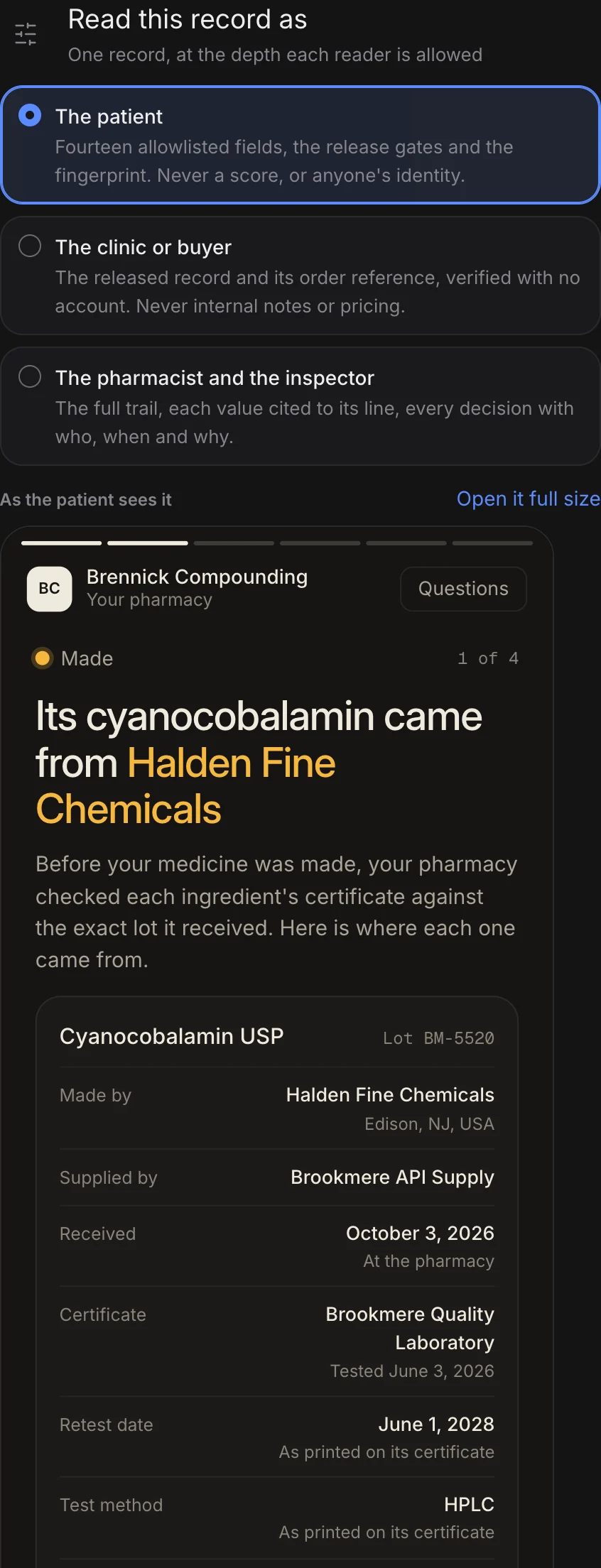
One record, two depths. Built from an allowlist.
The same record at two depths. The customer layer is built from an allowlist, so nothing internal leaks by accident.
| Layer | Operator workspace | Customer Passport |
|---|---|---|
| Evidence | Every check, finding and citation | The certificate lines, each beside its printed limit |
| Decision | The verdict, the reviewer, the signature and the reason | That a person reviewed the lot, and who released it |
| Supplier | The supplier file, its gaps and the correspondence | The supplier and the maker, by role |
| Commercial | Billing, usage and internal notes | Never shown |
| Language | Findings in the product's fixed vocabulary | No score, band or posture word, and no supplier approval language |
Documentation evidence only. Veritura does not certify supplier quality, approve a product, give medical or legal advice, determine safety, replace laboratory testing, or turn a certificate into proof that a product claim is true.
Five jobs get shorter. The answer exists before the question.
Five jobs get shorter, because the answer already exists when the question arrives.
Recall handling. Search the lot once and see the connected orders, clinics, certificates, supplier files and open gaps.
Dispute resolution. The record keeps the certificate, the supplier evidence, the reviewer and the customer proof as they stood at release.
Customer trust. Customers open a clean Passport while internal notes, pricing and supplier correspondence stay private.
Supplier history. Repeated gaps, clean packets, missing fields and reused documents become visible across a supplier's lots.
Partner workspaces. Clinics, platforms and consultants read the same record at the depth each is allowed, without owning the review.
Twelve questions, one per field. An answer or a named gap.
Twelve questions, one per field. A record meets the standard when each has an answer or a named gap.
- Order ID
Can you name the order this proof belongs to?
- Buyer
Can you name who received it, without naming a patient?
- Product
Can you name the preparation and every ingredient in it?
- Lot
Can you name the lot, and every ingredient lot behind it?
- COA
Can you open the certificate as it was received, and the line each value came from?
- Supplier packet
Can you show the supplier file as it stood on the release date?
- Reviewer
Can you name the person who reviewed the evidence, and when?
- Decision state
Can you say what the record concluded, in one heading?
- Evidence rows
Can you list what was missing or could not be verified?
- Customer boundary
Can you say exactly what the customer was shown?
- Audit trail
Can you show every change, with who made it and why?
- Release guard
Can you show one release per order, and no more?
Sample records on this site show the shape of the record; sandbox records are free for testing. A workspace runs the record on your own orders.
Run the record on your own orders.
Bring one released order. We trace it field by field, from the order number to the person who reviewed the evidence.