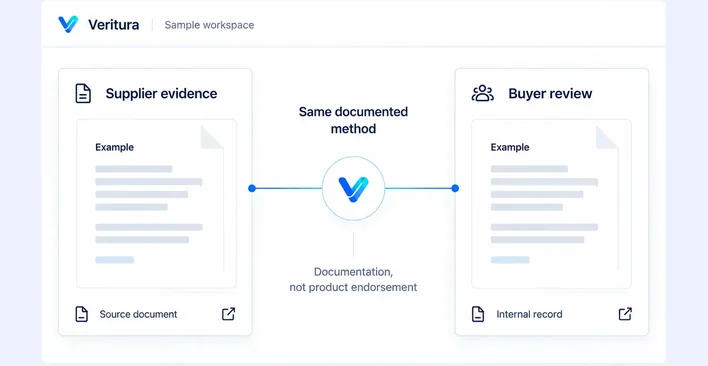
Talk to the people who built the method.
Founder-led. Send a note, whether it is one document or a whole supplier base.
- Founder-led. You hear back from the person who built the method.
- Send a real, redacted document set and we run it through the check.
- Encrypted in transit and access-scoped to your workspace.
Everything on this page, in full.
The complete text, for the reader who wants the whole story before a call.
We read the paperwork behind compounded medicine, independently of anyone selling it.
Every vial of compounded medicine starts as a stack of paperwork, and a forged certificate looks exactly like a real one.
Veritura reads that paperwork, resolves it against the policy the customer sets, and keeps the record reconstructable.
The decision always stays with the customer.
Three things a supplier portal structurally cannot be.
The people selling a product should not be the ones grading its paperwork.
Independent
We do not sell, source, or distribute any product. There is no incentive to look the other way.
Supplier-agnostic
We work across every supplier you buy from, not a single network. One layer over your whole supplier base.
Verified, not displayed
A forged COA displays as cleanly as a real one. We check completeness, reconcile the source chain, and scan for reuse signals.
Suppliers
Ongoing review due Jul 30
Corrected source route requested
The score grades the documentation evidence on file only. It is not an approval, a ranking, a certification, or a statement about any product.
A supplier's portal versus an independent check.
Both can show you paperwork. Only one is built to hold up when someone pushes on it.
What backs the work.
$1M professional liability (E&O) coverage in place
Professional liability / errors-and-omissions coverage supports the documentation-diligence work. It does not convert any report into approval, safety coverage, legal advice, or regulatory sign-off.
Published, versioned methodology
Every reviewed output carries v1.0 . 2026-04-30. Material changes require a new version.
Corrections, never silent
A correction changes the record and says that it changed. Supported observations are not removed because they are unfavorable.
The methodology has a named owner.
Methodology v1.0, dated April 30, 2026. Material changes require a new version and a visible record.
Joey Soto, founderAccountable for the methodology
PharmD and sterile-compounding advisorsInput on the methodology
Regulatory affairs and 503B quality advisorsInput on the methodology
Advisors appear as roles. No advisor quote is published unless that person gave it in writing and permitted its use.
What is on the record.
Four things you can check without taking our word for any of them.
v1.0, dated April 30, 2026
$1M E&O coverage in place
SHA-256 hash and evidence ID on every reviewed document
Veritura does not sell, source, or distribute product
We verify the documentation, not the product.
We do
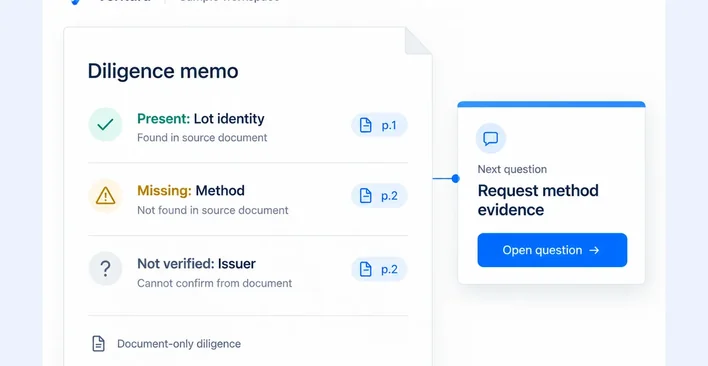
Document what is present, conflicting, missing, changed, or not verified in reviewed materials, with cited evidence, hashes, limits, and the next supplier question, for a human to decide.
We do not
Rank vendors by preference, payment, or judgment, recommend purchases, test physical material, certify products, provide medical, legal, or regulatory advice, determine legality, or confirm FDA approval, clearance, or registration.
Veritura does not test medicine, approve suppliers, recommend purchases, or make medical, legal, product-safety, or FDA-approval determinations. There is no paid or subjective placement: suppliers cannot pay for a better result or a better position, no listing fee, no subscription, and no pay-to-rank. Where results are ordered rather than filtered, the order is set by a published documentation-coverage grade, and that grade is never a recommendation, a preference, or a statement about any product.
That discipline is not a limitation. It is exactly why the record holds up when it is challenged.
Veritura by the numbers.
Three things a supplier portal structurally cannot be.
The people selling a product should not be the ones grading its paperwork.
01
Independent
We do not sell, source, or distribute any product, so there is no incentive to look the other way. A supplier's portal can show you paperwork; only a party with nothing to sell is built to hold up when someone pushes on the record, and that is the seat Veritura was designed to occupy from the first line of the methodology.
Nothing to sell means nothing to protect, which is why the record can say what it finds, including findings a supplier would rather it did not.
- Nothing to sell, nothing to protect
- Built to hold up when pushed
- The referee seat, by design
02
Supplier-agnostic
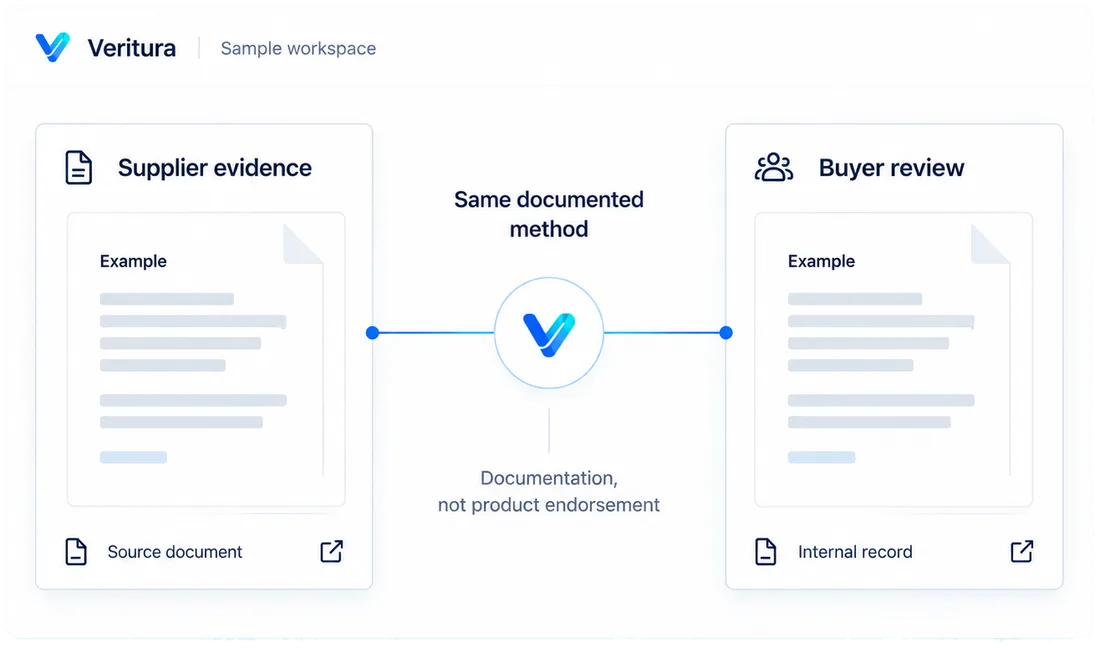
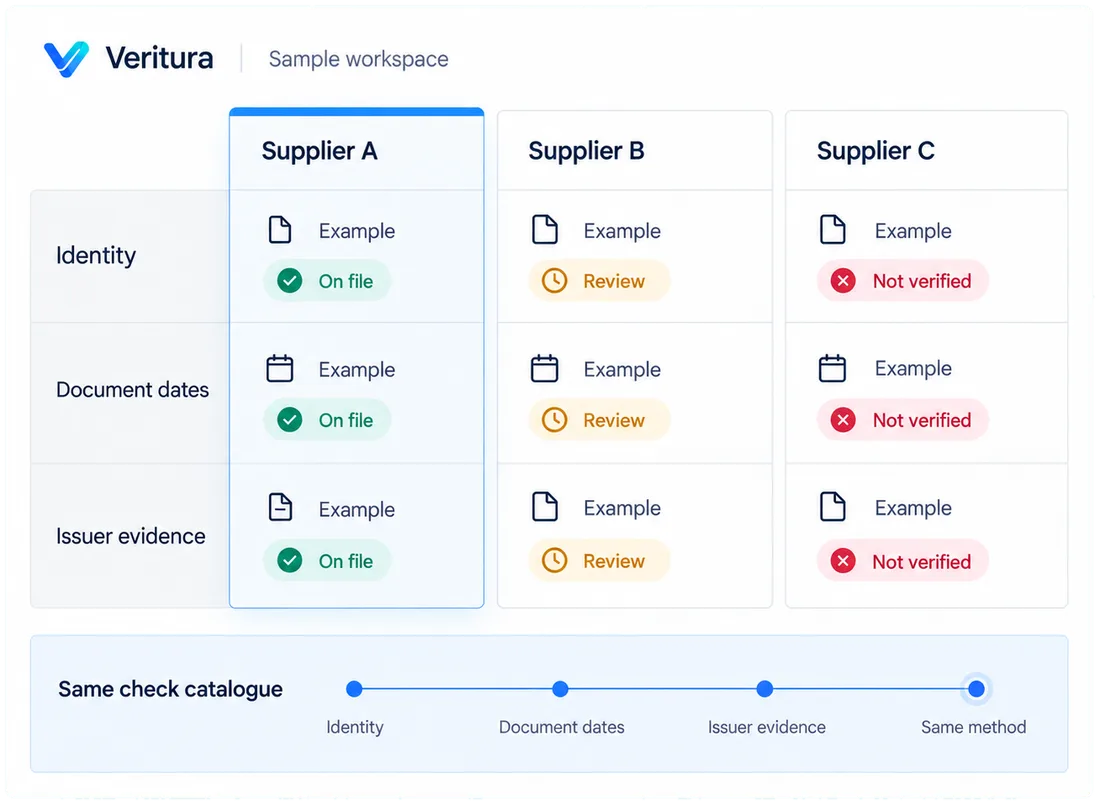
We work across every supplier you buy from, not a single network. One layer sits over your whole supplier base, so the record for a lot from a large manufacturer and a lot from a small broker is built the same way, checked against the same sources, and labelled with the same four origin labels.
One layer over the whole supplier base means the small broker and the large manufacturer are held to the same method, the same sources, and the same labels.
- Every supplier, one layer
- The same method for every source
- The same four origin labels
03
Verified, not displayed
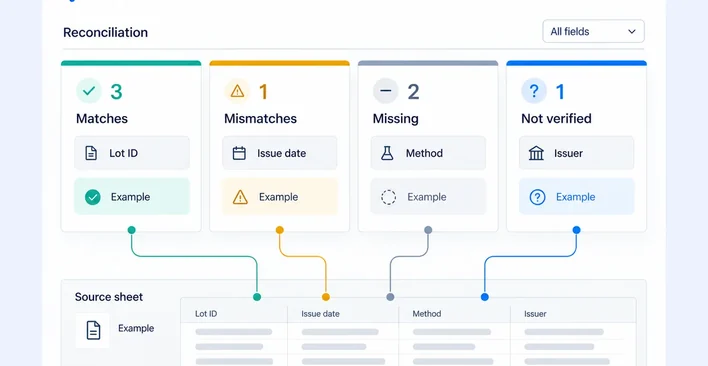
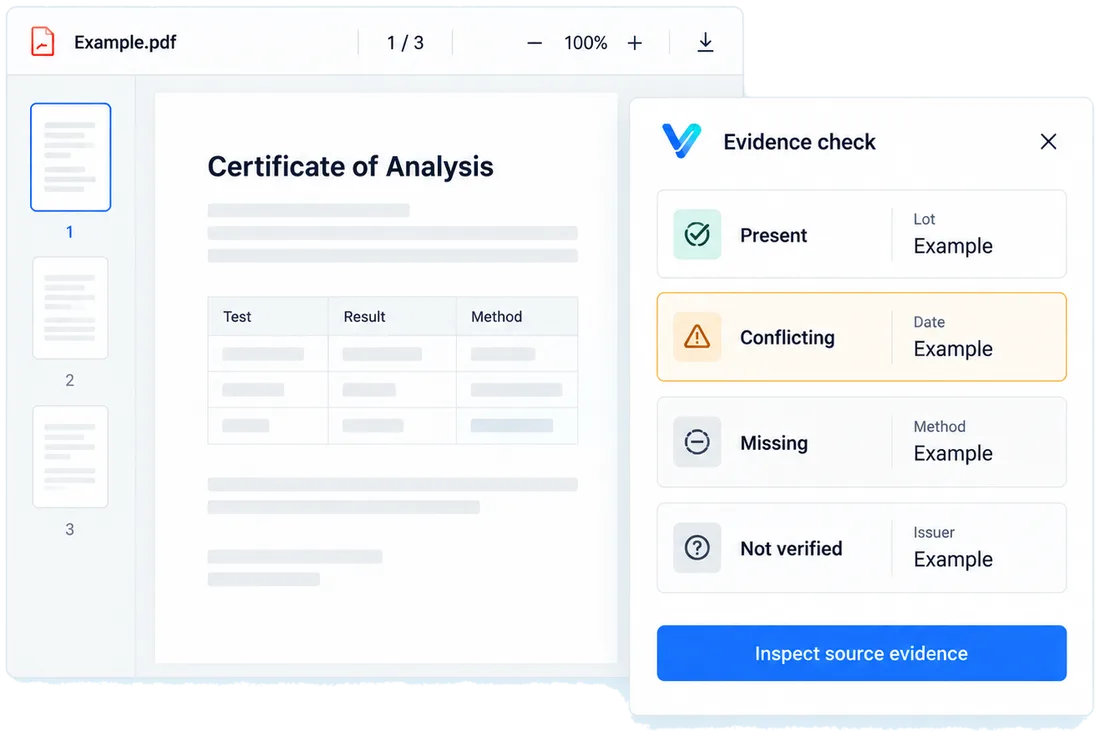
A forged certificate displays as cleanly as a real one. We check completeness field by field, reconcile the source chain back to the issuing laboratory, and scan for reuse signals across the whole index, then record what is present, conflicting, missing, changed, or not verified, with cited evidence, hashes, and limits, for a person to decide.
Verified means read, reconciled, and checked for reuse, with the evidence cited and the limits stated, for a person to decide, which is the opposite of displayed.
- Completeness, source chain, reuse
- Present, conflicting, missing, changed, not verified
- Cited, hashed, limited, for a person
04
We verify the documentation, not the product
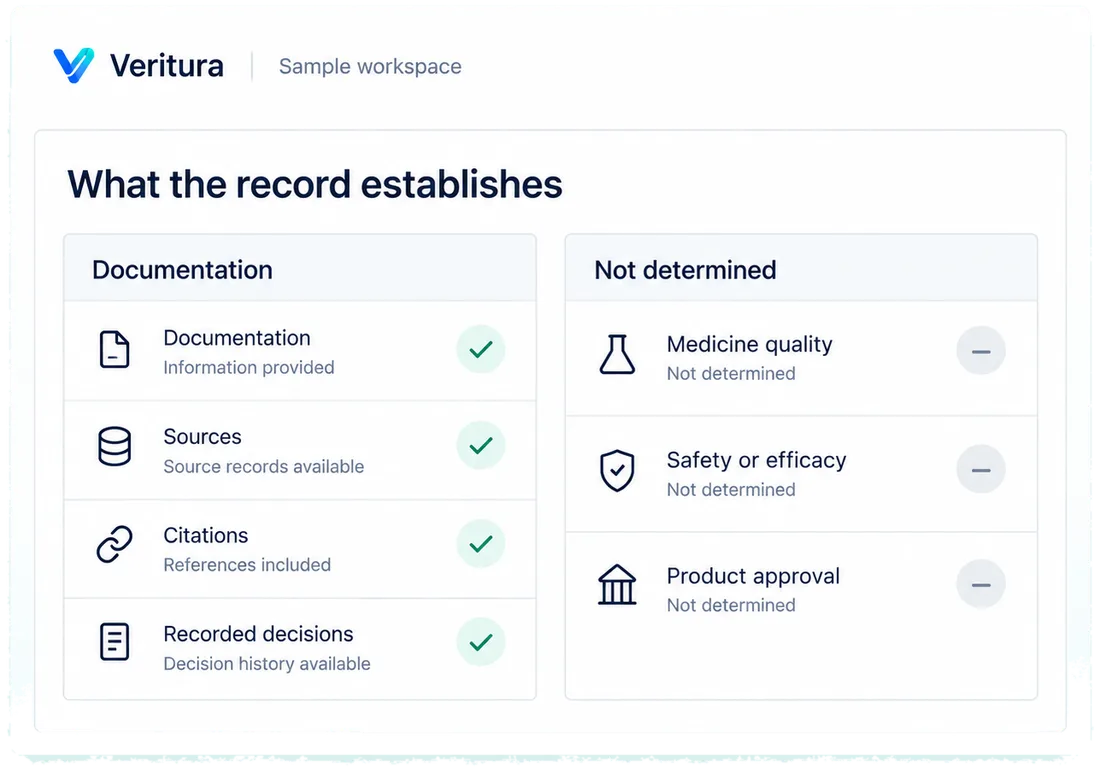
We document what is present, conflicting, missing, changed, or not verified in reviewed materials, with the next supplier question, for a human to decide. We do not rank vendors by preference, payment, or judgment, recommend purchases, test physical material, certify products, provide medical or regulatory advice, or confirm FDA standing.
The list of what we do not do is as fixed as the list of what we do, and it is published so the record can be relied on for exactly what it says.
- What we document, with the next question
- No ranking, no recommendations, no testing
- No medical or regulatory advice
Why this exists
The law already asks for a valid certificate. It never says how to check one.
Federal law requires that bulk substances used in compounding be accompanied by a valid certificate of analysis, and names no method for establishing that a certificate is valid. Every pharmacy, facility, clinic, and platform in the chain is left to decide for itself. That gap is the whole reason an independent evidence layer exists.
The requirement appears in the federal compounding provisions for both 503A pharmacies and 503B outsourcing facilities. Validity is required. A way to establish it is not described.
In 2026 the FDA published a warning letter to a bulk supplier on its own published lists, describing relabelled active ingredient and altered manufacturing and retest dates. A buyer who checked the list and received a certificate still held a document that did not say what it appeared to say.
A large telehealth provider ran a per-batch certificate lookup from a code in each shipment for over a year and reported thousands of subscribers opening it every month. The demand for the record is not the question. Who checks it is.
What changes
What you get, in practice.
Veritura sells, sources, and distributes nothing, so the record can say what it finds.
Every reviewed output carries v1.0, dated, with material changes visible.
You talk to the people who built the methodology.
What backs the work
Four things you can check without taking our word for any of them.
Every reviewed output carries v1.0, dated April 30, 2026. Material changes require a new version and a visible record.
Errors-and-omissions coverage supports the documentation-diligence work. It does not convert any report into approval or regulatory sign-off.
A correction changes the record and says that it changed. Supported observations are not removed because they are unfavourable.
You talk to the people who built the methodology, and the methodology has a named owner.
Veritura reads and connects the paperwork behind an order. It never tests, grades, or endorses the medicine itself, and it never releases anything on its own.

FAQ
No. Veritura does not sell, source, or distribute any product, does not rank vendors, and does not recommend purchases. That is the whole design.
It has a named owner and a version. Every reviewed output carries v1.0, dated April 30, 2026, and material changes require a new version and a visible record.
The people who built the methodology. Veritura is founder-led.
Still have questions? Talk to a person.