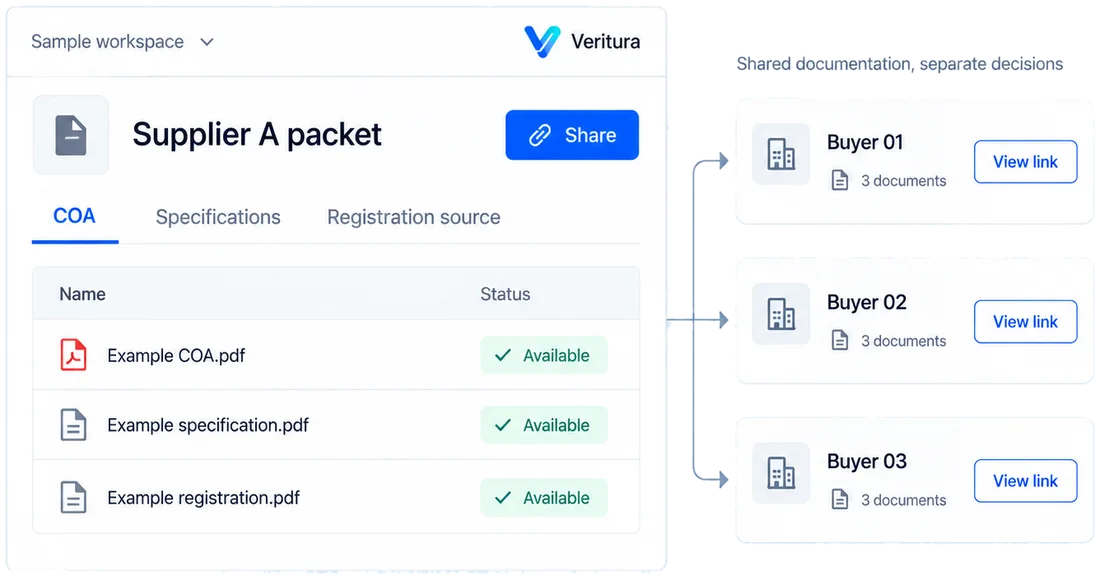
You run cGMP already. What a buyer cannot get from your own page is a record of the lot that you did not write, with every line labelled evaluated, attested, source-confirmed or human-reviewed, and a custody statement per lot: shipped, received, administered, unaccounted. Your QMS stays responsible for manufacture and release. Veritura keeps the record a buyer can rely on.

The job, in four moves
Registration and identity checked and published as a credential anyone can look up, with the date it was checked.
A record of the lot you did not write, from a cleared lot only, with an origin label on every line.
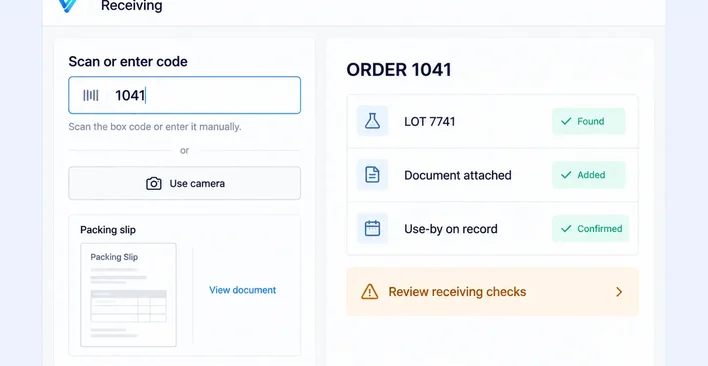
The release slip carries a shipment code. The customer scans it once and every unit lands on their desk with your paperwork attached.
Every customer holding the lot sees the units named. You hold a numbered custody statement per lot and see who opened the notice.
A documentation record with a published method. Payment never changes a result, and your QMS stays responsible for manufacture and release.
01
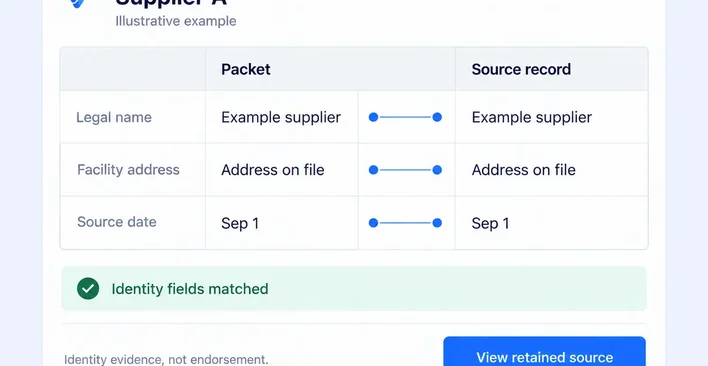
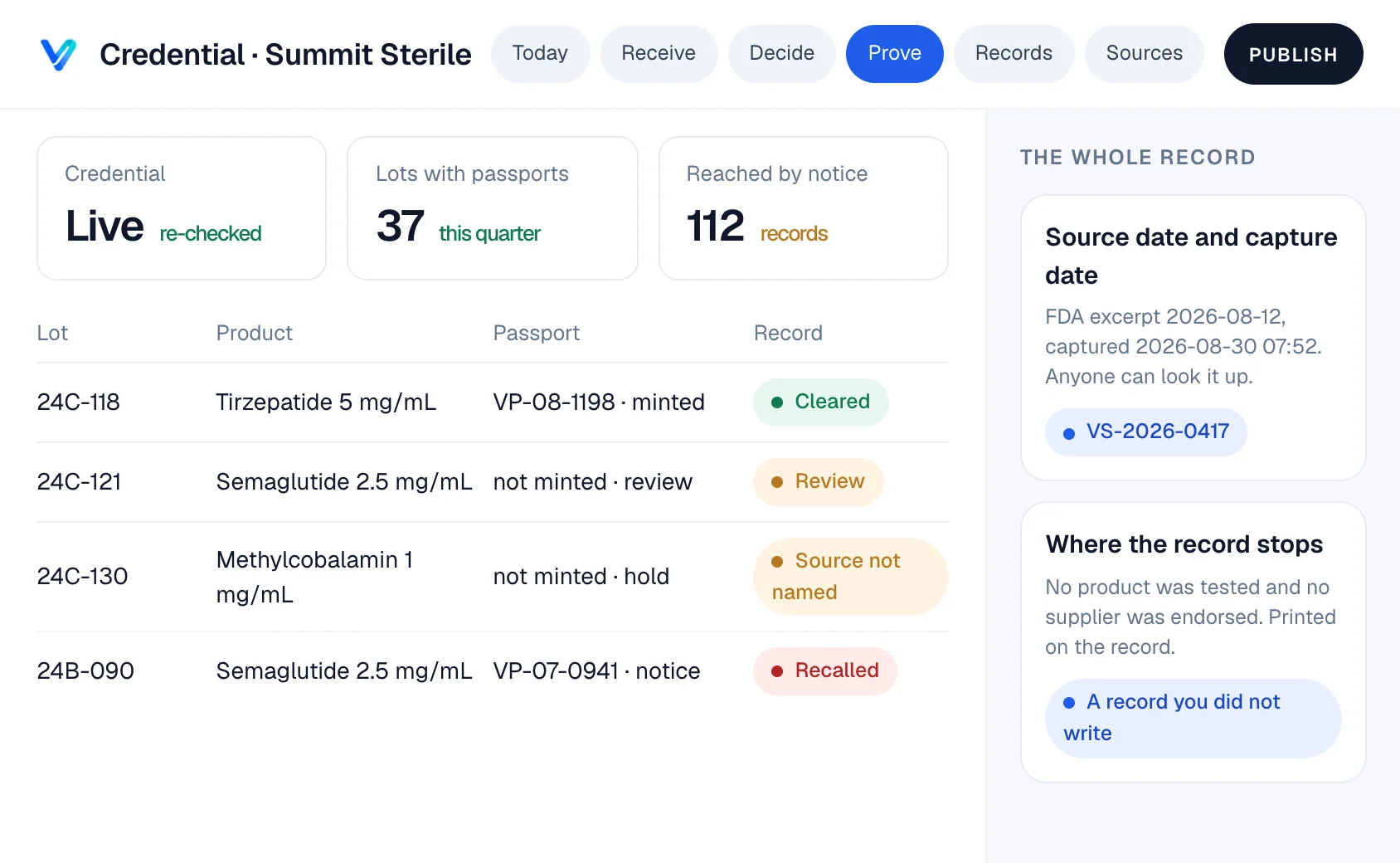
Your FDA registration and identity are checked and published as a credential anyone can look up, stamped with the date it was checked and the date the source was captured, never a live-sounding badge. Add monitoring and it is re-checked on a cadence, so a buyer opening it next quarter sees when it was last confirmed.
Showing the source date beside the capture date is deliberate: a buyer sees exactly when the registration was confirmed, rather than a badge that only looks live.

02
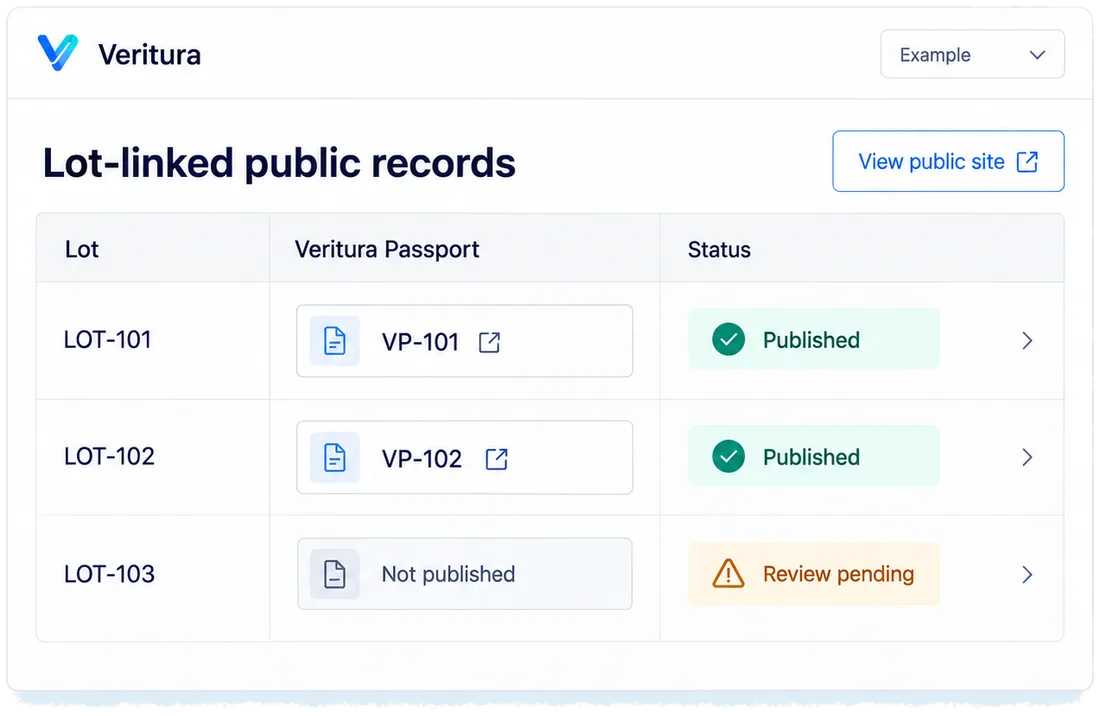
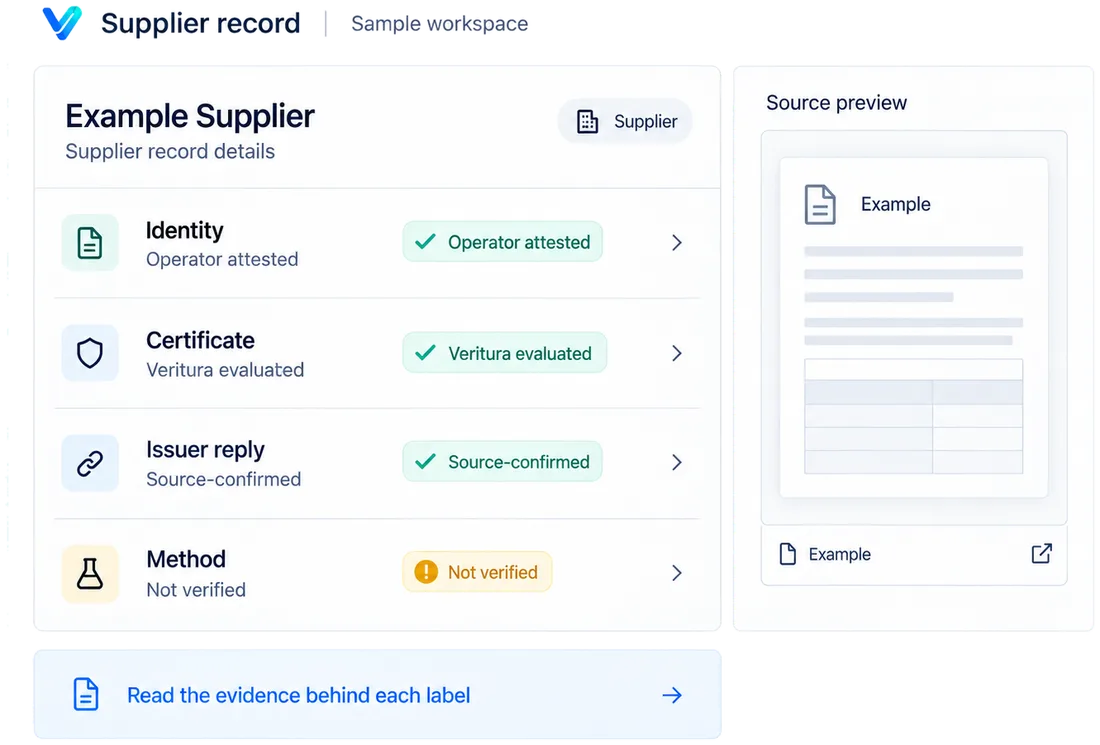
A verifiable, co-branded proof for each lot, issued by an independent party rather than by you. It is minted from a cleared lot, never from a claim, so an uncleared lot can never publish one. Each document on it carries exactly one origin label: Veritura evaluated, operator attested, source-confirmed, or human-reviewed.
Because the passport is issued by a party that does not sell the medicine, does not rank suppliers, and never sells placement, a 503A or a clinic can rely on it in a way it cannot rely on a page you publish about yourself.

03
A 503A or a clinic opens the passport for the exact lot in front of them and reads what was checked, where each line came from, and where the record stops. A buyer cannot rely on a supplier’s page about itself the way it can rely on a record the supplier did not write, and that record is what wins the account.
The record states where it stops, on its face, which is what lets a quality team at your customer accept it into their own file without a call to you.

04
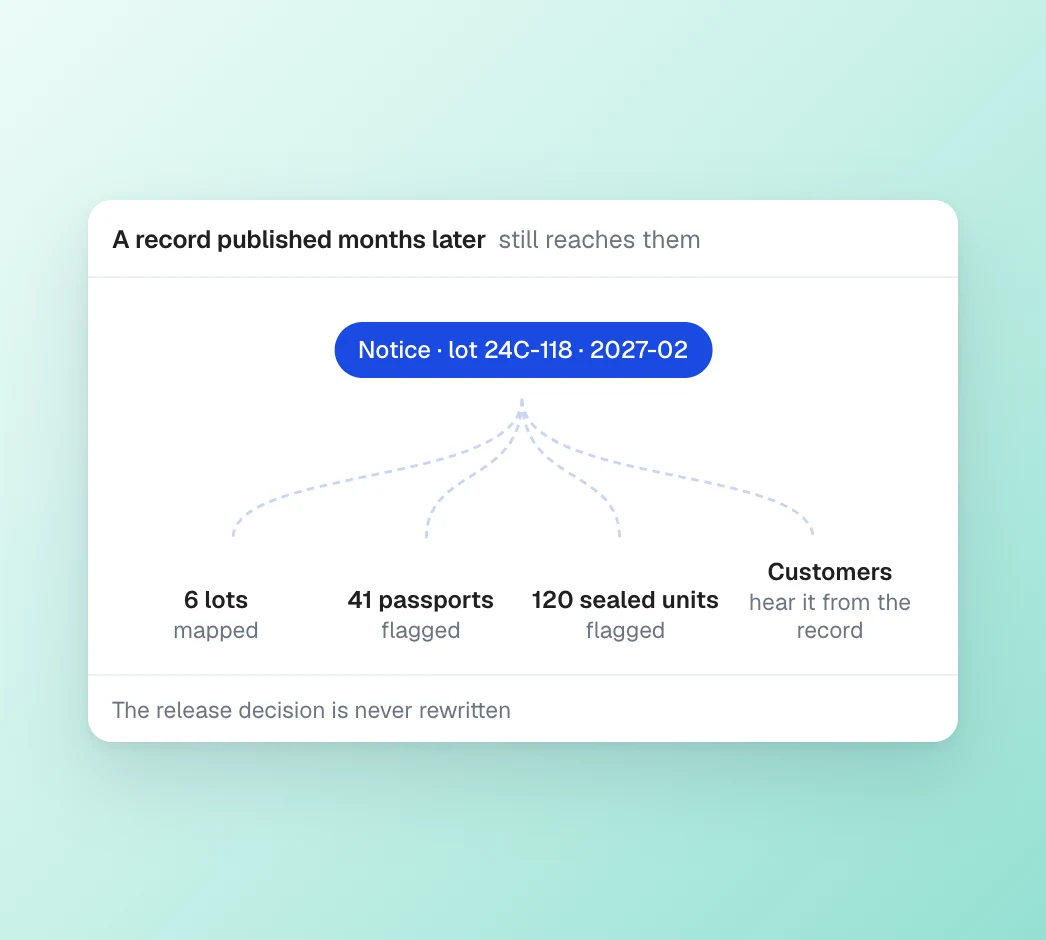
An FDA enforcement record published months after release is mapped to the lots that match it, the passports minted from them, and the people holding a sealed vial. The decision that released the lot is never rewritten; a post-release signal is stamped beside it, and your customers hear it from the record before they hear it from the news.
The post-release signal reaches your customers from the record before it reaches them from the news, and the release decision that preceded it stays exactly as signed.

Why this exists
Federal law requires that bulk substances used in compounding be accompanied by a valid certificate of analysis, and names no method for establishing that a certificate is valid. Every pharmacy, facility, clinic, and platform in the chain is left to decide for itself. That gap is the whole reason an independent evidence layer exists.
The requirement appears in the federal compounding provisions for both 503A pharmacies and 503B outsourcing facilities. Validity is required. A way to establish it is not described.
In 2026 the FDA published a warning letter to a bulk supplier on its own published lists, describing relabelled active ingredient and altered manufacturing and retest dates. A buyer who checked the list and received a certificate still held a document that did not say what it appeared to say.
A large telehealth provider ran a per-batch certificate lookup from a code in each shipment for over a year and reported thousands of subscribers opening it every month. The demand for the record is not the question. Who checks it is.
What changes
A co-branded passport issued by a party that does not sell the medicine, from a cleared lot only.
Registration and identity checked against the dated FDA snapshot, re-checked on a cadence.
A later enforcement match reaches every passport and sealed vial from that lot.
The record a 503A or a clinic opens states documentation completeness in words. It carries no posture word and no numeric score.
The represented product and the lot identifier, with the order reference and the received, released, and issue dates beside them.
Stated in words: reads complete, has gaps, or is largely undocumented. It describes the paperwork, not the medicine.
Whether the lot was released against the configured policy, on a separate axis from completeness.
Your identity against the dated FDA registration snapshot, shown with both the source date and the capture date.
The limits printed on the record itself, next to the evidence, with the methodology version that produced it.
The complete text, for the reader who wants the whole story before a call.
Your batch records are airtight. But the one thing you cannot hand a 503A or a clinic is a neutral record that a lot met the bar, because it comes from you, and a buyer knows a supplier grading its own goods is not proof.
So every new account is a fresh round of emailing the same packet, answering the same questions, and asking to be trusted. The quality is there. The independent proof of it is not.
Veritura is the referee seat: independent, verifiable proof of your lots and your registration that a buyer can check without taking your word for it.
How it works for you
Your FDA registration and identity are checked and published as a credential anyone can look up, stamped with the date it was checked. Add monitoring to keep it re-checked.
A verifiable, co-branded proof for each lot, issued by an independent party, not by you.
You appear in the independent directory buyers search, and a recall on your lots reaches you and them first.
A passport is minted from a lot, never from a claim. The cleared lot IS the gate, so an uncleared lot can never publish one.
An order ships, from the workspace or from the API.
The order is written with its lot number. The lot is resolved by number within the account and stamped as an exact reference. An ambiguous lot number matching several lots is refused, never guessed.
The floor is checked: the lot must exist, be cleared, carry no ClearGate hold and no recall signal, and satisfy any human-review or ClearGate-Allow requirement the policy sets.
The order arrived before its lot cleared.
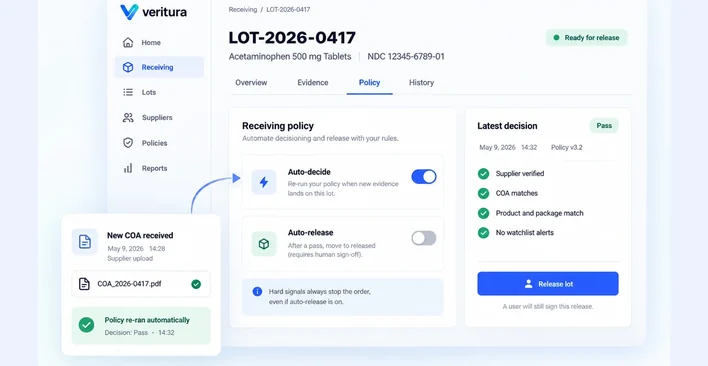
The order parks rather than releasing on its own say-so. Nothing is lost and nothing is published.
The lot clears: the source is named, the missing document lands, the receiving gate passes.
When the account's policy authorizes unattended release, the parked order releases through the same sanctioned path, stamped with the exact policy id and version that authorized it and the lot evidence it rested on.
The buyer or patient opens the shared record.
The public page prints the read, the lab and the date. It states documentation completeness in plain words and no number.
An Evidence Passport publishes what the documentation for a lot states and where it came from. It is not a certificate of quality, an approval, or a statement about the medicine.
An FDA enforcement record published months later is mapped to the lots that match it, the passports minted from them, and the people holding a sealed vial.
Enforcement records in hand.
Each record's code info and product description are scanned for known lot numbers. A match must sit on a token boundary, so '1305' can never match inside '213055'. A product hint keeps two unrelated suppliers reusing the same lot number from being conflated.
Every matching lot, in every account that logged it, flips to flagged and carries the recall signal with its hits, confidence, detail and the lot number that matched.
A flagged lot has passports minted from it.
Every passport bound to that lot is stamped with a post-release recall signal. Stamping is idempotent: the record stays in the FDA window for its whole duration, so a repeat sweep refreshes the existing signal in place rather than stacking duplicates.
The passport stays bound to its lot forever, which is what lets a later recall reach it at all.
Each affected account is notified privately: a lot.recall_hit webhook and an email to the account owner, each seeing only its own lots. The fan-out is deduped so a given account, lot and recall fires once.
A lot carrying a recall signal mints no new passport and releases none, independent of every other state on the record.
A lot-number match against public FDA enforcement data is a documentation and enforcement signal, never a safety or approval determination. A lot number can be reused across firms, so the firm identity and the lot must be confirmed against the FDA record.
What a customer can inspect
A 503A or a clinic opens the passport for the exact lot in front of them and reads what was checked, where each line came from, and where the record stops.
Stated in words, with no numeric score. A paperwork-completeness read, never a product-quality or safety determination.
The issuing laboratory confirmed issuance through the recorded verification route.
OrderPO-DEMO-0413
LotLOT-7741-A
SupplierAurora Pharma Supply
Quantity250 g
ReceivedJuly 22, 2026
ReleasedJuly 23, 2026
Passport issuedJuly 23, 2026
Methodologyv1.0 · April 30, 2026
COA-7741-A.pdf · Issuing laboratory confirmed issuance through the recorded route
CoC-7741.pdf · Required identity, lot, and date fields present
SDS-SEMA-04.pdf · Current revision on file
GMP-AUR-2026.pdf · Supplied by the operator
Recorded in workspace · Container and label checked at receipt
LBL-7741-A.jpg · Lot identifier matches the certificate of analysis
Scan to verify, independent of the supplier.
The record a 503A or a clinic opens states documentation completeness in words. It carries no posture word and no numeric score.
A paperwork-completeness read, never a product-quality or safety determination.
The patient page prints the band in words and no numeric score. A number beside the name of someone's medicine reads as a quality grade, which it is not.
The represented product and the lot identifier the passport is bound to, with the order reference, the received date, the released date, and the issue date beside them.
Stated in words on the record: documentation reads complete, has gaps, or is largely undocumented. It describes the paperwork, not the medicine, and it is a separate axis from the release decision.
Whether the lot was released against the configured policy. Order- and lot-bound records release only when the evidence and operational gates are satisfied, so an uncleared lot can never publish one.
Your identity checked against the dated FDA registration snapshot, shown with both the source date and the capture date rather than a live-sounding stamp.
Each file on the record carries one of four labels and only one: Veritura evaluated, Operator attested, Source-confirmed, Human-reviewed. The record never overstates what was checked.
The limits are printed on the record itself, next to the evidence, with the methodology version that produced it.
A ClearGate decision always means the documentation meets your policy. It never means Veritura approves the supplier.
Not found in the snapshot never means not registered. It means the name did not match the captured list.
A supplier’s own portal reads as marketing, and a buyer discounts it on sight. Veritura issues a verifiable, co-branded proof for each lot from an independent party, so your customers trust a referee, not a supplier grading its own goods.
Proving who you are, one buyer at a time, never ends. Veritura publishes a credential checked against the FDA registration snapshot that anyone can verify, so you prove it once, in a way everyone can look up.
Buyers looking for verified sourcing cannot find what they cannot search. Veritura lists you in the independent directory they use. Buyer-pull: they come to you because they were looking.
The first to know about a problem with your lot should be you. With monitoring active, Veritura matches your lots against live FDA recall and enforcement records continuously, so you act first, and your customers see you acting.
Your larger customers want the proof inside their own systems, not as an email attachment. Veritura's API and webhooks push a passport to them on every lot you ship, so proof flows into your customers' systems automatically.
A problem on a lot that touches many buyers is invisible from any single account. Veritura matches lot numbers and documents across the whole network, firewall-safe, with no other party's data exposed, so a cross-network signal reaches you before it surfaces one customer at a time.
What you can skip
You already own your internal QMS and batch records. Veritura is the outward-facing, independent proof layer on top, not a replacement for it.
A "Verified by Veritura" profile or badge means an automated documentation profile checked submitted paperwork for completeness, consistency, field identity, forensic signals, FDA-registration evidence status, and an active public verify link, by a party that does not sell the product. It is not a certification, an approval, a human review, or a claim that any product is safe, effective, legal, or FDA-approved, and it may not be presented as one.
A credential a buyer can look up is only worth looking up if it says when it was checked and what happens when it is wrong.
Methodology versionv1.0 . 2026-04-30, owned by Joey Soto, founder
FDA list current as ofJune 23, 2026
Snapshot capturedJune 30, 2026
Per-document evidenceEvery reviewed document is hashed and assigned an evidence ID, preserved in the report so the file can be reconstructed at inspection time.
Nothing is silently rewritten, and nothing is quietly removed. This is the published correction policy, in full.
Connect it to their systems
Your larger customers want the record inside the system they already run. One call issues a passport bound to the lot and their order reference.
POST/v1/passportsIssue from a cleared lot with an order reference.
POST/v1/cleargateOne decision per order against the policy you set.
POST/v1/eligibilityAllow, Review, or Hold on whether a substance is eligible to compound for a facility type against the current FDA lists.
POST/v1/checkThe document check, as an embeddable call.
Every delivery is HMAC-signed in the X-Veritura-Signature header.
Test and live keys are self-serve from Settings on the Facility and Platform plans. Test keys run in sandbox. Rotate any time, revoke instantly.
Veritura does not test medicine, approve suppliers, recommend purchases, or make medical, legal, product-safety, or FDA-approval determinations. There is no paid or subjective placement: suppliers cannot pay for a better result or a better position, no listing fee, no subscription, and no pay-to-rank. Where results are ordered rather than filtered, the order is set by a published documentation-coverage grade, and that grade is never a recommendation, a preference, or a statement about any product.
Because a buyer knows a supplier grading its own paperwork is worth nothing. The passport is co-branded but issued independently, from a cleared lot, by a party that does not sell the medicine and never sells placement.
Your FDA registration and identity checked against the dated snapshot, shown with both the source date and the capture date, and re-checked on a cadence with monitoring.
Documentation completeness in words, whether the lot was released to policy, and where the record stops. It describes the paperwork, not the medicine, and carries no score.
Still have questions? Talk to a person.