For 503A compounding pharmacies

Start every receiving review with one scan. Prove it for the inspector.

Today you examine and clear every API and component lot by hand, into a binder, on every shipment. Veritura turns that into a scan, keeps the record ready to hand an inspector, and watches every cleared lot against live FDA recalls for you. The scan starts the review; your written policy and your responsible professional decide whether a lot clears, needs review, or holds.

The problem

Every incoming API and component lot has to be examined and cleared before it can be used.

A tech opens the COA, checks identity and strength, screens the source, writes it into a binder, and does it again on the next shipment. It is slow, it is the same steps every time, and the binder is only ever as current as the last person who maintained it.

Then a lot you cleared months ago gets caught in an FDA recall, and you hear it from a customer instead of from your own records. The examination was real work. The watching afterward was nobody's job.

Veritura turns the receiving examination into a scan, keeps the qualification file current on its own, and watches every lot you clear for the rest of its life.

Examining and clearing one incoming API lot at receipt.

Today, by hand

  1. A tech opens the COA and checks identity and strength.

  2. The same tech screens the source against public enforcement records.

  3. The result is written into the binder.

  4. The next shipment starts the same sequence again.

The binder is only ever as current as the last person who maintained it. The examination was real work. The watching afterward was nobody's job.

With Veritura

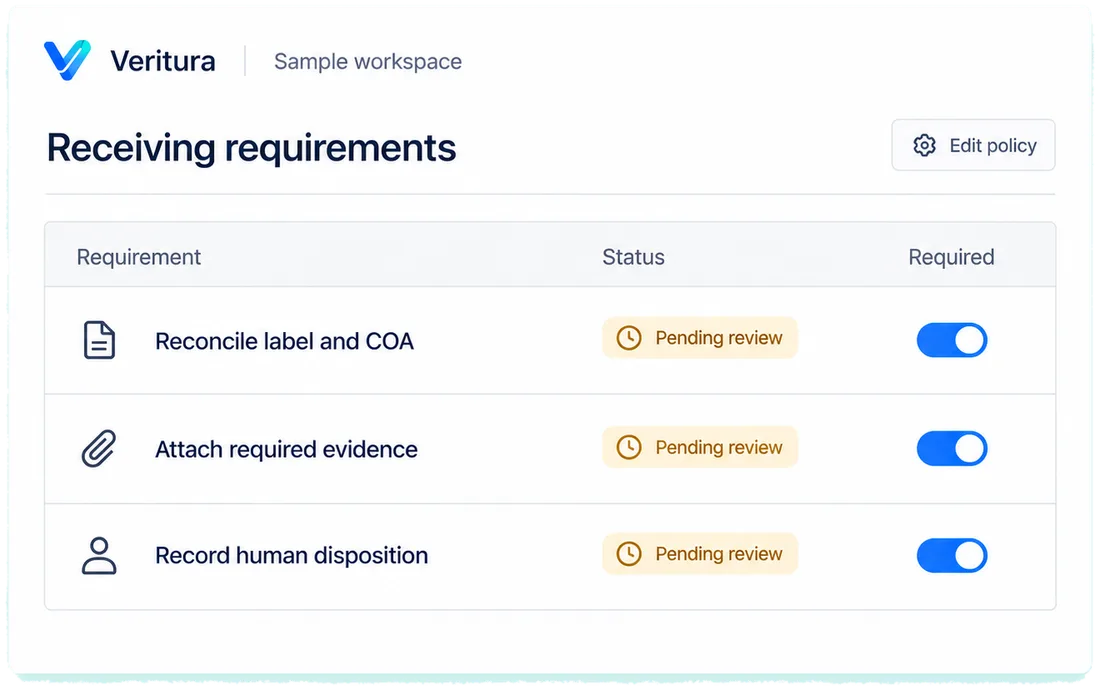
  1. Supplier, product and lot number are entered. All three are required; without them there is no lot to attach the record to.

  2. The container label is photographed. The engine reads it and containment-matches the paperwork's product, strength and lot against the text.

  3. The server fills in what it already holds: whether a supplier qualification file exists, whether a certificate for this lot was already read, and which panels are even in scope for this preparation.

  4. Seven gates evaluate, one of four dispositions is written with the lot state it produces, and a draft correction request is composed from the specific gaps found.

  5. The lot stays mapped against FDA enforcement records pulled on a cycle, so a record published months later still reaches it.

A person still decides. A label-to-paperwork mismatch stays the operator's explicit call, a photo that could not confirm a field records as unconfirmed rather than as a mismatch, and a hand-set Present with no evidence attached records as claimed-unverified.

How it works for you

Three steps, then it runs itself.

  1. 01

    Scan it in

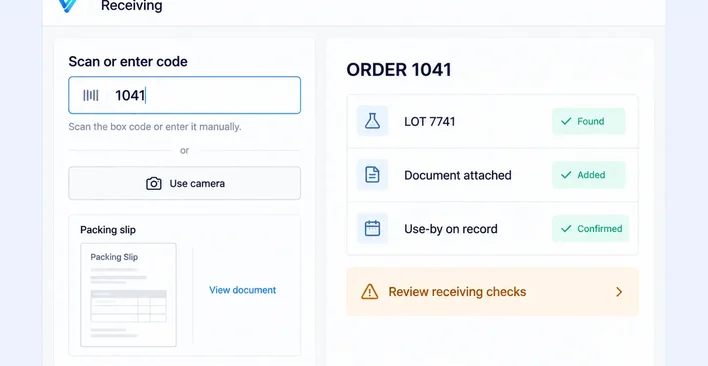
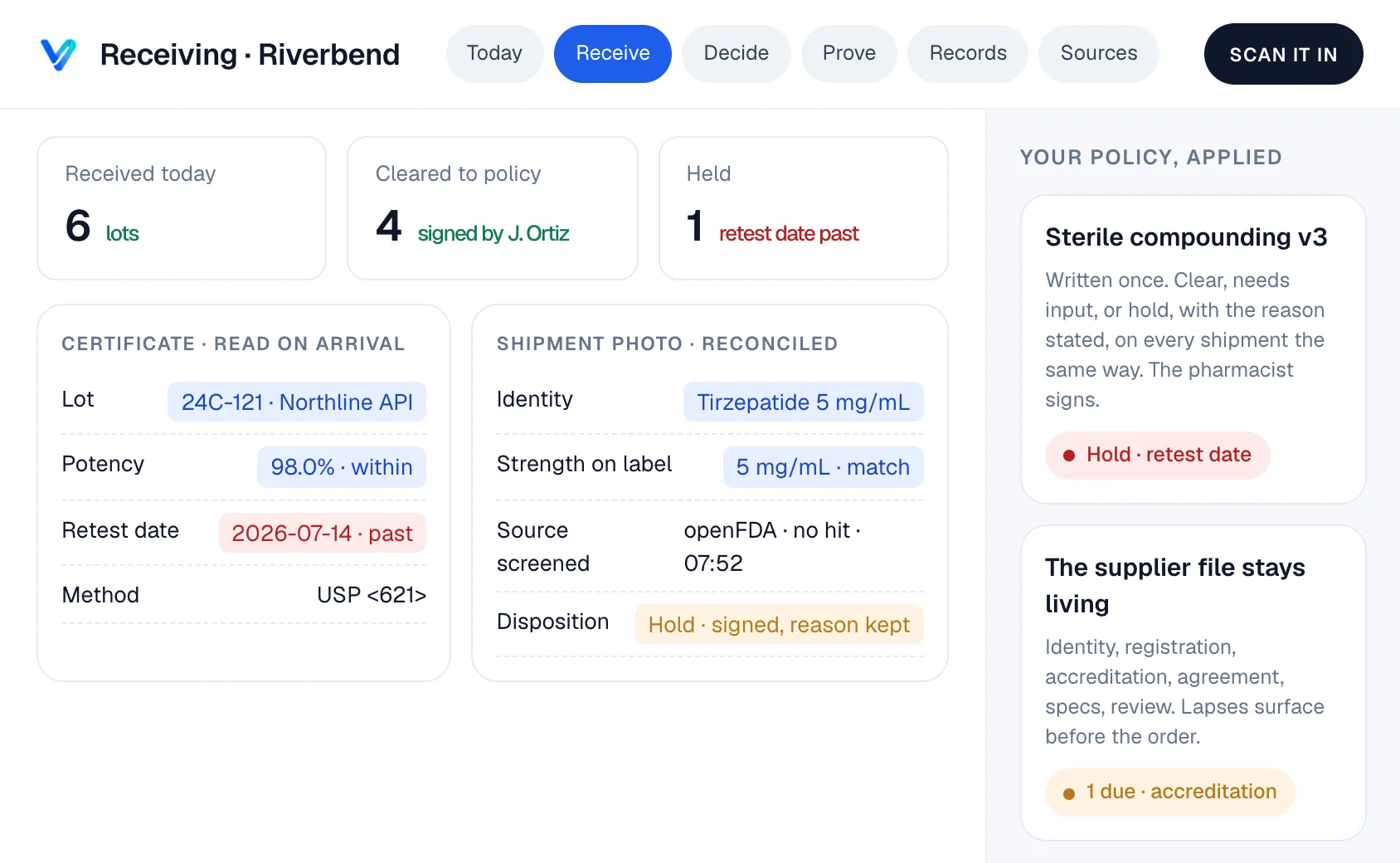
    Photograph the COA and the shipment. Veritura reads it, reconciles identity and strength, and screens the source against FDA enforcement.

  2. 02

    Clear it to your policy

    The lot clears, needs input, or holds, against the written policy you set. One click, on the record.

  3. 03

    Keep it watched

    Every cleared lot is rechecked against live FDA recalls for as long as you hold it. You hear it first.

One shipment, from the dock to the vial.

Nine stops in the order the product performs them. Each one names who acts, what the system does with what it already holds, and the state it leaves on the record.

  1. Operator

    A shipment lands on the bench.

    Supplier, product and lot number are entered. All three are required; without them there is no lot to attach the record to.

    400 identity_required when any of the three is missing.

    Record state: Receiving record started
  2. Operator

    The container is in hand.

    The operator photographs the label. The engine reads it and containment-matches the paperwork's product, strength and lot against the text. The photo-read tier is earned server side under a one-time token bound to the account and to that lot, never echoed by the browser.

    The token expires in an hour and is kind-scoped, so a temperature-report token can never dress the label gate.

    Record state: Label gate tier earned, or left at attested
  3. Engine

    The form is submitted.

    What the server already knows is filled in before deciding: whether a supplier qualification file exists, whether a certificate for this lot was already read, and which panels are even in scope for this preparation. Only blanks are filled; an explicit operator entry always wins.

    Out of scope is not a gap. A non-sterile topical was being quarantined for sterility and endotoxin it never needed.

    Record state: Gate inputs resolved
  4. Engine

    Gate inputs resolved.

    The seven gates evaluate and one of four dispositions is written with the lot state it produces. A draft correction request to the supplier is composed from the specific gaps found.

  5. Engine

    The record is saved.

    The lot is upserted from the receipt. A clean receiving release does NOT lift an existing flag when a recall still stands, when the flag was routed for human review, or when a high-severity documentation finding stands: a receipt cannot answer a document finding, a corrected certificate can.

    A re-receipt that comes back quarantine or correction supersedes an earlier auto-clear until the gates pass again.

    Record state: Lot state updated, with the reason written into its history
  6. Your policy

    New evidence landed on the lot.

    When the account's policy has auto-decide on, ClearGate re-runs against the lot immediately and stores the signed decision, through the same path a manual run uses.

    Record state: ClearGate decision recorded on the lot
  7. Operator

    An order ships, from the workspace or from the API.

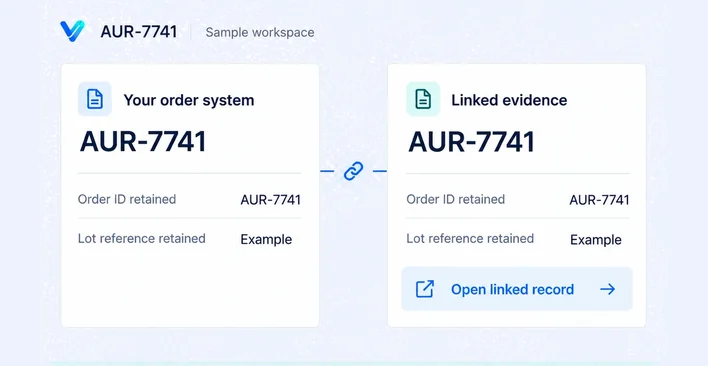
    The order is written with its lot number. The lot is resolved by number within the account and stamped as an exact reference. An ambiguous lot number matching several lots is refused, never guessed.

    Record state: Passport record created
  8. Engine

    Release is attempted.

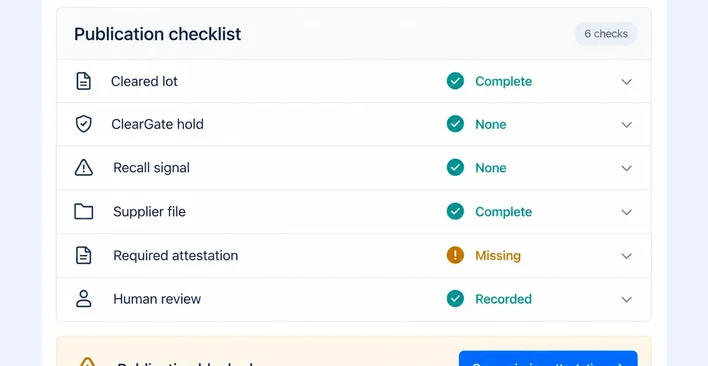
    The floor is checked: the lot must exist, be cleared, carry no ClearGate hold and no recall signal, and satisfy any human-review or ClearGate-Allow requirement the policy sets.

    A live recall blocks the mint on its own, independent of state, so the gate never rests solely on clearGateHold.

    Record state: Release authorized, or a 409 naming the unmet requirement
  9. Operator

    A lot is ready to go out the door.

    Serials are minted against that lot in the shape VS-XXXX-XXXX, collision-checked against every serial already issued and against the batch's own output. When order references are supplied, each serial is bound one-to-one to one order at mint time.

    The binding is the right-patient guarantee, and it is PHI-free: order references only, no patient identity exists to mis-route.

    Record state: Seal batch created
  10. Operator

    Packing.

    The label goes on the vial. Where serials were bound to orders, packing becomes the same label-to-packing-slip match the pharmacy already performs for addresses.

    Record state: Vial sealed

Documentation receiving gate only. This is not a product quality, safety, efficacy, compliance, or FDA-approval determination.

What suits you

Every feature closes a gap you have today.

  • One-scan receiving

    The mandatory receiving examination is a person opening a PDF and copying fields into a binder. Veritura reads the COA and the shipment photo, reconciles identity and strength, screens the source, and files it.

    A 60-second scan instead of a binder chore, and the record is kept for you.

  • ClearGate policy clearance

    Whether a lot may be used is a judgment call made and re-made by whoever is at the bench. Veritura runs each lot against the written policy you set and returns Allow, Review, or Hold, with the reason on the record.

    Your release policy, applied the same way every time and signed.

  • Supplier qualification file

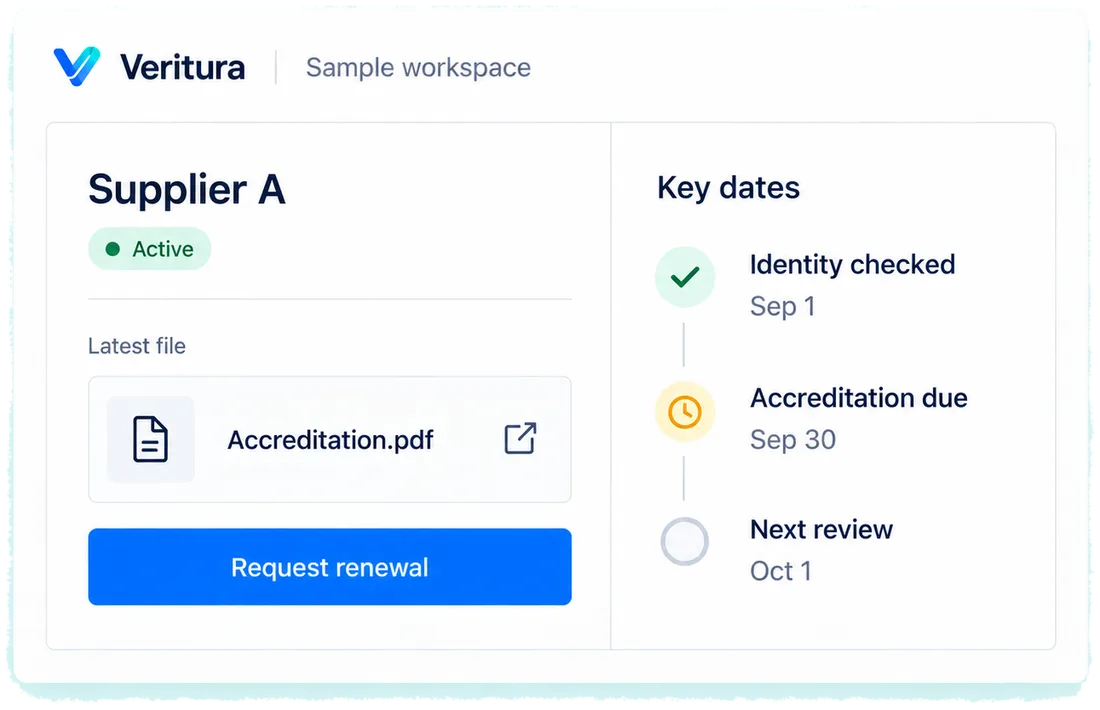
    The file a board inspector asks for goes stale the moment someone stops maintaining it. Veritura keeps each source's identity, FDA registration, accreditation, and history current and re-checked on a cadence.

    Always ready to hand over, with nobody re-typing it.

  • The Living Formulary

    Whether a substance is still eligible to compound shifts as the FDA lists change, and nobody re-checks the file you built last year. Veritura re-verifies each substance against the current lists every day.

    You are told when a substance's status moves, not months later.

  • Lot recall watch and monitoring

    A recall on a lot you cleared last quarter is invisible until it reaches you the hard way. Veritura rechecks every cleared lot and every supplier against live FDA recall and enforcement records continuously.

    You find out before it becomes your problem.

  • Evidence Passport

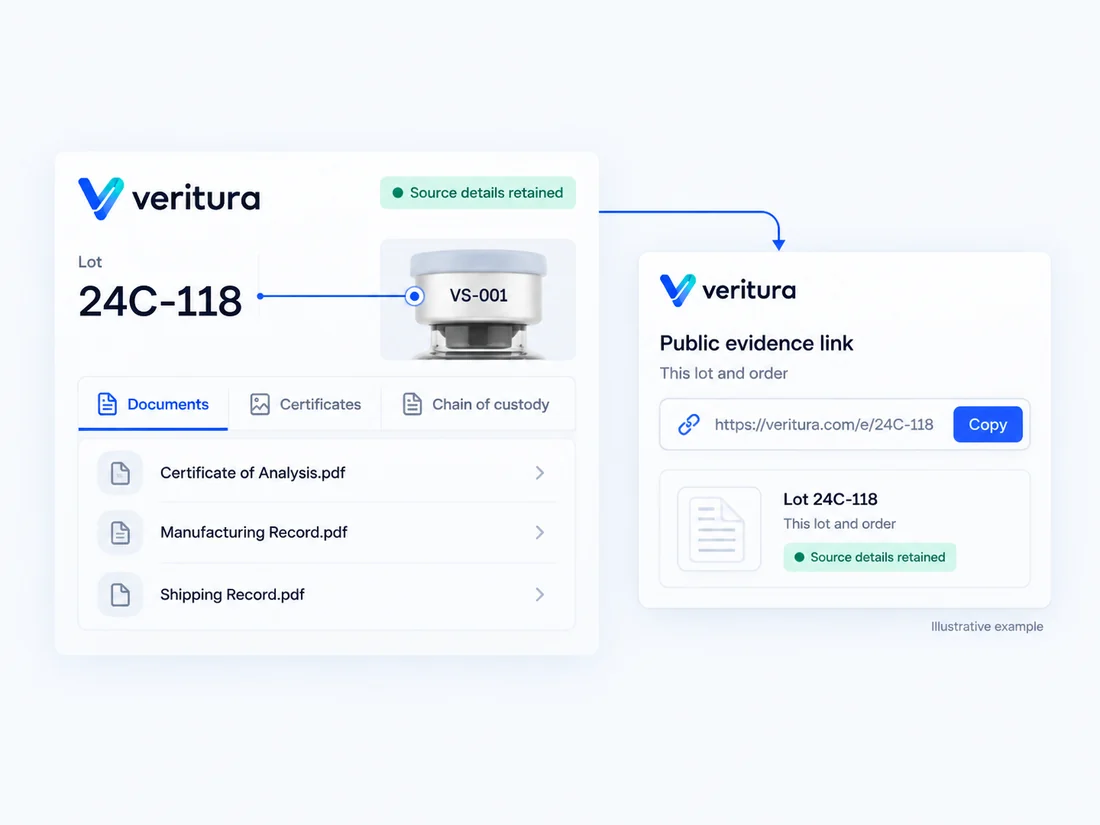
    When a buyer or an inspector asks you to prove a lot, you go digging. Veritura gives you one verifiable link, backed by the lot's real documentation.

    The proof on demand, that a gray-market seller cannot produce.

  • Inspection-readiness binder

    An inspection means assembling the whole file under pressure. Veritura keeps a Board-Ready binder built from your live records, ready to export the moment you need it.

    Inspection day is a download, not a two-day scramble.

  • Veritura Seal

    If a lot goes bad you cannot reach the patients who received it. Veritura's serialized vial labels let a patient claim their vial, so a recall can reach the person, PHI-free.

    The recall reaches the patient, not just your shelf.

What you can skip: You do not need the brand-claim tools or the telehealth API. This is the receiving, sourcing, and inspection desk for your bench.

At the loading dock

The intake gate for each shipment.

Match the label to the paperwork, read the micro evidence, and set the lot state before anything moves downstream.

  • Label vs COA match
  • Sterility and endotoxin read as evidence
  • Sets the lot state
  • Documentation release support only

Snap the delivery paperwork

the fast path: one photo, no typing

Photograph the COA or packing slip that came in the box. The document engine reads the supplier, product, and lot, runs the same receiving gate as the form, and hands back the shelf answer, RELEASE or QUARANTINE, with a printable green or red shelf tag for the tote.

The seven gates, in the order they evaluate

  1. 01

    Vial label matches paperwork

    matched - photo read · matched - operator attested · not checked · blocker

    A photo that could not confirm a field is 'unconfirmed', never a hard mismatch. Absence of proof on a photo is not proof of conflict, so the hard mismatch stays the operator's explicit call and a photo can only ever raise the tier.

  2. 02

    COA attached or referenced

    present · missing

    The lot's own document set counts. If a certificate for this lot was already read, the gate resolves it rather than asking the operator to re-supply what they just supplied.

  3. 03

    Supplier packet linked

    on file · claimed - not on file · not linked

    A real lookup, not the operator's word. A ticked checkbox with no qualification file on record is surfaced as claimed-but-not-found.

  4. 04

    Sterility

    present · present - unverified · not applicable · not tested · missing

    When the COA text is attached, the result is read off it rather than taken from a typed status. A panel out of scope for the preparation is marked not applicable, never counted as a gap.

  5. 05

    Endotoxin

    present · present - unverified · not applicable · not tested · missing

    Same read-it-rather-than-ask-it rule as sterility.

  6. 06

    Temperature evidence

    documented - report read · excursion stated - report read · present · missing · not required

    An uploaded data-logger report outranks the typed status and its own stated outcome is quoted verbatim. A stated excursion becomes a documentation gap for review rather than being absorbed by a typed 'present'.

  7. 07

    FDA-source / enforcement screen

    clear · clear - unverified · review · not checked · hit

    A hit is a hard blocker. 'Clear' with no screen terms attached is reported as clear-unverified, not clear.

What the gate returns

What enters

One arriving shipment

Supplier, product and lot number are entered. All three are required; without them there is no lot to attach the record to.

What runs

Seven gates evaluate

What the server already knows is filled in before deciding: whether a supplier qualification file exists, whether a certificate for this lot was already read, and which panels are even in scope for this preparation. Only blanks are filled; an explicit operator entry always wins.

One of these four

  • Receiving disposition: Documentation release ready

    No hard blocker, a COA present or referenced, no micro gap, and temperature evidence not missing.

    Lot: cleared

  • Receiving disposition: Request supplier correction

    A soft gap only: label match not checked, no supplier qualification file on record, or the source screen not attached.

    Lot: pending_review

  • Receiving disposition: Quarantine pending evidence

    No COA attached or referenced, a sterility or endotoxin gap, or temperature evidence expected and missing.

    Lot: pending_review

  • Receiving disposition: Hold for human review

    A hard blocker: the operator recorded a label-to-paperwork mismatch, or the FDA source screen returned an enforcement hit.

    Lot: flagged

Earned, not claimed.

  • A hand-set Present with no pasted evidence records as claimed-unverified and quarantines the lot.
  • Run the source screen to earn a verified Clear. A hand-picked Clear records as claimed-unverified.
  • Photograph the container label and the engine reads product, strength, and lot itself, upgrading that check from your word to a machine read.
  • Attach the temperature report and the engine reads the report's own stated outcome, clean transit or excursion, quoted verbatim on the gate.

Boundary

Documentation receiving gate only. This is not a product quality, safety, efficacy, compliance, or FDA-approval determination.

Release

One decision per order, against the policy you set.

ClearGate reads the file and your configured policy and returns one decision when an order is placed. You set the bar; we keep the record.

ClearGate: Allow
Meets your policy
ClearGate: Review
Needs review
ClearGate: Hold
Does not meet policy

A ClearGate decision always means the documentation meets your policy. It never means Veritura approves the supplier.

What runs when an order is screened

  1. Your policy

    An order is screened, a check is saved, or a shipment is received.

    ClearGate evaluates. When the policy has auto-decide on, no one has to click Run; the trigger is recorded but the record produced is identical to a manual run.

    Record state: Evaluation started
  2. Engine

    Evaluation started.

    The supplier qualification file and the lot are read against the policy. Hold beats review beats allow. Every reason carries the policy rule code that produced it.

  3. Engine

    A decision exists.

    The decision is signed and hash-chained to the one before it, with the policy version pinned inside the record.

    Record state: Signed decision on the chain
  4. Engine

    The decision is stored.

    A hold stamps clearGateHold on the lot, which blocks the passport on its own. A later allow or review clears that hold; the signed record itself is never mutated.

    Record state: clearGateHold set or lifted

ClearGate reports documentation conformance against the policy the customer wrote. The customer owns the policy; Veritura owns the verification. A decision is never a product pass, a safety statement, or an approval.

Every reason names the rule that fired.

The evaluator returns codes, not adjectives. Hold beats review beats allow, and a decision replays from the stored evidence and the pinned policy snapshot to the identical label and reasons. Every Hold and Review code, and what each one means, is listed against the decision that emits it on the ClearGate page.

Presets, or your own rules

Strict, Standard, and Lenient presets on the Clinic plan. Per-rule toggles, thresholds, and operator-attested items on Facility, with a tamper-evident signed decision log either way.

Honest by construction

Every element is labeled Veritura evaluated, read from the document or a public source, or Operator attested, where you confirm what we cannot read. The file never overstates what was checked.

Replay it later

The stored evidence and the pinned policy snapshot are fed back through the same evaluator. A correct decision replays to the identical decision, label and reasons; anything else means the record was altered.

All three re-run automatically when new evidence arrives. Only Strict withholds the release: Standard and Lenient release a passport the moment the policy allows it, Strict keeps that click with a person.

What an inspector sees

An inspection is a print job, not a panic.

Know today how much of a records request you could hand over. Coverage counts against named references, never a compliance determination.

  • Coverage percentage right now
  • Recall Drill
  • Daily coverage snapshots
  • One-click binder

Board-Ready inspection packet

One click pulls your lots, suppliers, issued passports, and any FDA enforcement or recall exposure into one inspector-ready PDF, organized for a board or FDA records request. Documentation diligence only, not a determination of compliance.

The Living Formulary

Every substance you compound as one living record, so an FDA list change never reaches you weeks late through a newsletter.

  • Verified daily vs the FDA lists
  • Change-day alerts
  • Lots and signed decisions attached
  • 503B worksheet export

The six-element supplier qualification file

A qualification file is the file you keep on each supplier, and a state-board inspector grades it as a living system, not a one-time onboarding folder. Veritura builds the file as six structured elements, keeps each dated document current, and gates every order against it.

  1. 01

    Manufacturer identity

    Legal name, address, FDA registration and FEI number, confirmed against the openFDA registration snapshot when one is available, marked on file when it is not.

  2. 02

    Accreditation

    NABP, VAWD, or equivalent held with its effective and expiry dates, so a lapsed certificate surfaces on the file before an order goes out against it.

  3. 03

    FDA registration status

    Registration and listing checked against live openFDA enforcement and recall feeds, with any hit on the firm surfaced directly on the file.

  4. 04

    Quality agreement

    The signed quality agreement and its renewal date are held on the file and tracked the same way as every other dated document you rely on.

  5. 05

    Documentation specs

    Your required COA panels and document standards for the supplier, evaluated against what each packet actually contains, not assumed.

  6. 06

    Ongoing review

    A review cadence with a next-review date, so the file carries a living current, due, or overdue status instead of a stamp.

What you hand over

One record you send, one sticker you apply.

They are two products that happen to describe the same lot. The Passport is a record you send. The Seal is a sticker you apply.

Evidence Passport

When a buyer or an inspector asks you to prove a lot, you go digging. Veritura gives you one verifiable link, backed by the lot's real documentation. The cleared lot is the gate, so an uncleared lot can never publish a passport.

$3 per production Passport, or $0.50 each on a volume agreement at 500 or more per month. Sandbox records are free for testing.

Veritura Seal, on the vial

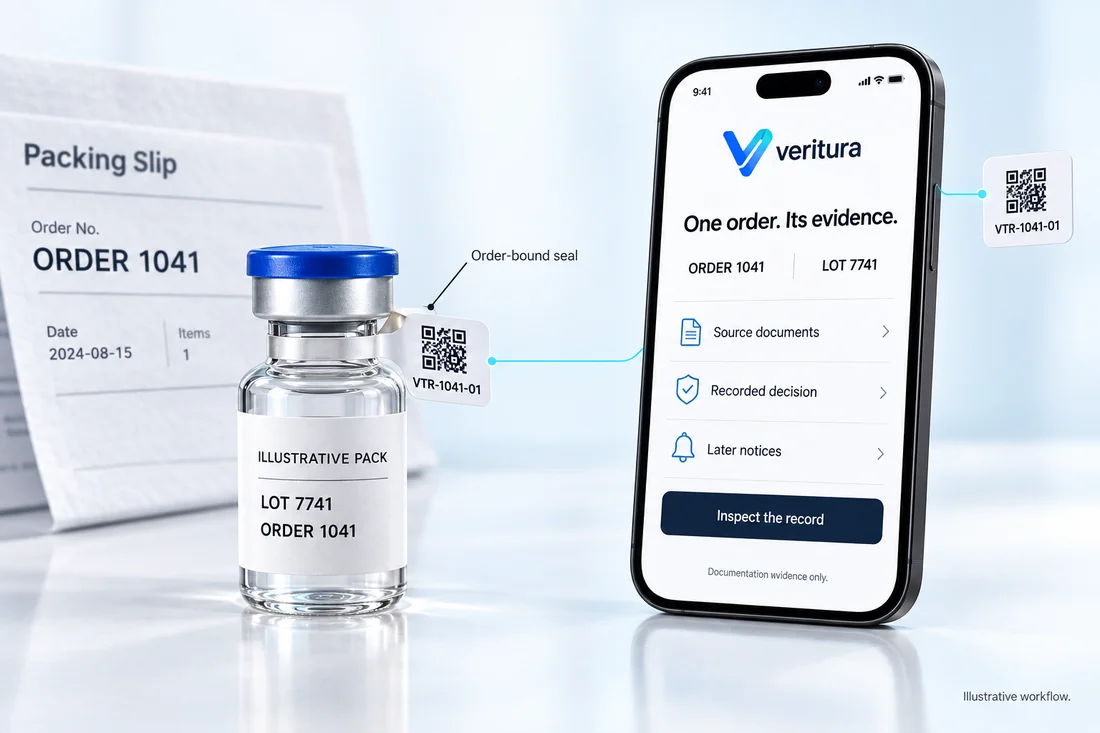
A serialized QR code printed onto the vial label itself, one per unit, from a label sheet or straight to a label printer. The patient scans the vial in their hand. Nothing to email and nothing loose in the box.

Shipping to orders
Ship orders mints one seal per order with the order number printed on the sticker, plus the passport and a bag slip. Match sticker to packing slip, and the patient's scan shows their own order.
Sealing stock
From any lot record: up to 500 lot-level labels at a time, printed as Avery 5160 sheets, a thermal roll, or raw ZPL straight to your label printer. The API mints them from your own system too.

The recall reaches the patient, not just your shelf.

What the record carries, region by region.

A passport is minted from a lot, never from a claim, and every element on it says who established it.

  1. The Evidence posture panel

    The document set for this lot's subject and dosage form is complete, it carries no unresolved high-severity finding, and the lot has a named supplier and lot number. That cleared lot is the gate: a release attempt on an uncleared lot comes back with the name of the unmet requirement instead of a published record.

    Evidence posture: Clear

  2. The Certificate of analysis panel

    An outside record answered. Either a registration matched a current FDA record, or the issuing laboratory's own recorded reply resolved the document. Only the laboratory's reply ever sets confirmed.

    Evidence origin: Source-confirmed

  3. The Lot field

    The passport is bound to the lot it was minted from, and the binding is permanent. That is what lets an FDA enforcement record published months later reach a passport that is already in a buyer's hands.

  4. Documents on file

    Every row carries the origin that established it. Operator attested means a person stated it and the record stamps who and when; reading the document behind an attestation still never verifies the practice behind it.

  5. The Share action

    Sharing publishes the record at a public verify reference. That page prints the read, the laboratory and the date, and states documentation completeness in plain words with no number. A number beside the name of someone's medicine reads as a quality grade, which it is not.

    Shown to the patient or buyer: Documentation reads complete

An Evidence Passport publishes what the documentation for a lot states and where it came from. It is not a certificate of quality, an approval, or a statement about the medicine.

Sample workspace · not a live account

Evidence Passport

Semaglutide (base) API

V-SBX-00013

Evidence posture

Evidence posture: Clear

The document set met the configured policy. It describes the paperwork, not the medicine.

Certificate of analysis

Source-confirmed

The issuing laboratory confirmed issuance through the recorded verification route.

Order
PO-DEMO-0413
Lot
LOT-7741-A
Supplier
Aurora Pharma Supply
Quantity
250 g
Received
July 22, 2026
Released
July 23, 2026
Passport issued
July 23, 2026
Methodology
v1.0 · April 30, 2026

Documents on file

6

  • Certificate of analysis

    COA-7741-A.pdf · Issuing laboratory confirmed issuance through the recorded route

    Source-confirmed
  • Certificate of conformance

    CoC-7741.pdf · Required identity, lot, and date fields present

    Veritura evaluated
  • Safety data sheet

    SDS-SEMA-04.pdf · Current revision on file

    Veritura evaluated
  • GMP certificate

    GMP-AUR-2026.pdf · Supplied by the operator

    Operator attested
  • Receiving inspection

    Recorded in workspace · Container and label checked at receipt

    Operator attested
  • Shipment label

    LBL-7741-A.jpg · Lot identifier matches the certificate of analysis

    Veritura evaluated

What this record does not establish

  • Documentation diligence only. No product was tested and no supplier was approved.
  • Absence of a public-source match is not proof of absence.
  • Produced under methodology v1.0, April 30, 2026.

When a signal lands after release.

Recent FDA drug enforcement records are pulled inside a rolling window and scanned for lot numbers the system already knows. Only distinctive lot numbers are eligible: a short all-digit number needs six or more digits and must not be date-shaped, because those appear constantly in enforcement texts as catalog numbers and dates, and a false recall flag on a real customer lot is far worse than a missed fuzzy match.

  1. Engine

    Enforcement records in hand.

    Each record's code info and product description are scanned for known lot numbers. A match must sit on a token boundary, so '1305' can never match inside '213055'. A product hint keeps two unrelated suppliers reusing the same lot number from being conflated.

    Record state: Matched lots identified
  2. Engine

    A lot matched.

    Every matching lot, in every account that logged it, flips to flagged and carries the recall signal with its hits, confidence, detail and the lot number that matched.

    Record state: Lot: flagged
  3. Engine

    A flagged lot has passports minted from it.

    Every passport bound to that lot is stamped with a post-release recall signal. Stamping is idempotent: the record stays in the FDA window for its whole duration, so a repeat sweep refreshes the existing signal in place rather than stacking duplicates.

    The passport stays bound to its lot forever, which is what lets a later recall reach it at all.

    Record state: Passport carries a post-release signal and a recall exposure line
  4. Operator

    The operator decides to tell the people holding the product.

    One button reaches every active claimant on that lot's seals. The pharmacy makes the call; the software does not send to patients on its own.

    Record state: Vial holders notified

What a recall signal blocks: A lot carrying a recall signal mints no new passport and releases none, independent of every other state on the record.

A lot-number match against public FDA enforcement data is a documentation and enforcement signal, never a safety or approval determination. A lot number can be reused across firms, so the firm identity and the lot must be confirmed against the FDA record.
Where it runs

The 503A lane.

Free
$0 one no-card previewStart here
Clinic
$99 per monthA single 503A pharmacy
Facility
$399 per monthBusy 503A and 503B operations

What each one carries. Clinic Starter at $49 per month is unlimited document review and the full evidence record, and nothing else on this page. Clinic at $99 adds the Receiving Gate, supplier qualification files, ClearGate on the standard policy, FDA monitoring and lot recall watch, the board-ready binder, team seats, and Passport production. Facility at $399 adds the /v1 API with signed webhooks and custom ClearGate policy. Production Evidence Passports meter separately at $3 per order, or $0.50 on a volume agreement at 500 or more per month. Nothing here is bundled into a lower tier than the one it is listed under.

See pricing

Boundary

A COA check or Passport records whether the documents are complete and consistent. It is not a safety, quality, efficacy, legality, or FDA-approval claim.

Boundary

Veritura does not test medicine, approve suppliers, recommend purchases, or make medical, legal, product-safety, or FDA-approval determinations. There is no paid or subjective placement: suppliers cannot pay for a better result or a better position, no listing fee, no subscription, and no pay-to-rank. Where results are ordered rather than filtered, the order is set by a published documentation-coverage grade, and that grade is never a recommendation, a preference, or a statement about any product.

See it on your own documents.

Independent documentation diligence. No safety, quality, legal, or FDA-approval claims.