Consultants: 483 responses and inspection readiness, inside each client's own records.
Free for consultants. Your clients keep the records.
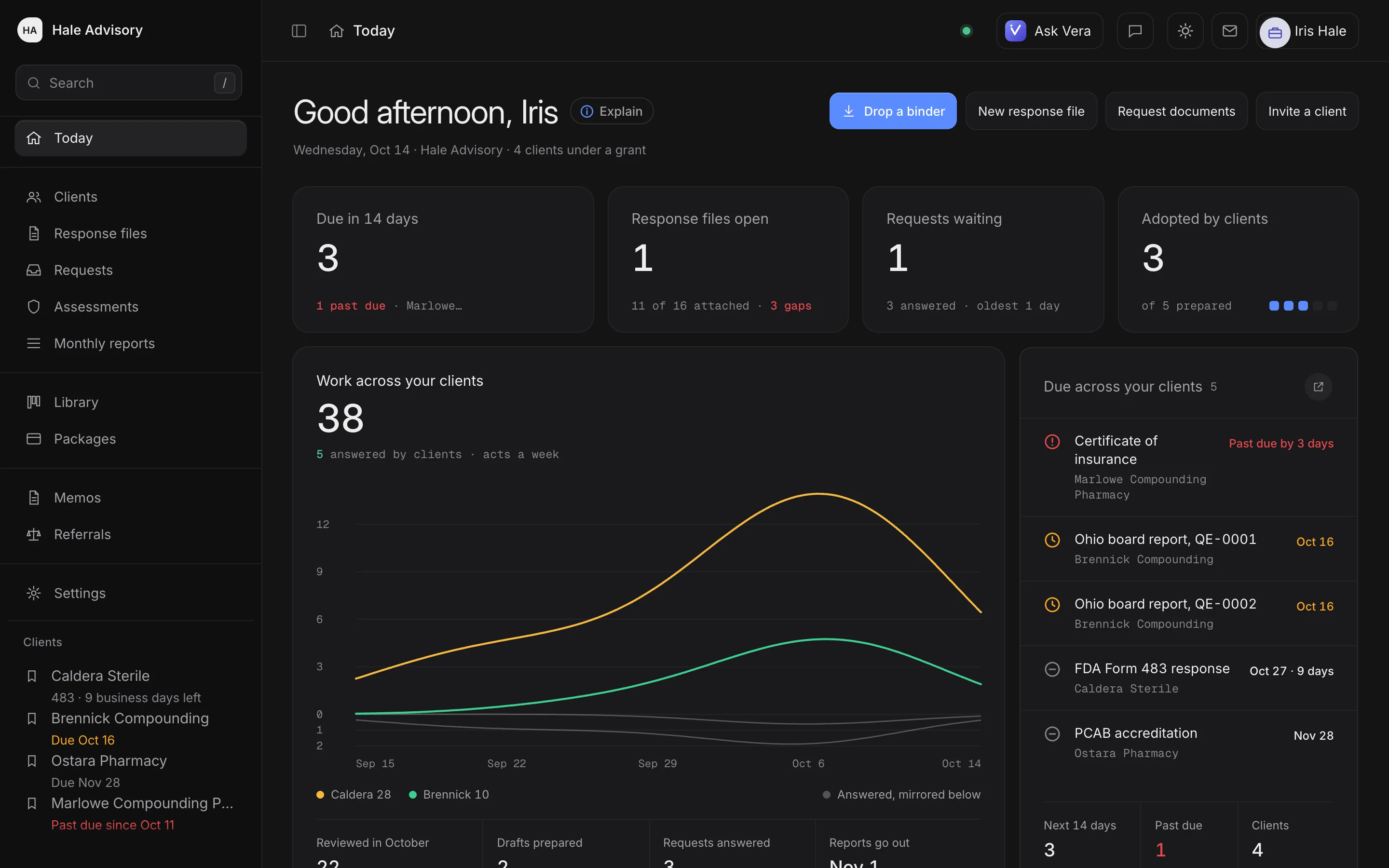
In 23 of 27 FDA warning letters to 503Bs since 2024, some fixes could not be fully evaluated. Not enough documentation.
FDA's words: “lack of adequate supporting documentation.” 26 of the 27 letters recommend a third-party consultant. Veritura Practice puts that consultant inside the facility's own records, so the supporting documentation travels with the response.
You prepare. The facility signs.
Four steps inside the client's own workspace, from the grant to one signed PDF, in the structure of FDA's March 2026 draft guidance on responding to a Form 483.
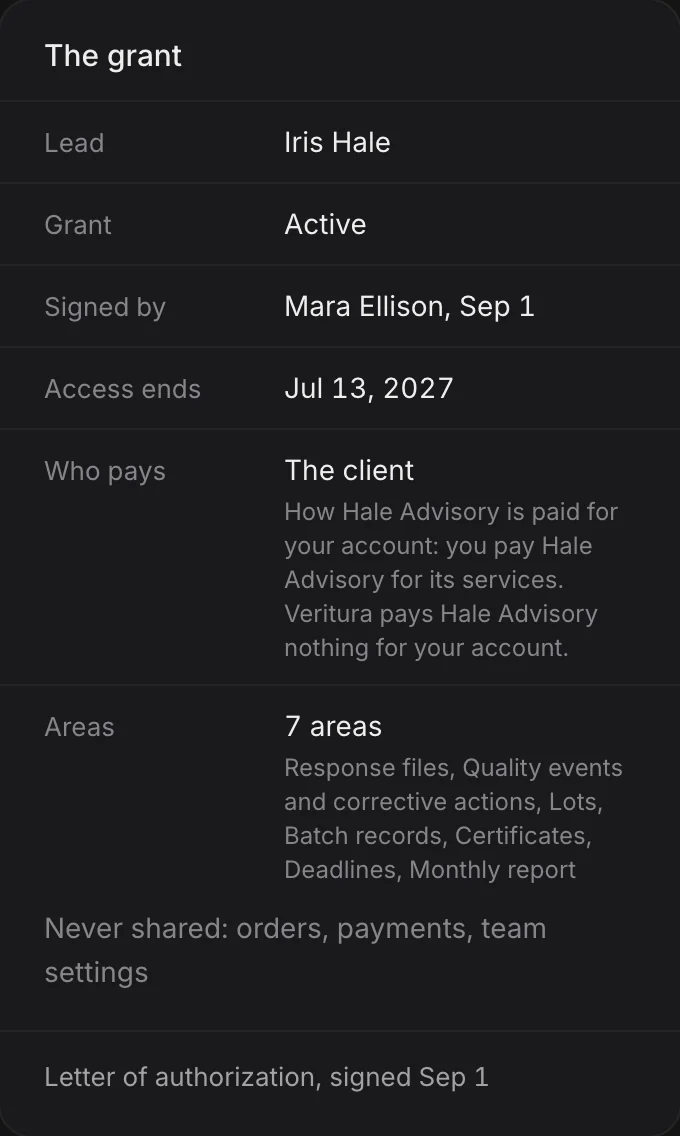
The client grants accessBy area, with an end date, in one signature.
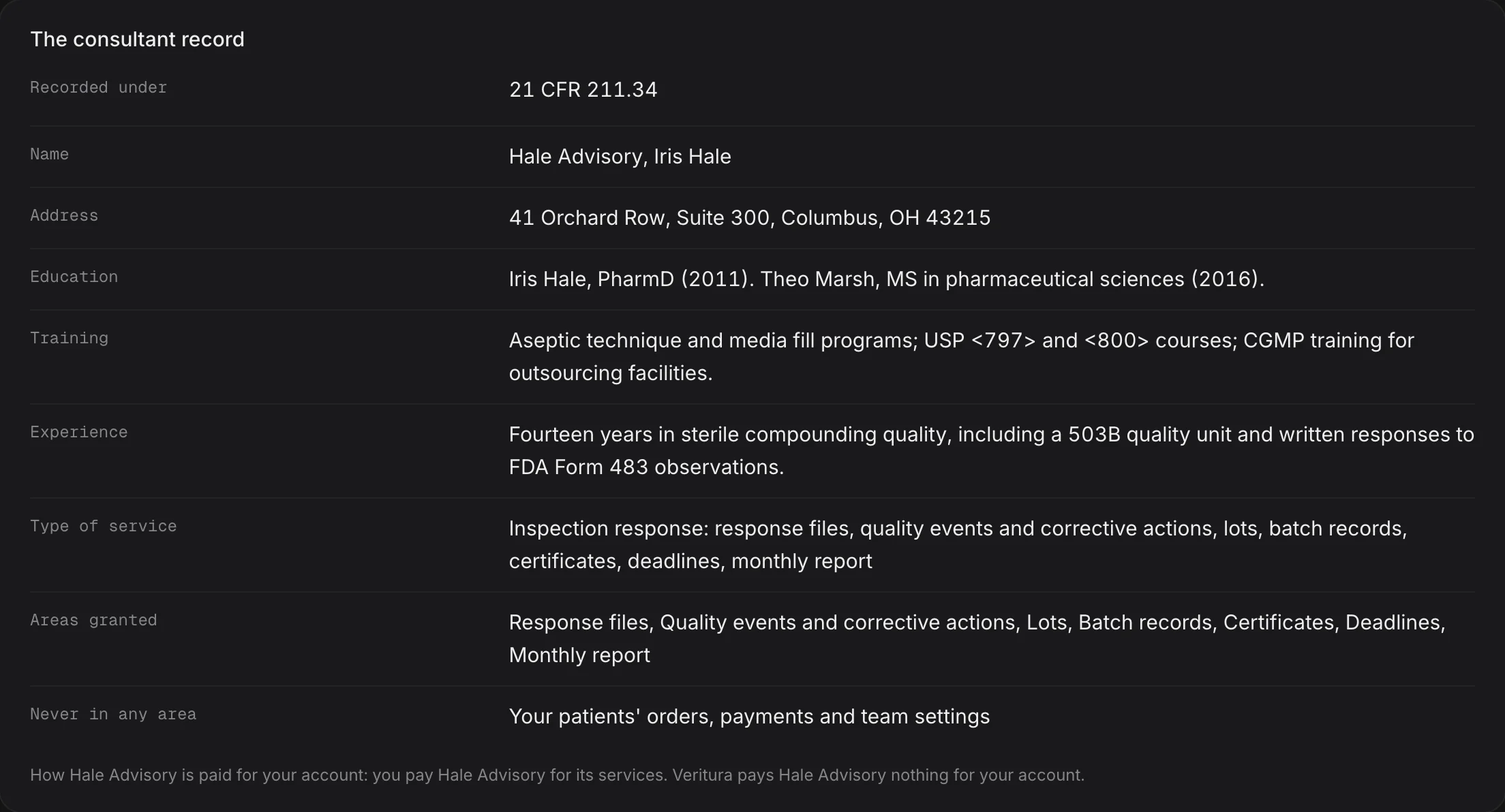
The facility's owner invites your firm and picks what the grant covers: inspection response, readiness monitoring or supplier qualification files. Signing it writes the consultant record 21 CFR 211.34 asks for, with your firm's name, address, qualifications and service, and the letter of authorization the draft guidance lists.
- Never the client's patient orders, payments or team settings
- The client ends it at once, with one signature
- Every request is checked against the grant, so ended access reads nothing
The binder is reviewedEvery page filed to the observation it answers.
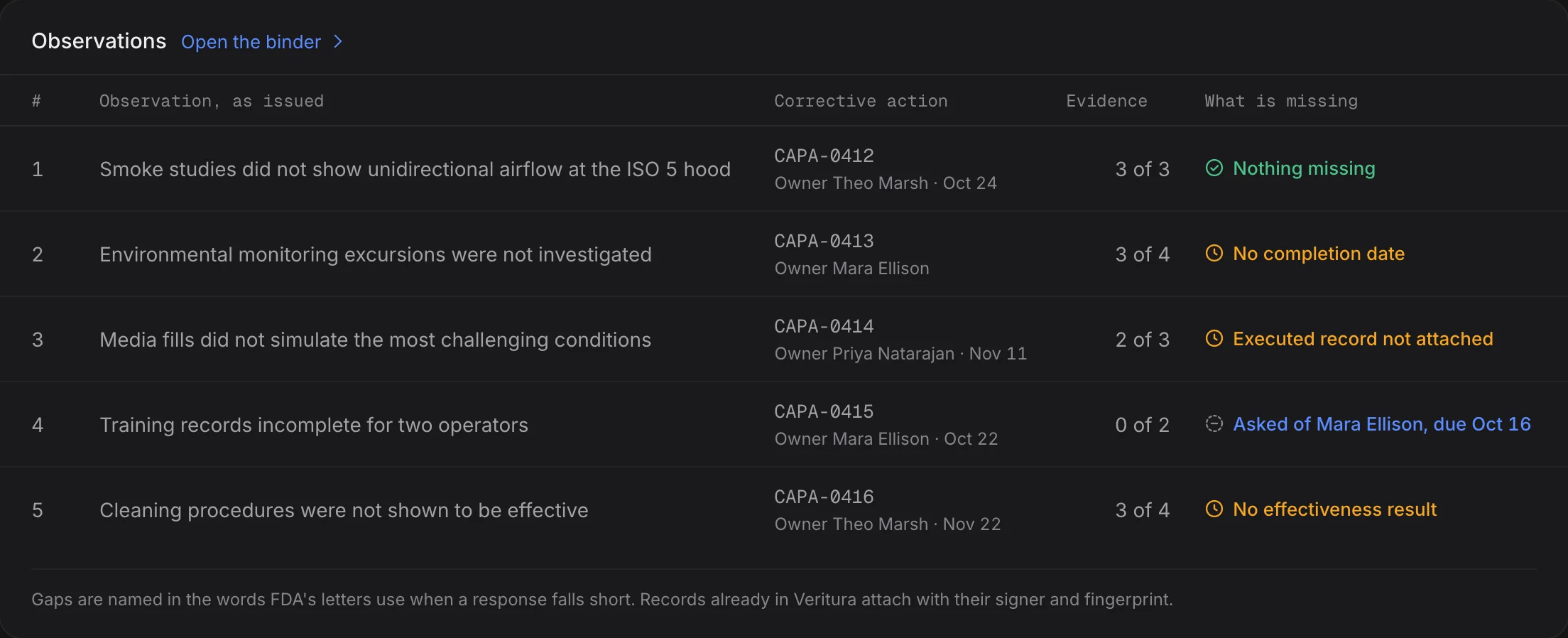
Drop the client's binder: batch records, training records, environmental monitoring, SOPs, investigations, the last response. Every page is filed to the observation it answers, with its page number, and checked for six defects.
- Unsigned, undated, or for the wrong lot
- A missing day in a dated log, or results dated before their protocol
- No effectiveness result after a change, and a person confirms each match before it is attached
Gaps are named, and asked forBefore the response goes out.
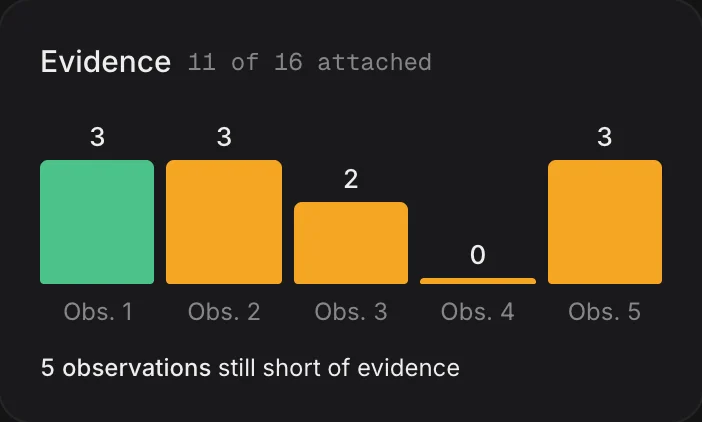
Each observation shows the evidence attached and names what is still missing, such as Executed record not attached, Training record not on file or No effectiveness result. A missing record becomes a request to a named person at the facility.
- Never asks for what is already on file
- Gentle reminders 2, 5, 9 and 14 days after asking, never more than five
- The answer files itself to the observation
Prepared, adopted, sentTwo signatures, one PDF.
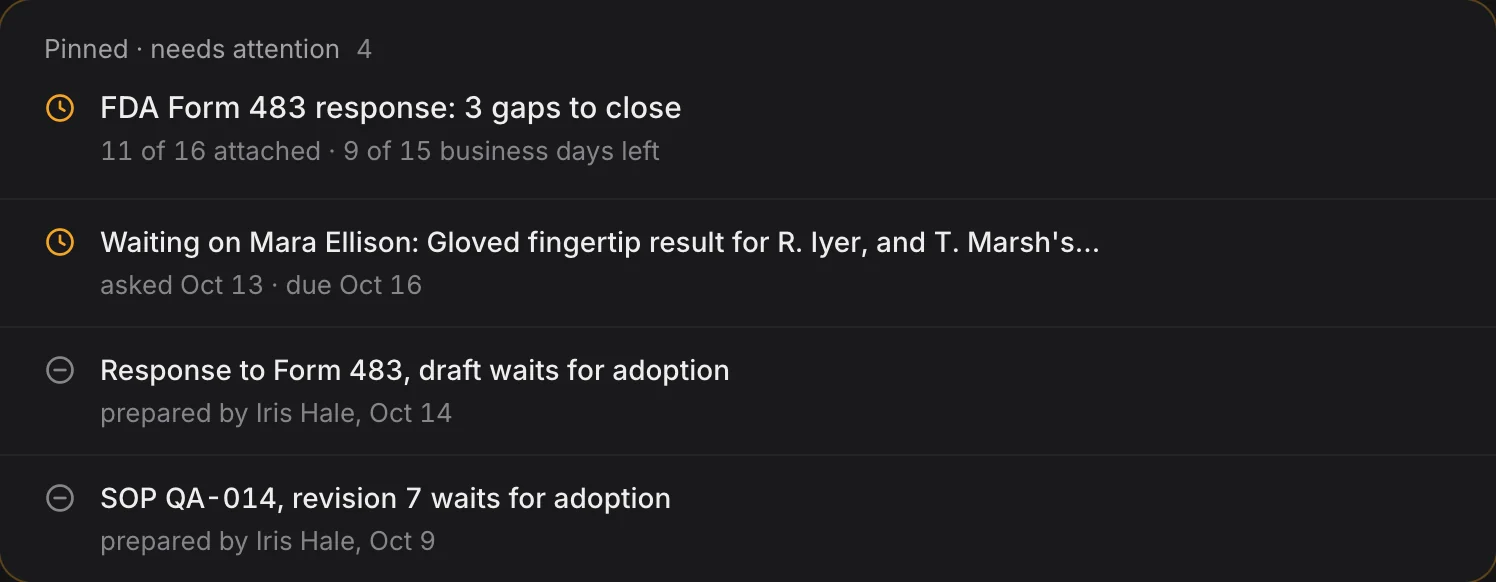
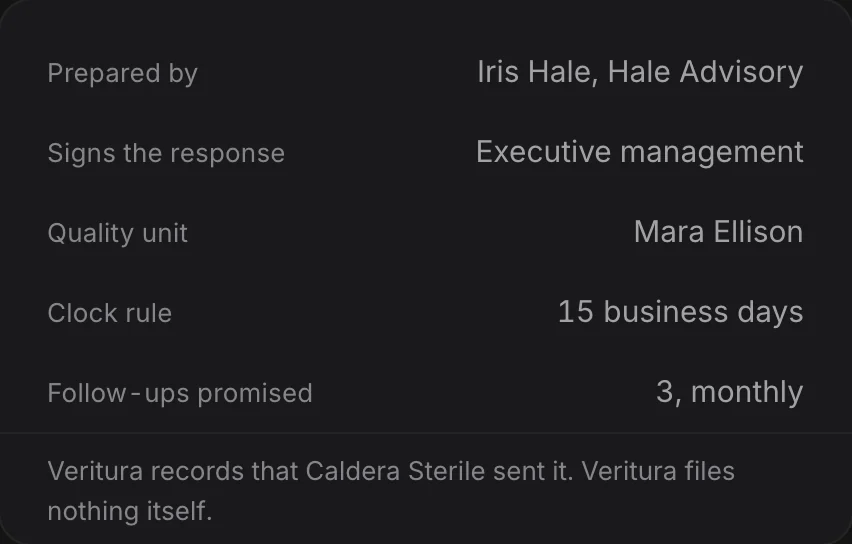
Vera, Veritura's assistant, drafts in the draft guidance's structure, from the evidence on file, and the draft says it was drafted by Vera. You edit it and sign as preparer. The facility's executive management signs the response, and the facility sends it.
- FDA's 15 business days counted, federal holidays excluded
- Signed attachments counted, and the lots within expiry listed for the risk assessment
- The file exports as one PDF; Veritura records that it was sent and files nothing itself
We keep the documentation. The judgment stays yours.
Beyond the 483, the same desk carries the recurring work.
Each regulator's clock, cited from its own text.
State forms prefilled from records: California 17M-39, Washington 690-296, Oregon.
Counted from the activity log, never typed.
Excursions first, renewal clocks, and each adopted SOP acknowledged by staff.
What lands on your desk, and what the client sees.
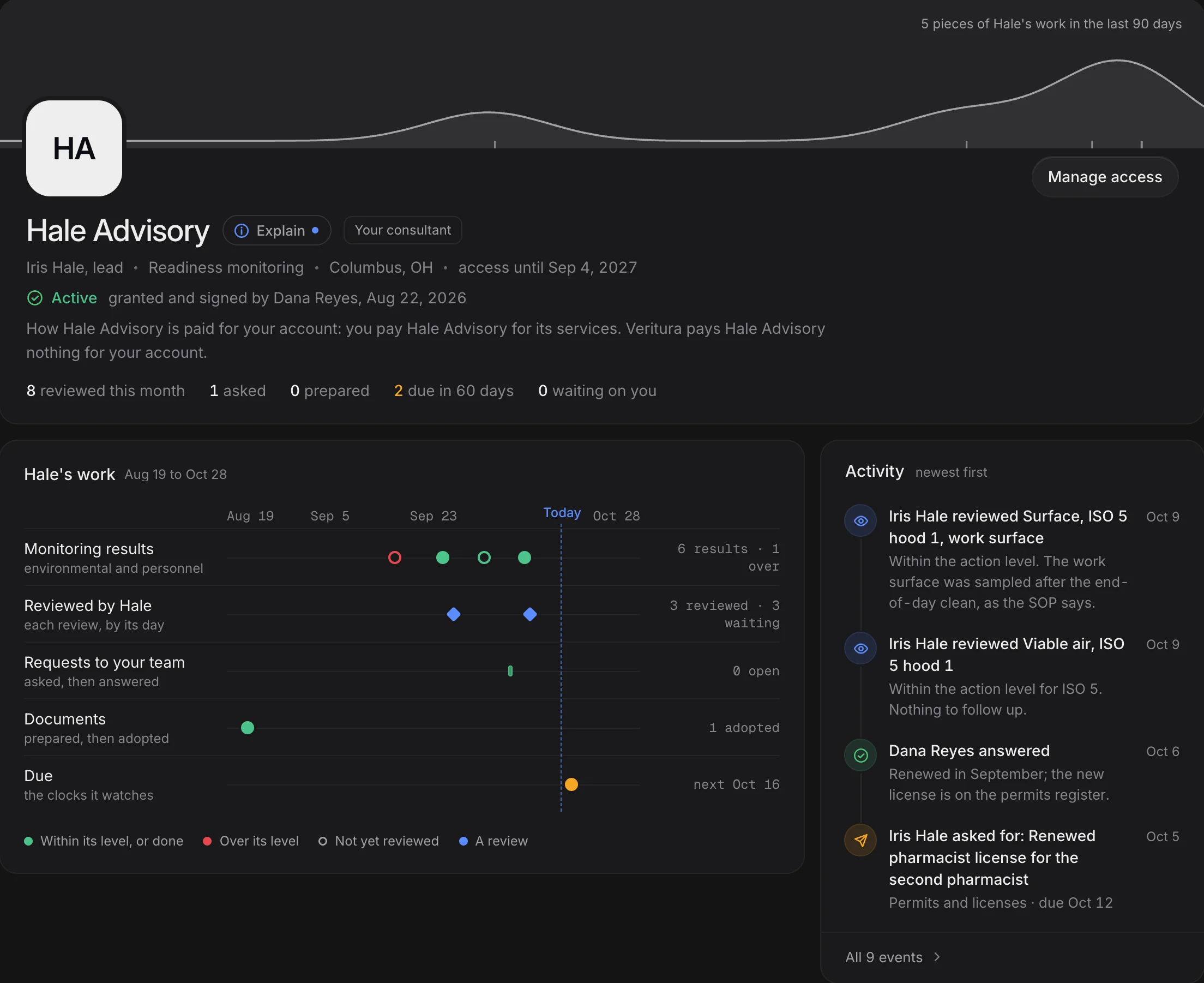
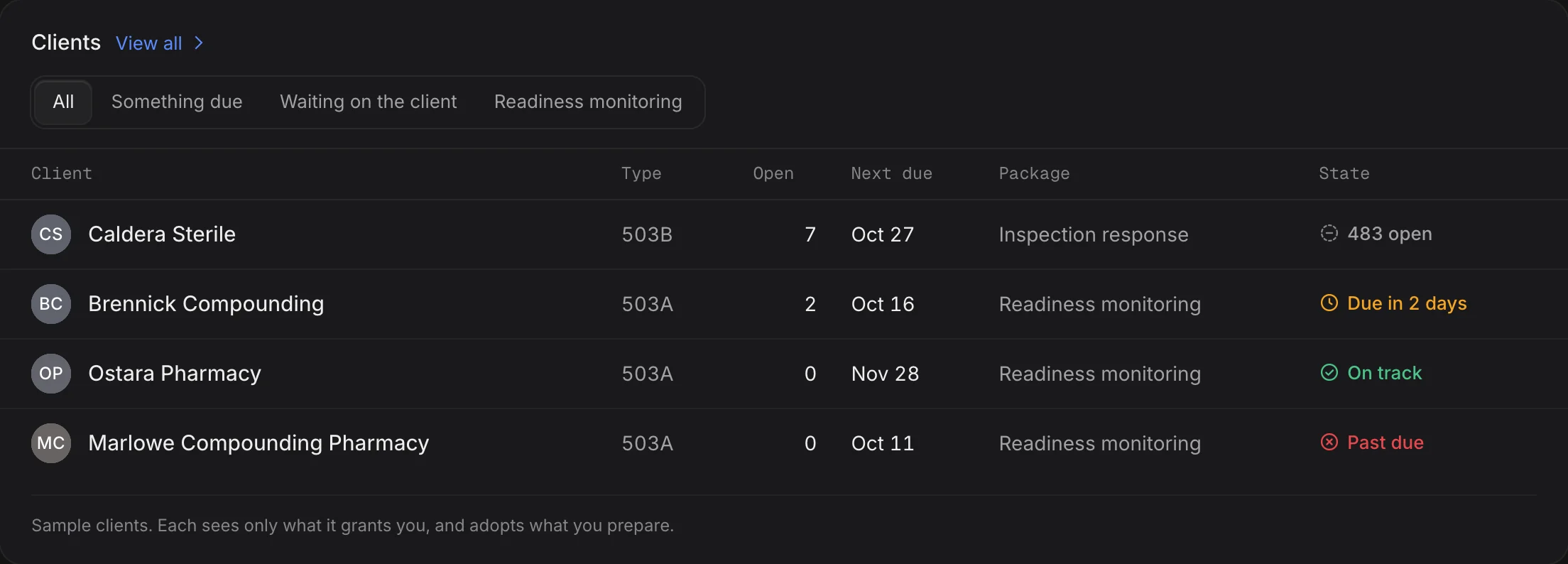
One set of records, two seats. You work in the client's workspace; the client sees every step from its own Consultant tab.
FDA response files need the client on the Workspace plan or higher; every paid plan includes the rest of Practice. Veritura reviews and documents the paperwork. It never tests, grades or endorses the medicine itself.
Who does what, in writing. Fixed by the product, not a clause.
A response is judged on its evidence and on who signed it. The roles stay plain.
| The question | Your client, and Veritura | You, the consultant |
|---|---|---|
| Who owns the records? | The client, in its own workspace. Veritura stores and reviews them for the client and never shows them to another account. | Reach by area, until the end date the client signed. |
| Who writes the response? | Vera drafts from the evidence on file, and the draft says it was drafted by Vera. | You edit it and sign it as prepared by your firm. |
| Who signs and sends it? | Executive management signs, and the client sends it. Veritura records that it was sent and files nothing itself. | Your signature is on what you prepared, never on the client's decision. |
| Who ends the access? | The client, with one signature, at once. | Ended access reads nothing on the next request. |
Free for consultants. Your clients keep their own plans.
Your firm pays nothing for its desk, its staff seats, its client grants, the sample client or the monthly reports, and Vera drafts at no charge. Clients pay their own Veritura plan.
To show a prospect what its binder holds before it signs up, the pharmacy's owner can grant your firm a free binder map: up to 300 pages for 30 days, three open at a time.
- A sample 503B with an open Form 483, ready to work
- Packages and prices you set, kept by your firm
- Staff seats at no charge
The file, in full. Each part of a response.
The grant, the binder, the clocks and the PDF, as the product keeps them.
Open the demo deskThe grant
- Scopes
- Inspection response, readiness monitoring, supplier qualification files, or a custom set of areas.
- Never shared
- The client's patient orders, payments and team settings.
- The record
- Your firm's name, address, qualifications and type of service, as 21 CFR 211.34 asks, written when the client signs, with the letter of authorization.
The binder
- Six checks
- Unsigned; undated; the wrong lot; results dated before their protocol; a missing entry in a dated series; no effectiveness result after a change date.
- Frames
- Filed against the Form 483, USP <797> sections, a state self-inspection form or a buyer's list.
- Pages
- Counted against the client's plan year. Past the allowance the owner buys page packs in the app; nothing is billed silently.
The clocks
- Form 483
- 15 business days, federal holidays excluded, the window FDA described in 2009 (74 FR 40211).
- Warning letters
- 15 working days, or the letter's own number when it states one.
- State notices
- Each state's own rule, cited on the file.
The response
- Structure
- The March 2026 draft guidance's parts: who prepared it and their relationship to the firm, who signs it, the letter of authorization, an executive summary table and signed attachments.
- Export
- One PDF with the file's fingerprint. The client sends it.
The boundary. Veritura reviews and documents the paperwork behind a response. It never advises in its own voice, never files anything with a regulator, and never tests, grades or endorses the medicine itself. We read documents. We do not test material.
Questions, answered plainly.
Nothing. Your desk, staff seats, client grants, the sample client, Vera's drafting and the monthly reports are free. Clients pay their own plan, and FDA response files need the client on Workspace or higher. How pricing works.
The client. Its records stay in its own workspace. You reach what the grant covers, by area, until the end date the client signed.
Yes, at once and with one signature. Every request is checked against the grant, so ended access reads nothing on the next request.
No. Vera drafts as your assistant and the draft says so. You edit and sign it, the client's executive management signs the response, and the client sends it. Veritura records that it was sent.
503B outsourcing facilities and 503A compounding pharmacies. Clinics and telehealth platforms can also invite a consultant from their own Consultant tab.
Still have questions? Talk to a person.
Ask for a desk.
Tell us your firm and the pharmacies you work with. A person sets up your desk and the sample 503B file.
- A person answers every request.
- Your desk, staff seats and client grants at no charge.
- Your clients' records stay in their own workspaces.