Cato AI, your own inspector.

He arrives, states his scope out loud, walks your records the way a surveyor does, and writes observations that cite what he saw. By appointment only, on your own records, before any of it counts.

An inspection, not a report

A report generator returns a sorted list. An inspector arrives, requests records one at a time, notices what is not produced, and leaves you something to answer. Cato does the second thing, in about twenty-five minutes, on the workspace you already keep, and he never sees Vera's notes before he starts.

By appointment

Cato reads the record a second time, independently.

He never sees Vera's notes. He starts from the documents, the policy, and the named sources, and writes his own reading of every field.

Field by field

Twelve fields, twelve independent readings.

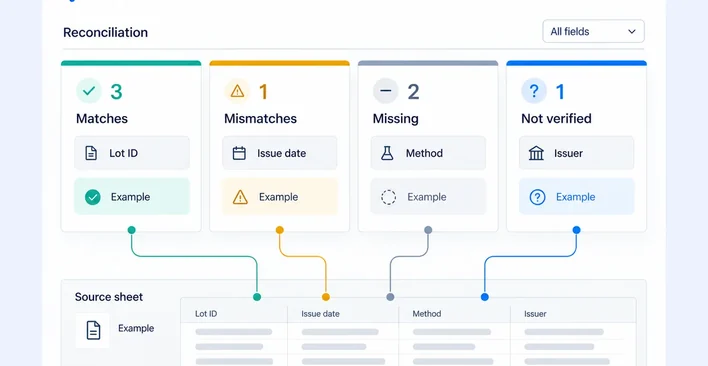
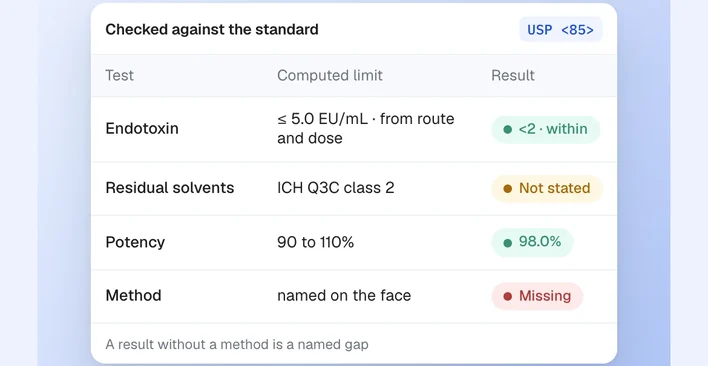
Identity, lot, method, spec, result, dates, signatory, and the four public sources. Each reading is locked to its page and line before it is compared.

Contested

Where the two readings differ, the record says so.

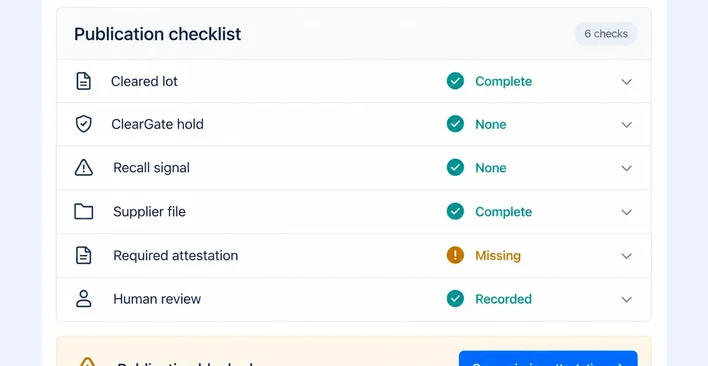
Eleven fields agree. One does not: the retest date. Both readings stay on the record, side by side, and the order cannot clear until a person resolves it.

Citation lock

An inspection you can replay.

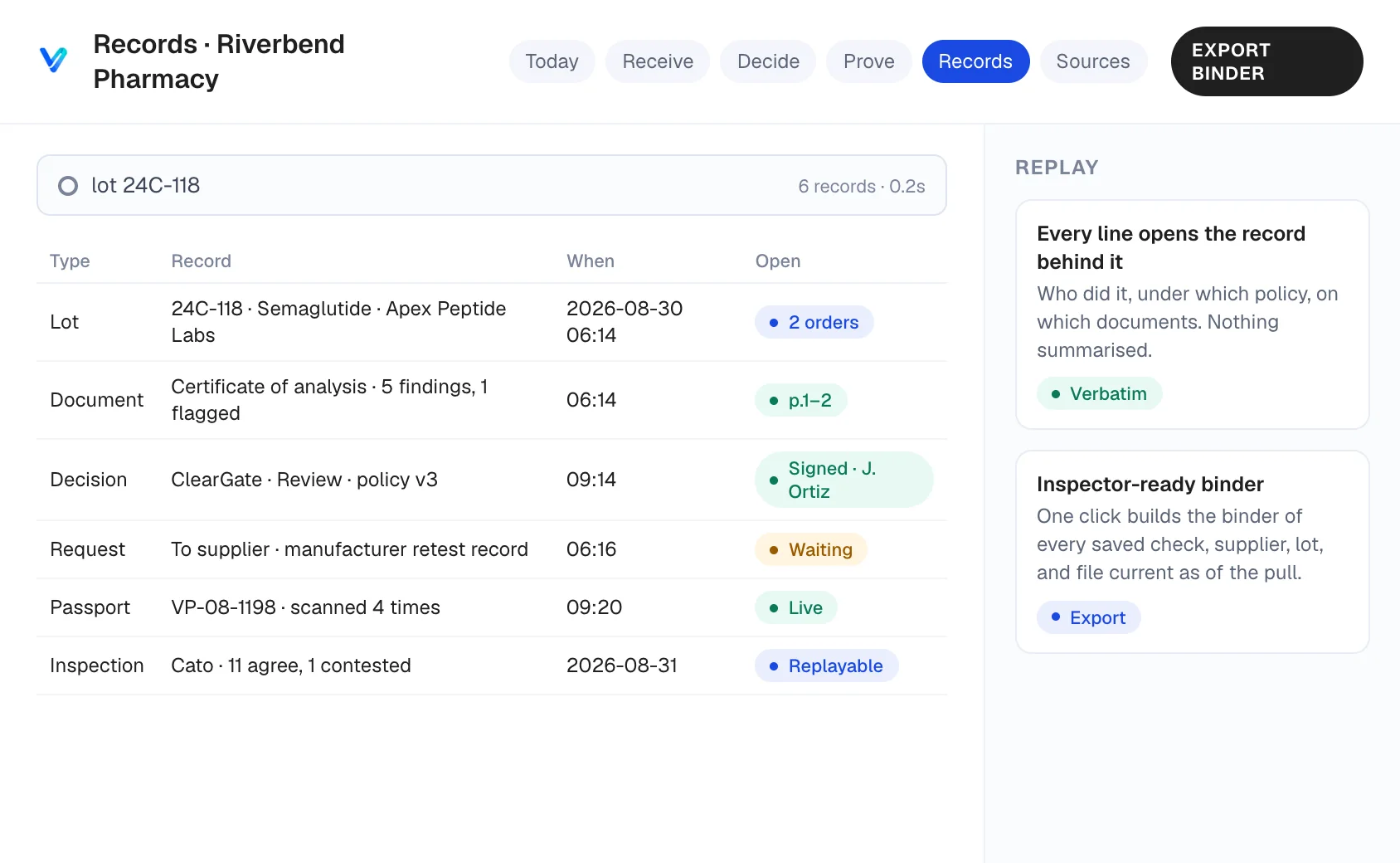
Every finding opens the page it came from. An inspector can follow the same path months later and reach the same record, which is the point of a second reader.

00:00Cato · inspection, by appointmentwalking the record
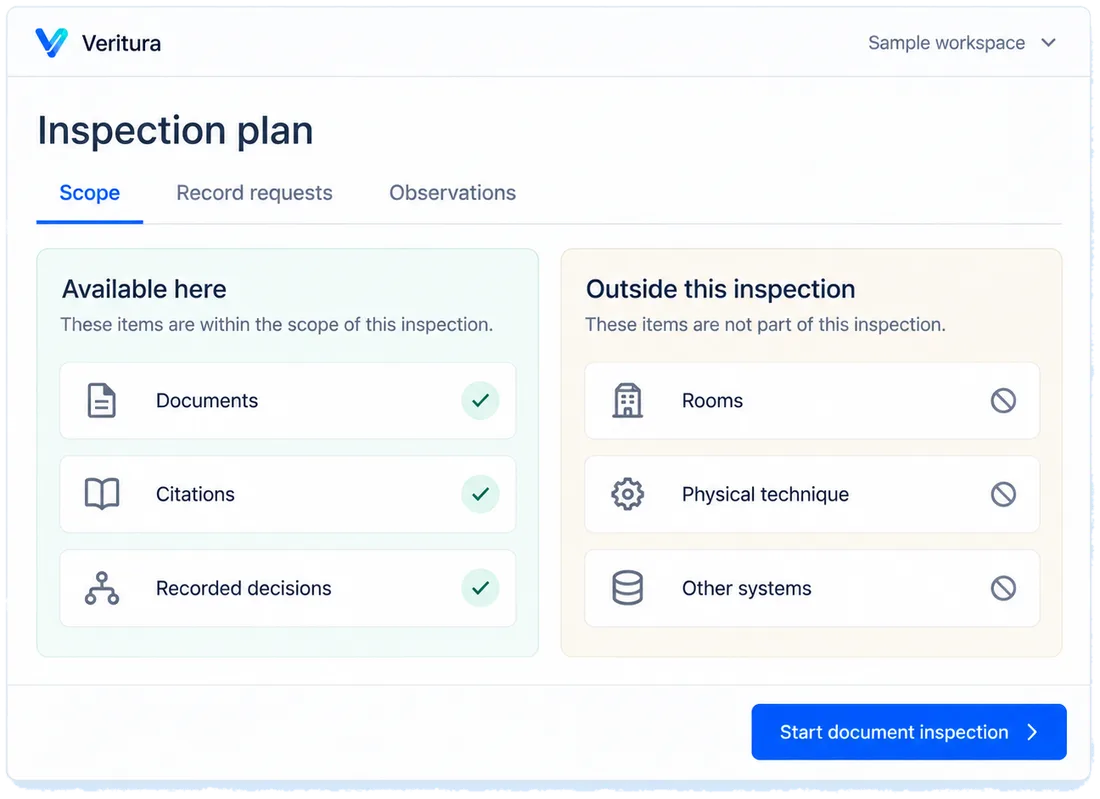
Scope stated firstOrder AUR-7741
Can examineDocuments, decisions, sources on the record
CannotTechnique, rooms, files in other systems
Supplier filesqueued
Certificates on recordqueued
ClearGate decisionsqueued
Passports issuedqueued
Enforcement watchqueued
Retention and replayqueued
Policy versionsqueued
0/12fields read independently
Vera readRetest 2027-03-02p.1 l.6 · certificate
Cato readRetest 2026-09-02manufacturer record
1 of 12 contested · order cannot clear
Citation-lockedEvery finding opens its page and line. Replayable by an inspector.11 agree · 1 contested · held
What an independent second reader changes.

One inspection, about twenty-five minutes, on the records you already keep.

01

States the scope first

Before touching a record he announces the plan and the honest denominator: what he can examine here, and what a real inspection covers that he cannot. Physical technique, rooms, and files in other systems are named as outside his reach at the start, so nothing he later writes is mistaken for a verdict on them.

Stating the denominator first is what makes the observations credible. Nothing he later writes can be mistaken for a verdict on the rooms, the technique, or a system he cannot see.

  • The plan announced before the first request
  • What a real inspection covers that he cannot
  • No score on anything he cannot see
Discover Methodology
States the scope first: a designed view of the Veritura workspace

02

Requests records one at a time

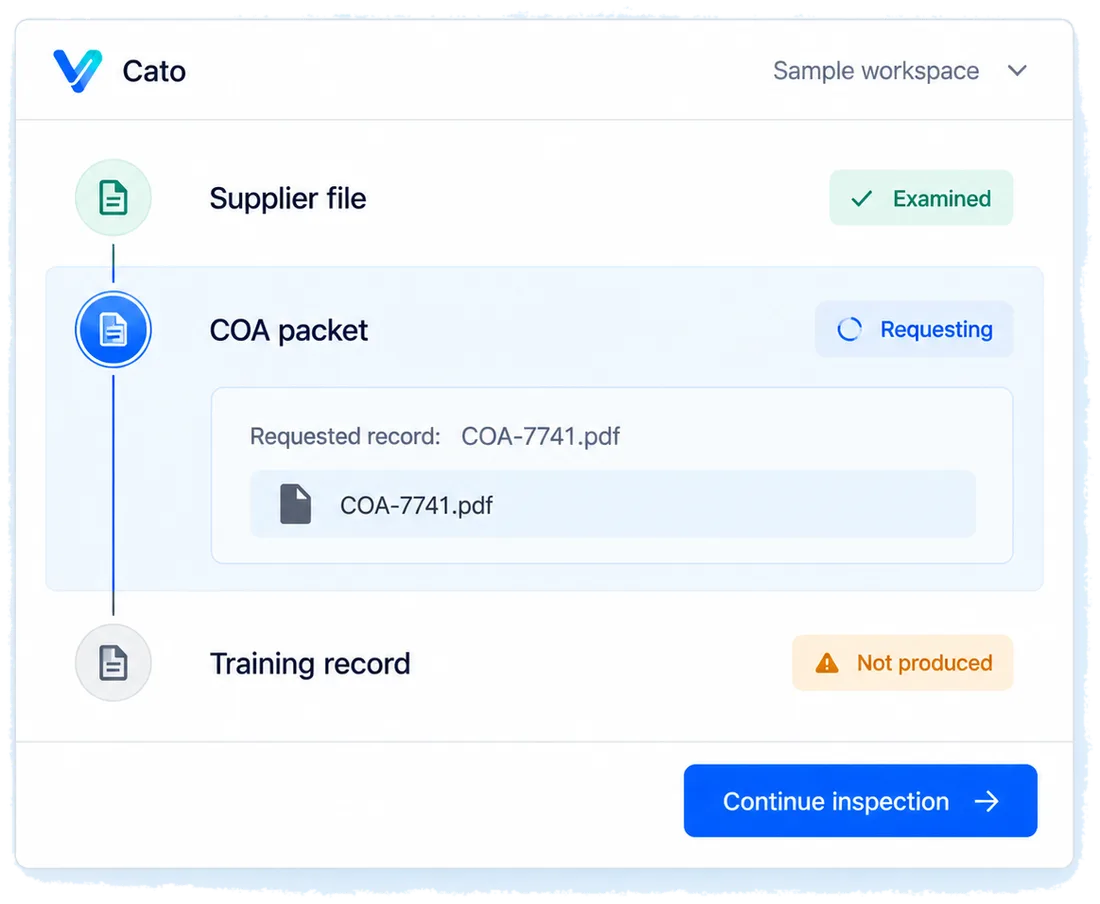
The walk is watchable. Each domain moves from queued to requesting to examined, in the order a surveyor's requests actually arrive, and you can watch or walk away. A record that is not produced is noted as not produced, in those words, rather than rounded up from a fragment into an answer.

You do not prepare for Cato. You open the door, and the walk runs in front of you or while you are away, in the order a surveyor's requests actually arrive.

  • Queued, requesting, examined, in order
  • Not produced is recorded as not produced
  • Watch it or walk away
Discover Order-level COA traceability
Requests records one at a time: a designed view of the Veritura workspace

03

Writes observations like the real thing

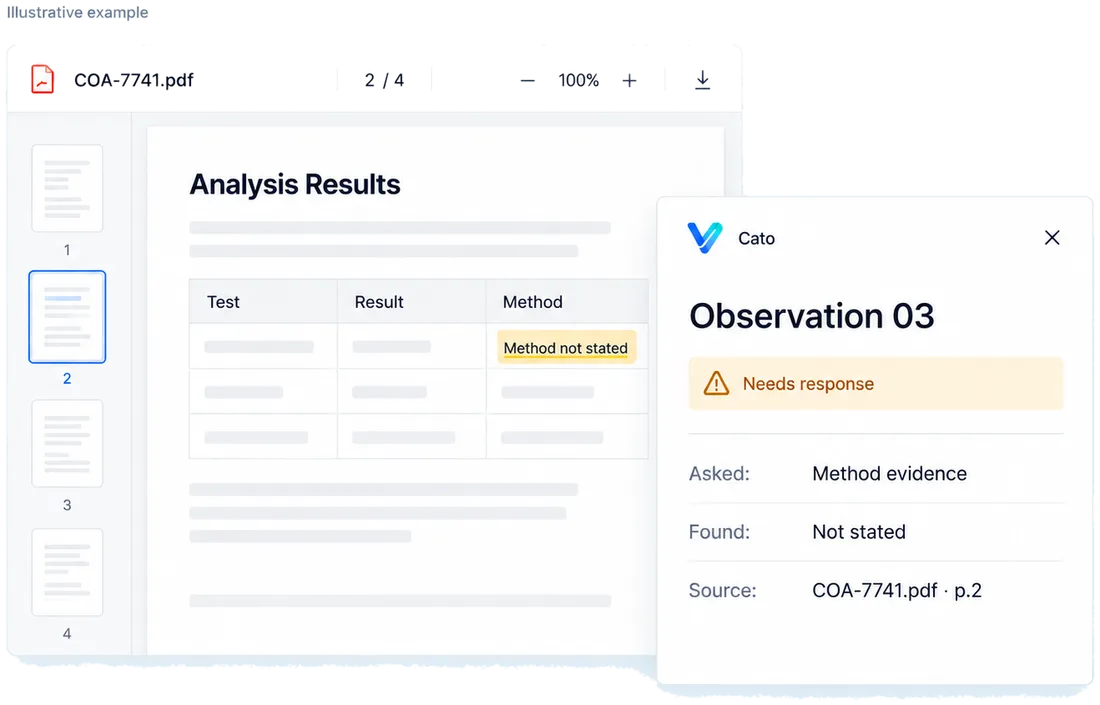
Clear, specific, and cited: the ask, the finding, the record it rests on, and the dates shown. Never a score with no sentence behind it. Where his reading differs from the first reader's, both readings stay on the record side by side, and the order cannot clear until a person resolves the difference.

A contested field is not averaged away. Both readings stay on the record with their sources, and the order cannot clear until a person resolves the difference by name.

  • The ask, the finding, the record, the dates
  • Disagreements kept side by side
  • Nothing clears on a contested field
Discover Supplier packet diligence
Writes observations like the real thing: a designed view of the Veritura workspace

04

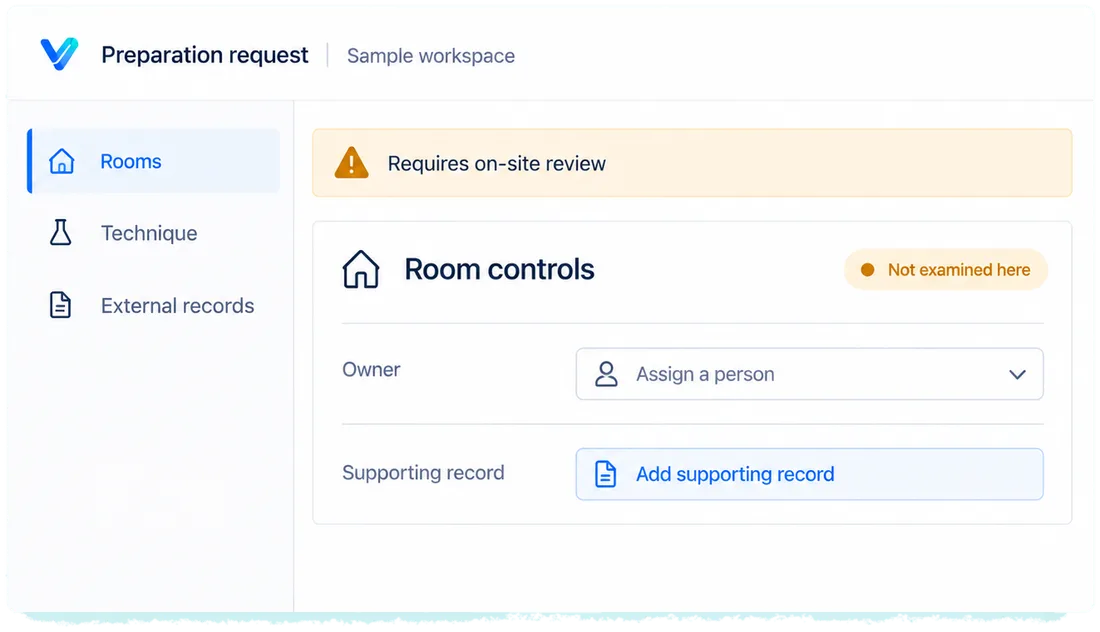
Raises what no software holds

Twenty-two requests he cannot answer, raised with what will be asked and what a good answer looks like, and never counted for or against you. Aseptic technique, the rooms and their controls, hazardous drug handling, and controlled-substance records are observed by a person or live in other systems, and he says so by name.

The twenty-two published requests tell you, before the visit, what will be asked and what a good answer sounds like, so the physical and observed findings are never a surprise.

  • Twenty-two published requests, never scored
  • What will be asked and what good sounds like
  • Physical and observed findings named as such
Discover Trust Center
Raises what no software holds: a designed view of the Veritura workspace

05

Issues a document that starts a clock

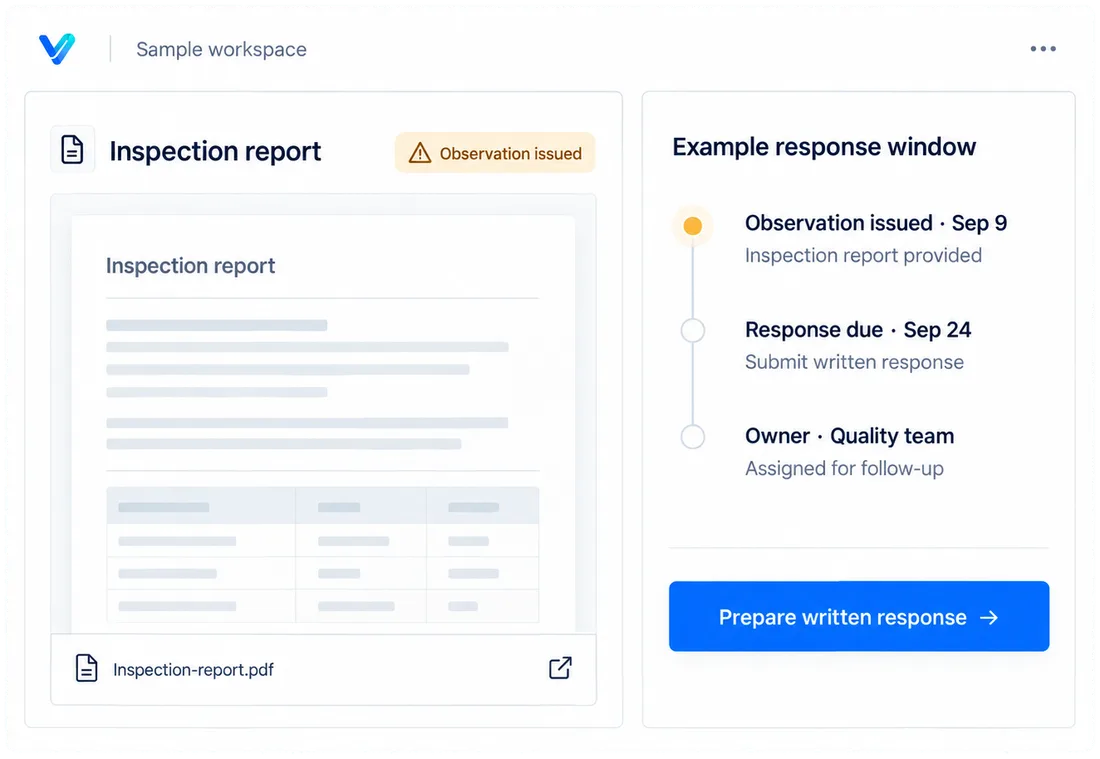
The inspection record is issued as a file, with the requested-but-not-held items listed by name, because real inspections expect a written response and so does he. An observation that comes back after your own written response is flagged in exactly those words, quoting your date and your named owner.

The written response loop is the point. An observation that comes back after your own dated response is flagged in those words, because knowing and not acting is the worst finding there is.

  • A file, not a dashboard
  • Requested-but-not-held items listed by name
  • Repeat findings quote your own response
Discover The evidence engine
Issues a document that starts a clock: a designed view of the Veritura workspace

What changes

What you get, in practice.

01The inspection before the inspection

A surveyor's walk on your own records, in about twenty-five minutes, before any of it counts.

02Findings with their evidence attached

The ask, the finding, the record it rests on, and the dates, never a score with no sentence behind it.

03The twenty-two, answered in advance

What no software holds, raised by name with what a good answer sounds like.

The method

1. Intake

Documents arrive by email, upload, or API and are retained as received.

2. Check

Read against identity anchors, your policy, and named public sources.

3. Decide

A named person signs every material decision, with the reason kept.

4. Issue

Cleared orders issue serialized Passports and Seals.

5. Retain

Every document and decision stays on the record for seven years.

An inspector you can trust knows what he cannot see

Every line here is structural, not a setting.

Named

Work is signed by the agent that did it, never by a vague system.

Visible

The walk plays in front of you. Nothing happens off screen.

Limited

The refusals are published, in the product and on this site.

Receipted

Every observation cites the record it rests on, with the dates shown.

Everything on this page, in full.

The complete text, for the reader who wants the whole story before a call.

You have read a year of promises about AI agents. Here are two with jobs.

Vera works your desk every day; Cato inspects by appointment. Both have names, both show their work while it happens, and both publish the exact lines they stop at. Not a copilot, not a chat window: a quality team whose every action carries a receipt and whose every refusal carries a reason.

What makes an agent real

  • Named. Work signed by the agent that did it, never by a vague system.
  • Visible. The walk plays in front of you; nothing happens off screen.
  • Limited. The refusals are published, in product and on this site.
  • Receipted. Every observation cites the record it rests on.
An inspection, not a report.

A report generator returns a sorted list. An inspector arrives, requests, notices what is not produced, and leaves you something to answer. Cato does the second thing.

States the scope first

Before touching a record he announces the plan and the honest denominator: what he can examine here, and what a real inspection covers that he cannot.

Requests records one at a time

The walk is watchable: each domain moves from queued to requesting to examined, in the order a surveyor's requests actually arrive.

Writes observations like the real thing

Clear, specific, and cited: the ask, the finding, the record it rests on, and the dates shown. Never a score with no sentence behind it.

Raises what no software holds

22 requests he cannot answer, raised with what will be asked and what a good answer looks like, and never counted for or against you. The full list is published below.

Issues a document that starts a clock

The inspection record, issued as a file, with the requested-but-not-held items listed by name. Real inspections expect a written response; so does he.

Remembers your answers

An observation that comes back after your own written response is flagged in exactly those words, quoting your date and your named owner, because knowing and not acting is the most damaging finding there is.

What he will never do

An inspector you can trust is one who knows what he cannot see.

Every line here is structural, not a setting. The rehearsal is credible precisely because these do not move.

Score what he cannot see

The 22 items no software holds are raised and never graded. A rehearsal that scores only what it stores is a vendor grading its own homework.

The most cited finding in the country is aseptic technique, observed by a person. No software sees it, and pretending otherwise would discredit everything else he says.

A rehearsal is practice on your records. It never forecasts what any board, surveyor, or agency will ask, find, or decide.

Borrow a regulator's words

He writes in his own vocabulary. Agencies' classification terms belong to their determinations, and he makes none.

Grade you to anyone else

The rehearsal is yours. Observations, responses, and history live in your workspace, for you, not as a score shown to anyone else.

Judge without an appointment

Vera, your teammate, never grades your mess. Cato judges only when you open the door, because your teammate should never be your grader.

Every question he refuses to score, in full.

A rehearsal that covers only what the vendor stores is a vendor grading its own homework. Here is everything a real surveyor asks for that lives outside any system: the ask as it will arrive, and what a good answer looks like.

Zone A: evidenced here

The workspace holds the record. Cato examines it and cites it: the document, the date, the gap, in the shape a real observation takes.

Zone B: partly here

A fragment or a proxy exists. Cato examines what is on file and names exactly what is missing, rather than rounding a fragment up to an answer.

Zone C: not here at all

Physical, observed by a person, or in another system entirely. Cato raises these as requests he cannot answer, says what good looks like, and never scores them. The list below is that zone, in full.

Why the list matters

The most cited findings are things software never sees.

of pharmacies were observed failing to maintain aseptic technique. Observed, by a person, watching. The most cited finding in the analysis.

NABP, published 213-inspection analysis

compounding pharmacies failed basic cleanliness standards in one state's unannounced sweep. Nothing in software sees a shelf.

Massachusetts board, unannounced inspection sweep

Pharmacies frequently sample on schedule and take no action on out-of-specification results; the missing action is what gets cited.

NABP, published 213-inspection analysis

Domain 1 of 5

Written procedures and the quality system

The paper spine of the operation: recipes, batch records, investigations. Most of it lives in your dispensing system or a binder, not in any oversight tool.

“Show me the Master Formulation Record for a preparation you compound regularly.”

A good answer: A written record per preparation: ingredients with amounts and sources, equipment, step-by-step method, beyond-use date and its basis, container closure, and labeling.

It is the recipe of record. Without it, two technicians can make the same preparation differently and nobody can tell.

“Show me the Compounding Record for the last batch you made.”

A good answer: A per-batch record naming who compounded, the lots of every component used, the yield, the checks performed, and who verified.

This is the link between a finished preparation and the components you can prove. Its absence breaks traceability in both directions.

“What beyond-use date do you assign this preparation, and on what basis?”

A good answer: The BUD, the specific USP category or stability data it rests on, and the SOP that fixes the method.

BUD errors are among the most frequently cited findings, usually from inconsistent method rather than bad intent.

“Show me a finished label and the SOP that governs it.”

A good answer: Content required by your state, auxiliary and hazard labelling, and the review step that catches errors before dispensing.

“Show me your last deviation, its investigation, and the corrective action you took.”

A good answer: A written investigation with a root cause, a corrective action, a due date, and evidence it was completed and effective.

A serious inspector digs here, because it shows whether your quality system is a habit or a binder.

“Show me the complaint and adverse-event log and one closed investigation.”

A good answer: A log with dates, the investigation, the conclusion, and the corrective action, closed on a stated timeframe.

“Show me current licenses for every pharmacist and technician working today.”

A good answer: Each individual license with its expiry, current, and a process that catches a lapse before it happens.

Facility registrations and individual licensure are different files; inspections ask for both.

Domain 2 of 5

The rooms and their engineering controls

Cleaning, temperatures, pressures, and what you did when a number went wrong. The logs are physical, the rooms more so.

“Which agent do you use on which surface, what is its required contact time, and show me the log.”

A good answer: The agent, its label contact time, the cleaning frequency per area, and a signed log matching that frequency.

Wrong agent, wrong contact time, or a missing log is among the most cited findings in the country.

“Show me refrigerator and freezer temperature records for the last 90 days, including any excursions.”

A good answer: Continuous or twice-daily records, alarm limits, and a written response for every excursion with a disposition for the stock involved.

“Show me the daily pressure differential readings between your anteroom and buffer room.”

A good answer: A daily record within your stated limits, with an action taken whenever it fell outside them.

“Your last out-of-specification environmental result: what did you do about it?”

A good answer: The investigation, the genus-level identification the 2023 revision requires at action levels, the corrective action, and the verification sample proving it worked.

Inspectors report that pharmacies often sample on schedule and then do nothing about the result. The action is what gets cited, not the sample.

“Walk me through the compounding area.”

A good answer: Clean, uncluttered surfaces, correct storage and segregation, no expired stock, working sinks and eyewash, and hazardous areas physically separated at negative pressure.

In one state's sweep, 36 of 40 compounding pharmacies failed basic cleanliness. Nothing in software sees a shelf.

“What water do you use for compounding, and how do you know it meets the requirement?”

A good answer: The water type per preparation and the record that supports it.

Domain 3 of 5

The compounders, watched

The most cited findings in the country are in this domain, and every one of them is a person watching a person. No rehearsal can substitute.

“I would like to watch someone compound.”

A good answer: Correct hand hygiene, correct garbing order, no first-air interruption, correct disinfection of every entry into the ISO 5 space, and unhurried technique.

The most cited finding in the country: 23% of pharmacies in NABP's 213-inspection analysis were observed failing to maintain aseptic technique. This is watched, never read.

“Show me your hand hygiene before garbing.”

A good answer: The full procedure, in order, without shortcuts, matching your own SOP.

“What is your personnel health and exposure programme for hazardous drugs?”

A good answer: PPE requirements per activity, a spill procedure with a stocked kit, and a documented exposure response.

Domain 4 of 5

The hazardous drug program

Storage, waste, and the physical separations. Verified by standing in the room, not by reading a file.

“Show me the hazardous drug storage, the negative pressure, and the spill kit.”

A good answer: Segregated storage, verified negative pressure, a stocked spill kit within reach, and staff who know where it is.

“How is hazardous drug waste segregated and disposed of, and by whom?”

A good answer: The waste streams, the containers, the licensed vendor, and the manifests.

Domain 5 of 5

Controlled substances, security, and dispensing records

These live in your dispensing system, your DEA records, and your building. An oversight layer holds the evidence chain for the lot; these are the neighbouring files it does not hold.

“Show me your perpetual controlled-substance inventory and a reconciliation.”

A good answer: A running count reconciled on a stated cadence, with every discrepancy investigated and documented.

“Show me your DEA 222 forms or CSOS records for the last year.”

A good answer: Complete, in order, matched to receipts.

“Show me how the pharmacy and its controlled substances are secured.”

A good answer: Access control, alarm coverage, camera retention, and a list of who holds keys or codes.

“Pull the prescription record for a specific patient and preparation.”

A good answer: The prescription, the compounding record it triggered, the label, and the dispensing record, retrievable in minutes.

The lot's evidence chain and your dispensing system's patient records are different systems, and an inspection walks the join between them.

The work you do is minutes, and it is the part that matters.

Everything mechanical is his: the requests, the examination, the citations, the document, the reminders. What remains is exactly the part that should never be automated.

  • Open the door. One click starts the inspection; you can watch or walk away.
  • Read the observations. Each one is a sentence with its evidence attached, not a dashboard to decode.
  • Sign the responses. Vera drafts them where she can; the owner and the date are always yours to add.
  • Answer the 22 out loud. The published catalog tells you what will be asked and what good sounds like, before it is asked in person.
  • Two agents, one firm

Cato finds it. Vera drafts it. You sign it.

The inspector and the quality team share one case file: an observation raised on the walk arrives with a drafted response beside it, waiting for a name and a date. An inspection that ends with drafted answers instead of homework is the whole point of having both.

What Cato is not

Cato examines documentation. He does not test medicine, observe technique, enter your rooms, or make any safety, quality, efficacy, legality, or approval claim about any preparation or facility. A rehearsal is not an inspection, does not predict one, and does not substitute for one. The catalog above is homework, not advice: it does not state or predict what any board, surveyor, or agency will ask or decide.

Open the door. He is ready now.

The live demo runs the whole choreography on a real workspace: the walk, the observations, the document, the response loop. No signup.

Veritura reads and connects the paperwork behind an order. It never tests, grades, or endorses the medicine itself, and it never releases anything on its own.
The boundaryDocumentation evidence, not medicinal judgmentVeritura

What runs underneath.

4Things every document is reconciled against: the issuing laboratory, the standard, the file, and every other document seen
17Forensic signals read on every file, from reused signatures to edit stacks
6Dated elements in every supplier file, each current, due, or overdue
0Autonomous releases, ever. A person signs every material decision

FAQ

The documentation you already keep in the workspace, against the policy and the named public sources. He starts from the documents, never from Vera's notes, and writes his own reading of every field.

Twenty-two requests a real surveyor makes that live outside any system: aseptic technique, rooms and controls, hazardous drug handling, controlled-substance records. He names them and never counts them for or against you.

An inspection record issued as a file, with requested-but-not-held items listed by name, each observation cited to its record and dates. A repeat finding quotes your own earlier response.

Still have questions? Talk to a person.