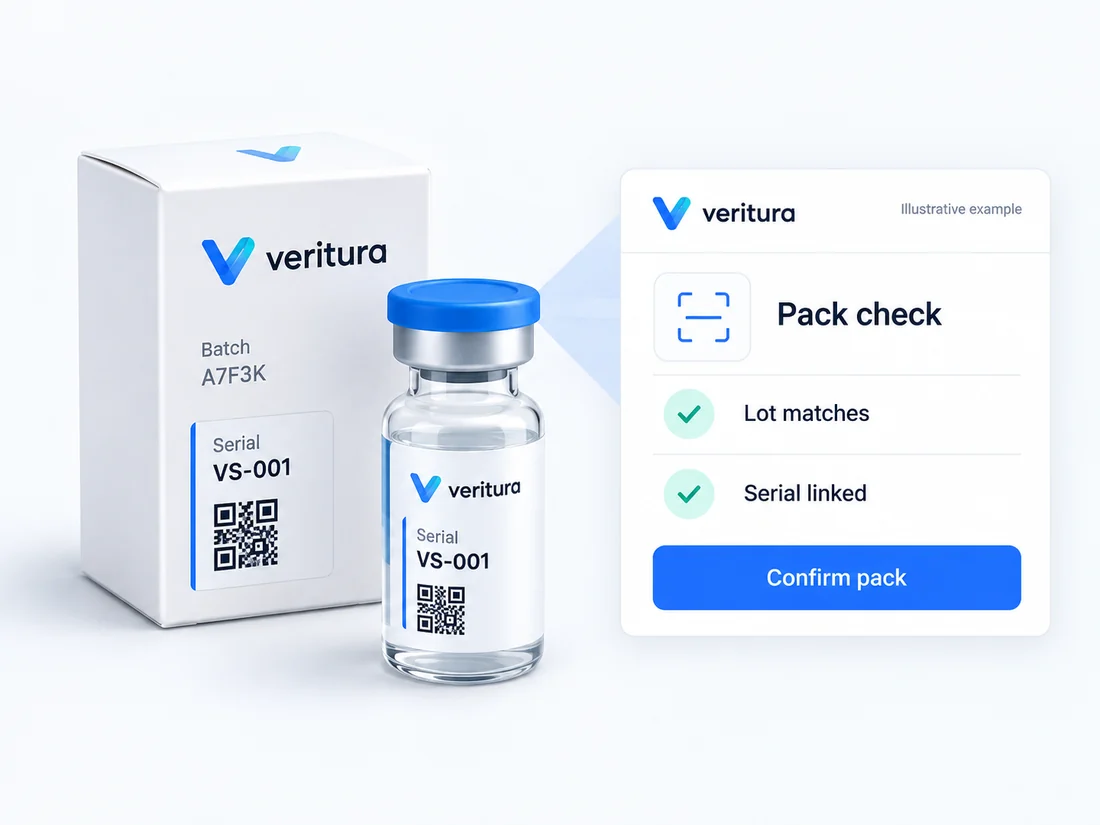
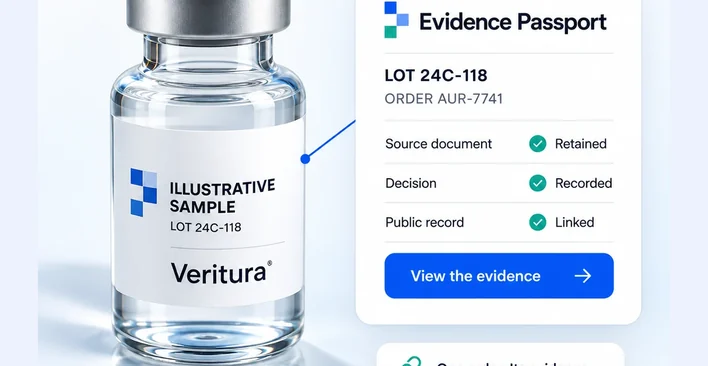
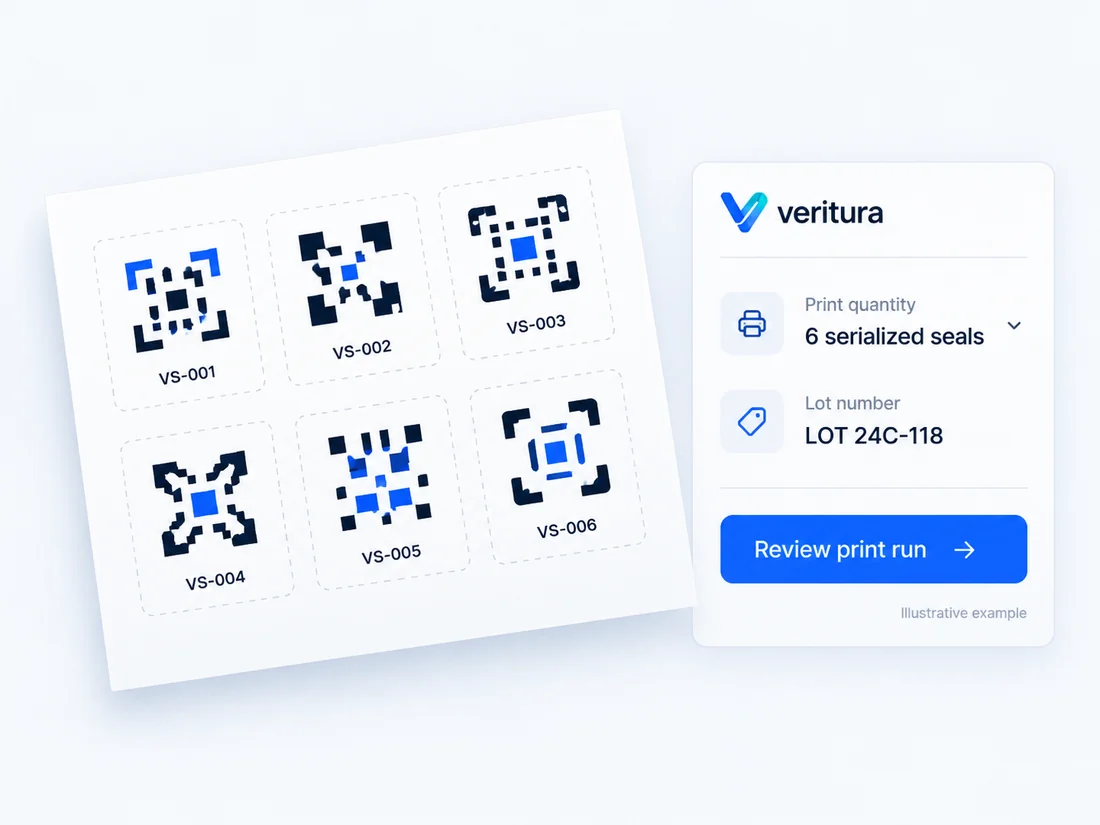
A serialized QR on the vial, so a notice can reach the person holding it.

A serialized sticker you print and apply to the vial. The patient scans the vial in their hand, sees that unit's record, and can save it. If a notice ever reaches that lot, one button reaches every person who saved one.

What a scan proves, and what it does not

Scan the QR on the label or type the serial printed beside it, and Veritura confirms whether that unit is bound to a real, released lot from a named source. This confirms the provenance of the paperwork, not the physical product, and the page that opens says so in plain language. It is a customer surface built to a different rule than the workspace: values and provenance labels only, with nothing a patient could mistake for a grade.

From the label printer to the right patient.

Four steps, then the order number does the rest of the work.

01

Print

A sheet of QR labels prints from the record on Avery 5160 or a thermal printer. Seals cut from the passport screen carry each unit's order number on the sticker face; seals cut from a lot are lot-level, for stock you have not yet assigned to an order. Every serial is minted against a lot before it is printed.

Seals are minted against a lot before anything prints, so a serial on a sticker is always a real unit of a real lot, and lot-level seals cover stock not yet assigned to an order.

Discover Methodology
Print: a designed view of the Veritura workspace

02

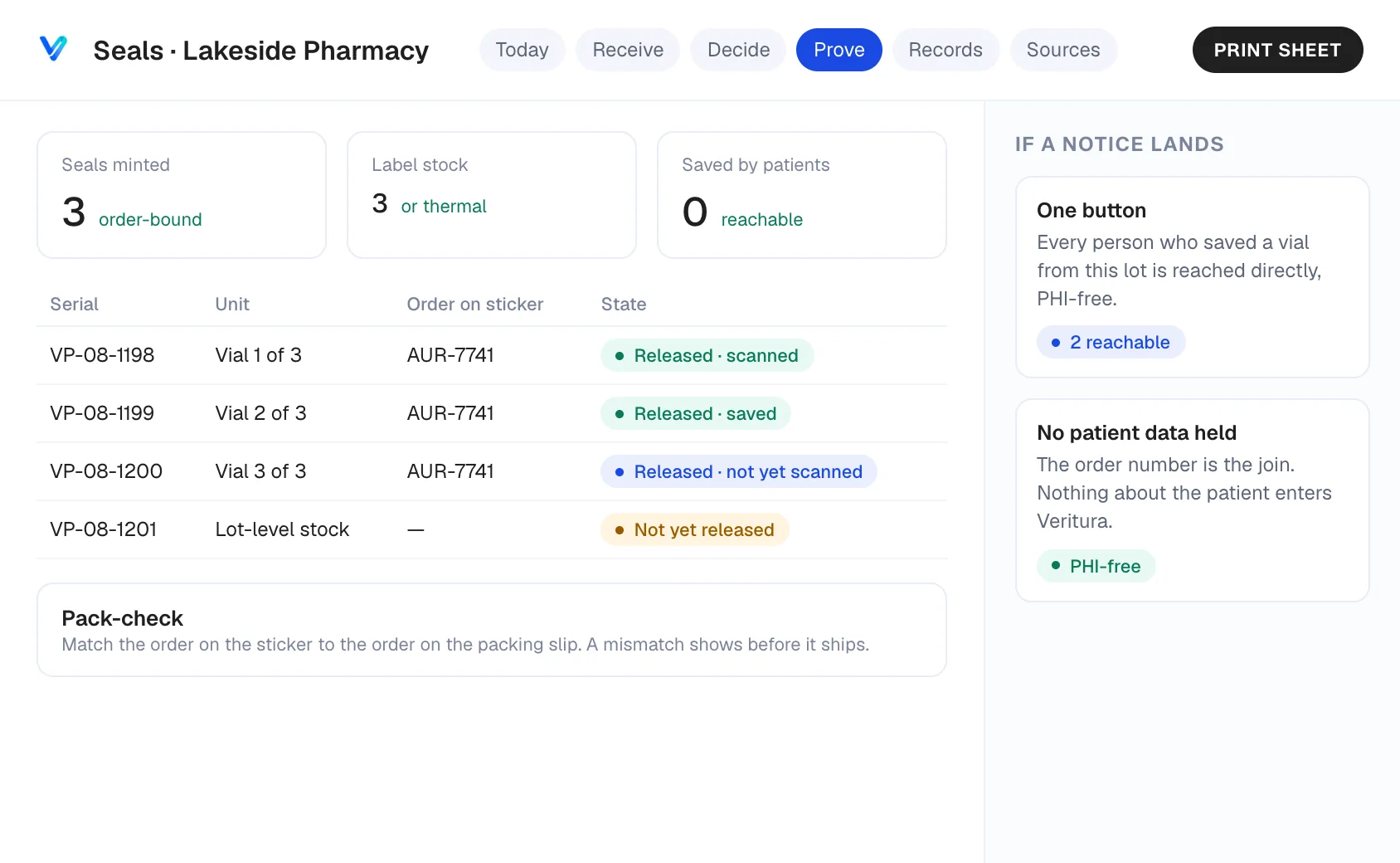
Stick and pack-check

One label per vial. For order-bound seals, the sticker goes on the unit going to that order, and at packing you match the order on the sticker to the order on the packing slip, the same glance you already give the shipping label. A mismatch is visible before it ships, not after a patient calls.

The pack-check is the same glance you already give the shipping label. Matching the sticker's order number to the packing slip catches a mismatch before it leaves the building.

Discover Order-level COA traceability
Stick and pack-check: a designed view of the Veritura workspace

03

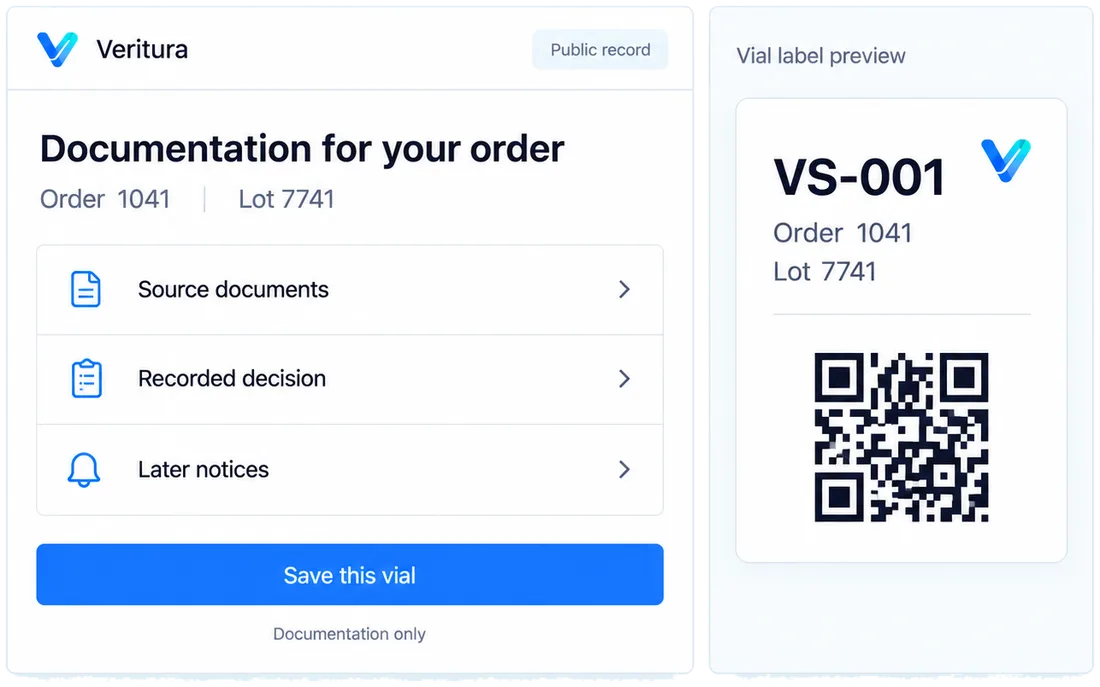
The patient scans

The QR opens the unit's record: released for their own order number, plus the lot's documented facts, in four plain-language lines. They match it against the order number on their own paperwork, and they can save the vial to their own space with nothing more than an email, which is what makes them reachable later.

A patient saves a vial with an email and nothing else. That is what makes them reachable later. The email lives in the patient’s own account, never in the pharmacy’s record, and Veritura never joins the two.

Discover Supplier packet diligence
The patient scans: a designed view of the Veritura workspace

04

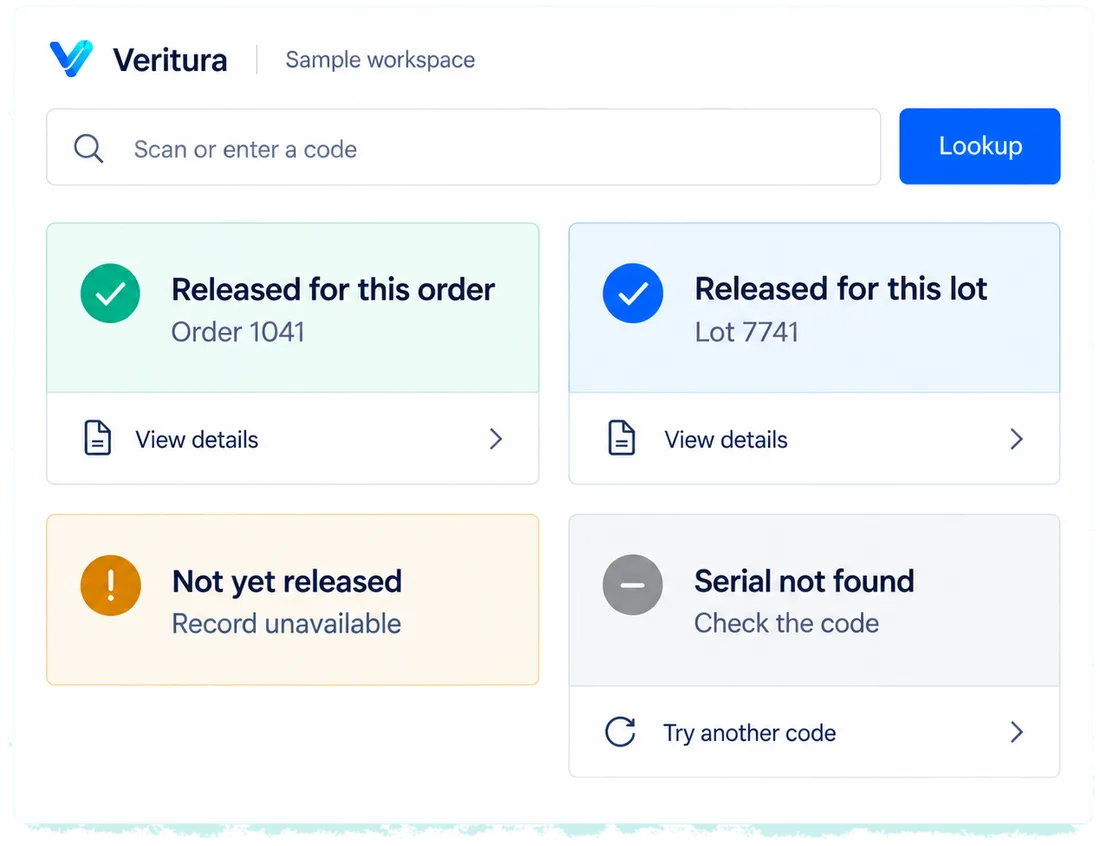
Every state the scan can report

A seal reports exactly what it is: released for this order, released for this lot, not yet released, or not found. An uncleared lot never has a seal that reads released, because seals are minted from the same gate as passports. A serial that does not exist says so rather than opening something that looks like a record.

A serial that does not exist says so instead of opening a look-alike record, and an uncleared lot never has a seal that reads released, because seals and passports share one gate.

Discover Trust Center
Every state the scan can report: a designed view of the Veritura workspace

05

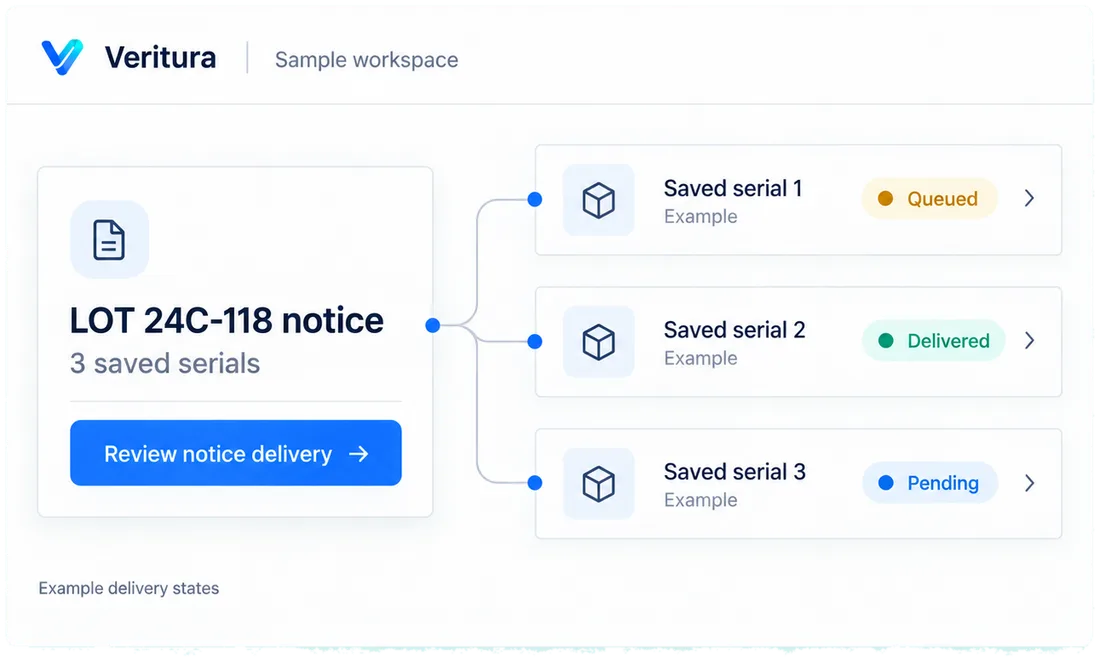
One button, every person who saved one

If an enforcement record or a recall ever matches the lot, the notice reaches every person who saved a vial from it, directly and PHI-free, and returns the order list for the ones only you can call. A recall that reaches the pharmacy but never the patient is not a recall that worked.

The recall reaches the person, not just the pharmacy. Everyone who saved a vial is notified directly and PHI-free, and the pharmacy gets the order list for everyone else.

Discover The evidence engine
One button, every person who saved one: a designed view of the Veritura workspace

Where the patient’s contact lives

No name enters the clinic’s record. A patient who wants to be reached saves the vial themselves.

Two records, one join. The clinic’s administration line carries the unit, the lot, the date and the clinic’s own visit reference, and nothing else. A patient who scans the vial can save it to their own space with an email they type themselves. That email lives in the patient’s account, never in the clinic’s record, and Veritura never joins the two.

The clinic’s lineUnit, lot, date, your visit reference

No name, chart or contact. The reference is yours, and Veritura never asks what it means. The log a board asks a clinic to produce is this line, per vial, per visit.

The patient’s accountAn email they type themselves

Scanning the vial and saving it creates the patient’s own space. The email is held there, for their notices, and is never written to the clinic’s or the pharmacy’s record.

A recallTwo paths, and the vial is the only join

Saved vials are reached through the patient’s own account. Everyone else is reached through the order list your clinic already holds. Nothing about a patient is stored to make the first path work.

What changes

What you get, in practice.

01A patient you can reach

Anyone who saved a vial is notified directly if a notice lands, PHI-free.

02Proof on the vial itself

A serialized QR that confirms the unit is bound to a real, released lot.

03Mismatches caught at packing

The order on the sticker matched to the packing slip with the glance you already give.

The method

1. Intake

Documents arrive by email, upload, or API and are retained as received.

2. Check

Read against identity anchors, your policy, and named public sources.

3. Decide

A named person signs every material decision, with the reason kept.

4. Issue

Cleared orders issue serialized Passports and Seals.

5. Retain

Every document and decision stays on the record for seven years.

Two products, three ways to reach a patient

Pick by what you actually hold: an email address, or a label printer.

You have the patient's email

A per-order web record, sent as a link. Nothing is printed and nothing goes in the box.

You do not have an email

The same per-order record printed as a slip with its own QR, dropped in the package, needing no patient details at all.

A QR printed on the label

A serialized code on the vial label itself, one per unit, from a label sheet or a thermal printer.

No patient data, ever

The order number is the join. Nothing about the patient enters Veritura, and the claim is made from the vial.

Everything on this page, in full.

The complete text, for the reader who wants the whole story before a call.

Two products, three ways to reach a patient.

Pick by what you actually hold: an email address, or a label printer.

Evidence Passport, by email

You have the patient's email

A per-order web record. The patient gets a link to it by email. Nothing is printed and nothing goes in the box.

Per order. Only a released passport on a cleared lot sends.

Evidence Passport, printed slip

You do not have an email

The same per-order record, printed as a slip with its own QR code, dropped in the package. This is the fallback whenever you hold no email address, and it needs no patient details at all.

Same record, same link.

Veritura Seal, on the vial

A QR printed on the label

A serialized QR code printed onto the vial label itself, one per unit, from a label sheet or straight to a label printer. The patient scans the vial in their hand. Nothing to email and nothing loose in the box.

Monthly allowance, or unlimited on lots with a released passport.

The Evidence Passport is a record you send. The Veritura Seal is a sticker you apply. They are separate products that happen to describe the same lot.

If a lot goes bad you cannot reach the patients who received it. Veritura's serialized vial labels let a patient claim their vial, so a recall can reach the person, PHI-free.

The recall reaches the patient, not just your shelf.

Six steps, from the label printer to the person holding the vial.

Serialized labels are minted against a lot, printed, applied to the vial, and scanned by whoever holds it. One button then reaches every person who saved one.

A lot is ready to go out the door.

Serials are minted against that lot in the shape VS-XXXX-XXXX, collision-checked against every serial already issued and against the batch's own output. When order references are supplied, each serial is bound one-to-one to one order at mint time.

The binding is the right-patient guarantee, and it is PHI-free: order references only, no patient identity exists to mis-route.

Labels print as an Avery sheet, as single thermal labels, or as raw ZPL fed straight to the printer. The QR is the printer's own symbol at a magnification that clears the quiet-zone requirement on all four sides.

The label goes on the vial. Where serials were bound to orders, packing becomes the same label-to-packing-slip match the pharmacy already performs for addresses.

The person holding the vial scans the QR or types the serial.

The public page at /u/<serial> shows the substance, the lot, what the certificate stated, the lab and the date, plus the verify link when the lot has a released production passport. Values and provenance labels only: no report ids, no file names, no hashes. The certificate stays with the pharmacy.

The person chooses to save the vial.

An email is entered. The claim starts at pending_confirm and only the emailed link activates it. Two or more simultaneously active claims on one serial is surfaced as the same-seal-claimed-twice signal.

Something changes on the lot's documentation record.

One button reaches every active claimant across every seal batch of that lot, deduped so one address gets one notice, each deep-linked to that person's own vial page. One notify per lot per hour.

The notice history stores serial, lot, subject and time, never the email, so the table cannot leak who was notified.

A notice says the documentation record changed. It is not a safety or quality determination, and the notice tells the reader to contact their pharmacy or provider with any medication question.
What a scan proves, and what it does not.

Scan or enter the serial printed on your vial. Veritura confirms whether that unit is bound to a real, released lot from a named source. This confirms provenance of the paperwork, not the physical product, and is not medical or legal advice.

Local sample data. Not a live account. Every supplier, lot, order, and document shown here is fictional.

Check the seal on the vial.

Scan the QR on the label, or type the serial printed beside it.

What a resolving serial establishes

  • Serial resolvesThis serial matches a seal Veritura minted, bound to one lot.
  • Origin stated per lineEach line says who established it: Veritura, the operator, the issuing lab, or a reviewer.
  • Evidence linkedThe certificate and the supporting documents on file for that lot open from here.
  • Trail unbrokenThe record's dated history, each entry timestamped, with nothing overwritten.
  • Notices carriedAny later FDA enforcement record naming this lot appears here.
  • A resolving serial establishes that this record exists and is bound to this lot. It is a paperwork read, never a statement that the medicine is safe, effective, or approved.

    Sealed unit on record

    Released for orderORD-DEMO-1084

    ProductSemaglutide (base) API

    SourceAurora Pharma Supply

    LotLOT-7741-A

    Recorded by the dispensing pharmacy

    Identity, as stated on certificateSemaglutide

    DocumentedJuly 23, 2026

    These values are transcribed from the documentation on file. The source certificate stays with your pharmacy; ask them directly if you need the original document.

    The page that opens on the patient's phone.

    This is a customer surface, so it is built to a different rule than the workspace: values and provenance labels only, in plain language, with nothing on it that a patient could mistake for a grade.

    The notice line, above everything

    It states either that no recall notices affect this lot's record, or the detail of the notice that does. It carries no status colour, because a notice on a lot's paperwork is neither an evidence posture nor a policy decision on that lot.

    Released for order

    The release binding leads, because it is what turns this from a vial of this lot into the vial released for their order. Serials are bound one to one to an order at mint, and the holder matches that number against their own packing slip.

    Product, source and lot

    The identity of what shipped, recorded by the dispensing pharmacy. Only parties the paperwork names appear here.

    Documentation on file

    The values transcribed from the certificate, each framed as a statement on the document rather than a determination about the medicine. No number is printed anywhere on this page.

    What is deliberately absent

    No report ids, no file names, no paths and no hashes. The certificate itself stays with the pharmacy, and the footer says so and tells the reader to ask them for the original.

    Every state the scan can report.

    Sealed unit on recordThe serial resolves. The record carries the order it was released for, the product, the source, and the lot, recorded by the dispensing pharmacy. A live chip states either that no recall notices affect this lot's record, or the detail of the notice that does.

    Verified unit, released lotThis serial resolves to the lot it was bound to at issue, with the product, the source, the lot, and the Evidence Passport reference.

    This serial does not resolveWe have no record of this unit serial. It may have been mistyped, never issued, or altered.

    Could not verify right nowThe lookup itself did not complete. The page says so and asks you to try again shortly. It does not fall back to any other state.

    What the record carries.

    The release binding, first

    The order number the holder can match against their own packing slip. That is what turns the scan from a vial of this lot into the vial released for their order.

    Documentation on file

    The substance and the lot, then the values transcribed from the documentation, each with the reference it was read against. Identity leads: what the certificate states the substance is, framed as a statement on the document, never a lab identity determination.

    Backed by Evidence Passport

    When the lot has a released production Evidence Passport with a public verify link, the scan carries its reference and a link to the signed record. Sandbox passports, unreleased statuses, and passports with no public link never produce that chip.

    Never the source file

    Values and provenance labels only. No report ids, no file names, no paths, no hashes. The certificate itself stays with the pharmacy.

    Provenance verification only. A valid serial resolves to the lot it was bound to at issue; a serial that was never issued, or was altered, does not resolve. Veritura verifies documentation, never the product, and makes no safety, quality, or FDA-approval determination.

    These values are transcribed from the documentation on file. The source certificate stays with your pharmacy; ask them directly if you need the original document.

    Verified by Veritura. How this record works.

From the label printer to the right patient.

Four steps, then the order number does the rest of the work. It is the join, and no patient data ever enters Veritura.

Print

A sheet of QR labels prints from the record: Avery 5160 or thermal. Seals cut from the passport screen carry each unit's order number on the sticker; seals cut from a lot are lot-level, for stock not yet assigned to an order.

Stick

One label per vial. For order-bound seals, put the sticker on the unit going to that order. The order number is printed on the label face.

Pack-check

At packing, match the order on the sticker to the order on the packing slip, the same glance you already give the shipping label. A mismatch is visible before it ships.

Patient scans

The QR opens the unit's record: released for their own order number, plus the lot's documented facts. They match it against the order number on their own paperwork.

Shipping to orders

Ship orders mints one seal per order with the order number printed on the sticker, plus the passport itself. Match sticker to packing slip; the patient's scan shows their own order.

Sealing stock

From any lot record: up to 500 lot-level labels at a time, printed as Avery 5160 sheets, a thermal roll, or raw ZPL straight to your label printer. The API mints them from your own system too.

The three artefacts on an order

An Evidence Passport, a verify link for that customer. A Veritura Seal, a serialized sticker with the order number on its face. The same record by email, when you hold the address.

What comes off the printer.

Batch sizeUp to 500 serialized seals per mint

Label formatsAvery 5160 PDF, thermal-roll PDF, raw ZPL

Label geometry2.25 by 1.25 inches at 203 dpi

Direct to printerPort 9100 or a raw print queue, no driver in between

Serial shapeVS-XXXX-XXXX, from a 30-symbol alphabet with 0, O, 1, I, L and U removed

Typed by handCase and dashes are tolerated; a character outside the alphabet is a typo, never guessed at

Top line on the labelYour operation's own name, shown as Dispensed by on the public scan page

What sealing is included in.

Plan

Passported lotsA lot with a released production Evidence Passport seals without limits

Everything elseMetered against the monthly allowance on a paid plan

Shipping to orders

Sealing is included with Evidence Passports and paid plans. Mint the lot's production Evidence Passport or upgrade to seal it.

A vial they can save.

Scanning opens that unit's record. Patients can save their vial with just an email, and if a recall notice ever reaches the lot, one button notifies every saved vial.

Leave an email and Veritura will notify you if this lot's documentation record changes, for example when a recall notice reaches it. We store only your email and this serial, nothing else. Contact your pharmacy or provider with any medication questions.

Three states, and nothing else.

Confirm and unsubscribe are both idempotent, because an emailed link gets clicked twice. Any other move leaves the claim exactly as it was.

What stops a label being farmed.

Per serial

At most a handful of live claims may exist on one printed label. A real household is a handful of people; dozens of live claims on one label is scripted abuse or a copied label. An opt-out frees the slot.

Per email, per day

A daily ceiling on save requests from one address. This one counts every request regardless of status, because each request costs a confirmation email, so an opt-out never refunds the daily budget.

Two live claims on one serial

Two or more simultaneously active claims on the same serial is the same-seal-claimed-twice tell, surfaced as a signal of a re-used or copied label. A signal for review, never an accusation.

The free patient space

The free home for every vial you save: current record status and notice history, in one place. Free, always.

No saved vials yet. Scan the Veritura seal on a vial and tap Save this vial; once you confirm the email, it appears here.

We never receive patient names, addresses, conditions, or prescribers. A patient who saves a vial gives only an email and that vial's serial.

Your space stores only your email, your saved vial serials, and their record notices. A notice means a lot's documentation record changed; it is never a safety, quality, or approval determination, and it is not medical advice. Contact your pharmacy or provider with any medication questions.

When a notice reaches the lot, one button.

Every active claimant across every seal batch on that lot, deduped to one notice per email, each deep-linked to that person's own unit record.

The list builds itself

The notify list is every active claim across all seal batches of that lot, deduped case-insensitively so one email gets one notice, each carrying one of the serials it claimed so the notice can link to that person's own unit page.

What the notice says

Each notice says the record changed and to contact their pharmacy or provider. It is a documentation-record notice, and it is never a safety determination.

It fires from the screen a real signal lands on

On a real signal this same screen fires automatically, and the Notify patients button on the seal panel reaches every saved vial in one click.

Rehearse it before you need it

A recall drill traces every order that shipped from this lot, every serialized unit, and how many patients saved their vial and are reachable, through the same computation a live recall signal uses.

The seal panel on every lot carries the count of seals minted, the count of vials saved by patients, and when that lot was last notified.

Before anything sends, the button states how many patients who saved a vial from this lot will be emailed, and what the notice will say.

Documentation exposure only; never a safety determination.

Print Veritura Seals from your own system.

Mint the serials, pull the labels in the format your printer wants, and feed a networked label printer directly.

POST/v1/seal-batchesMints up to 500 serialized vial seals for a lot, optionally bound 1:1 to your order numbers.

GET/v1/seal-batches/<id>/labels?format=avery|thermal|zplReturns the labels: Avery 5160 PDF, thermal-roll PDF, or raw ZPL your networked label printer can be fed directly, on port 9100 or a raw print queue, with no driver in between.

Same plan entitlement as sealing from the dashboard.

A scan proves the record, not the medicine.

Every string below is rendered as the product publishes it. None of them is a footnote to a claim above; on this product the boundary is the position.

Provenance verification only. A valid serial resolves to the lot it was bound to at issue; a serial that was never issued, or was altered, does not resolve. Veritura verifies documentation, never the product, and makes no safety, quality, or FDA-approval determination.

These values are transcribed from the documentation on file. The source certificate stays with your pharmacy; ask them directly if you need the original document.

Your space stores only your email, your saved vial serials, and their record notices. A notice means a lot's documentation record changed; it is never a safety, quality, or approval determination, and it is not medical advice. Contact your pharmacy or provider with any medication questions.

Veritura does not test medicine, approve suppliers, recommend purchases, or make medical, legal, product-safety, or FDA-approval determinations. There is no paid or subjective placement: suppliers cannot pay for a better result or a better position, no listing fee, no subscription, and no pay-to-rank. Where results are ordered rather than filtered, the order is set by a published documentation-coverage grade, and that grade is never a recommendation, a preference, or a statement about any product.

Users should redact patient data, protected health information, patient identifiers, prescription records, nonessential pricing terms, and unrelated commercial information before submitting materials for review.

Seal a lot and scan it yourself.

Create a workspace, mint a batch, print a sheet, and scan one with your own phone. Or talk to us about how your labels print today.

Veritura reads and connects the paperwork behind an order. It never tests, grades, or endorses the medicine itself, and it never releases anything on its own.
The boundaryDocumentation evidence, not medicinal judgmentVeritura

What runs underneath.

4Things every document is reconciled against: the issuing laboratory, the standard, the file, and every other document seen
17Forensic signals read on every file, from reused signatures to edit stacks
6Dated elements in every supplier file, each current, due, or overdue
0Autonomous releases, ever. A person signs every material decision

FAQ

That the unit is bound to a real, released lot from a named source. It confirms the provenance of the paperwork, not the physical product, and the page says so in plain language.

No. The order number printed on the sticker is the join. A patient who saves a vial does so with an email, and nothing about the patient enters Veritura.

One button reaches every person who saved a vial from the lot, directly and PHI-free, and returns the order list for the ones only you can call.

Still have questions? Talk to a person.