You administer compounded medicine you did not make. When a recall lands, the lot is on a label in the fridge and the letter may never arrive. Veritura puts every vial on your desk with the pharmacy’s certificate attached, writes the administration line with one scan, and reaches the patients who saved their vial. The desk is free, and no name enters the clinic’s record.

The job, in four moves
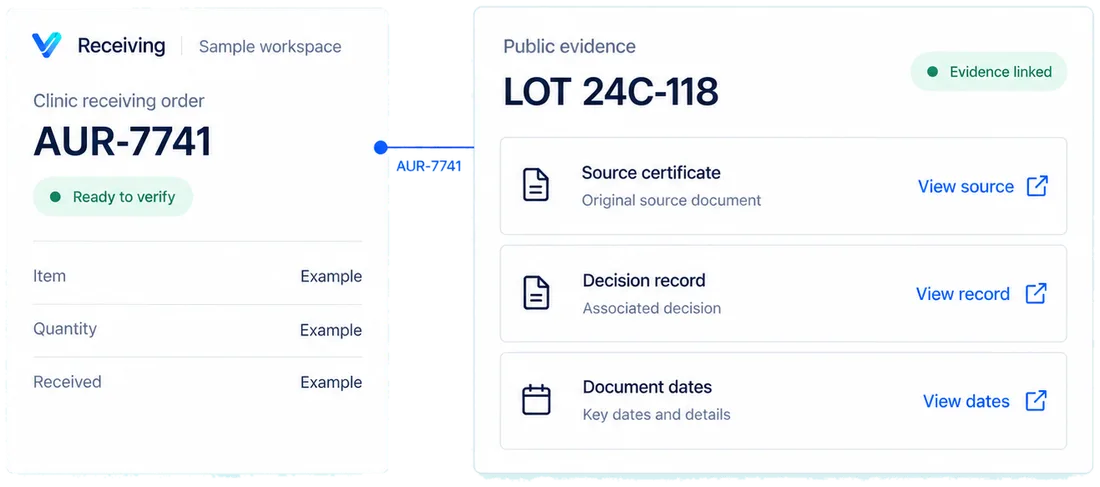
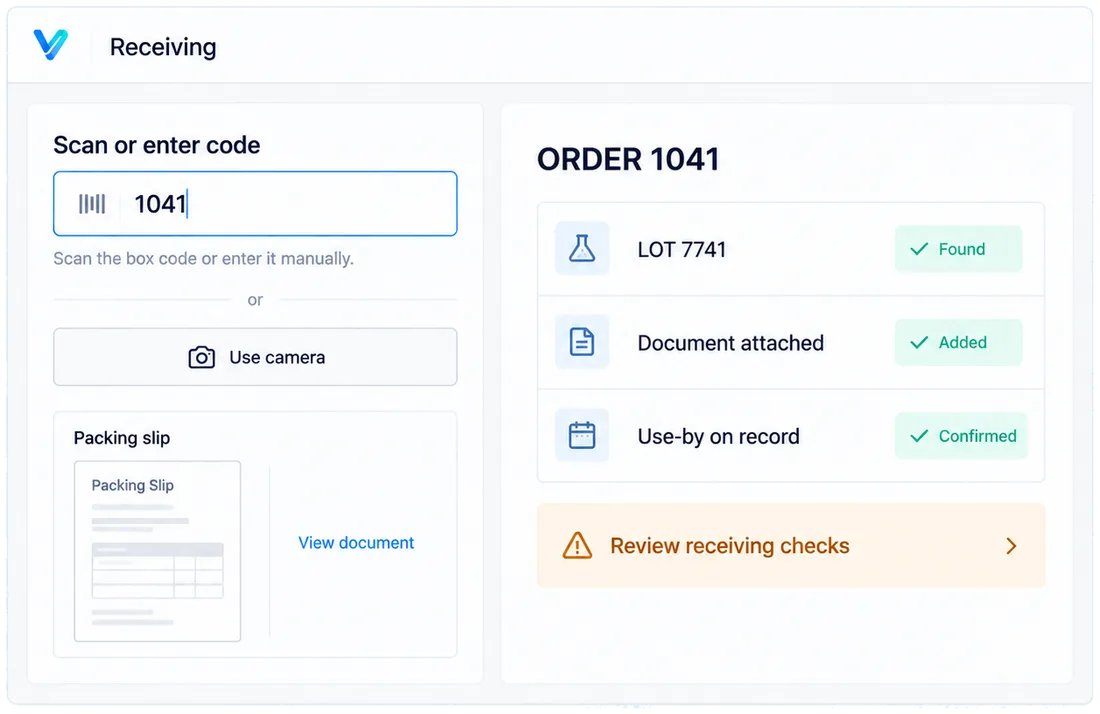
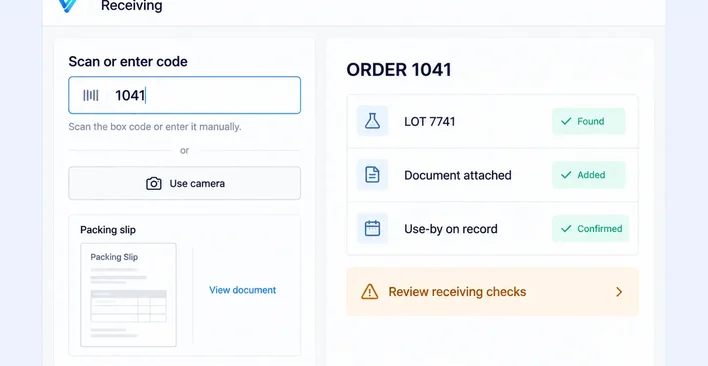
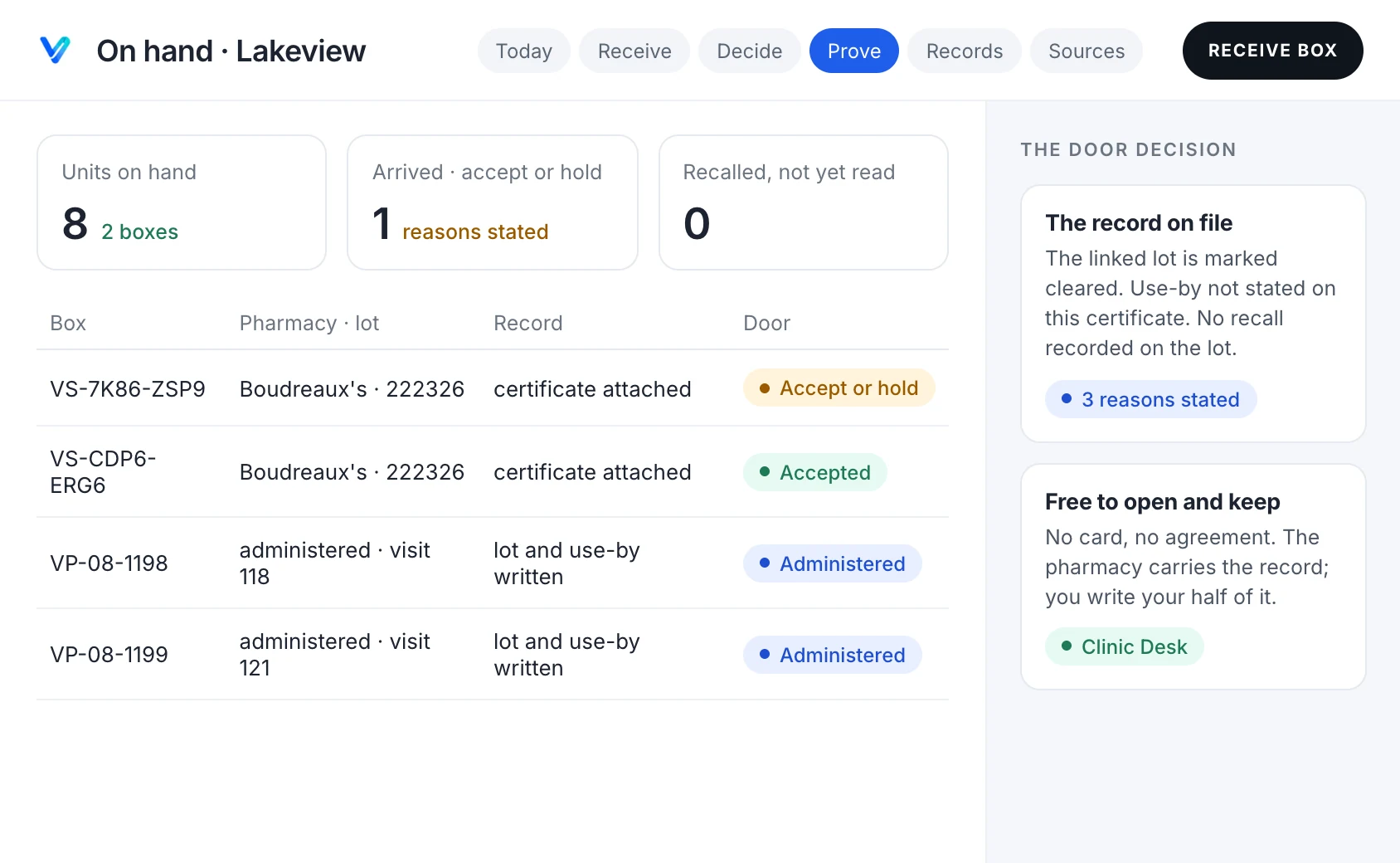
Scan the release slip once. Every vial lands on the desk with the certificate attached, accept or hold with the reasons stated.
One scan writes unit, lot, date and your visit reference. No name, chart or contact.
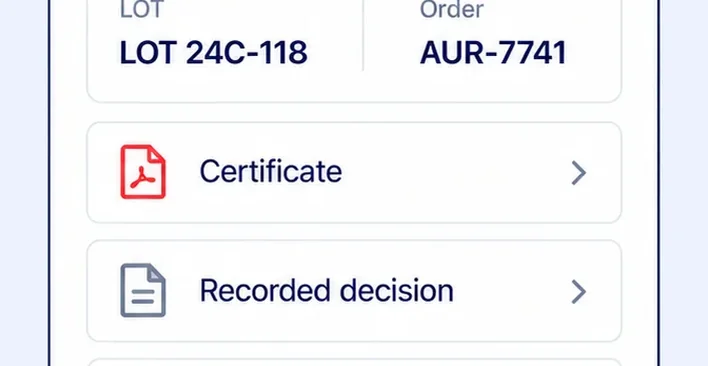
They scan the same code and read the record in plain words: what the certificate reports, who established each line, and the chain to your chair.
The lot is named on your desk. Patients who saved their vial are notified through their own account; the order list covers everyone else.
Care decisions stay with the clinician. The desk costs nothing, needs no agreement with the pharmacy, and works on any box.
01
Hand the patient their exact lot's independently checked documentation: product, lot, what the certificate reports, and who established each line, in plain words on their phone. The patient trusts your name on the vial, and now you can show them what stands behind it instead of shrugging at a question you could not answer.
The record answers the patient's question in the room, with the documentation behind their exact lot, which is a different conversation from asking them to trust your name.

02
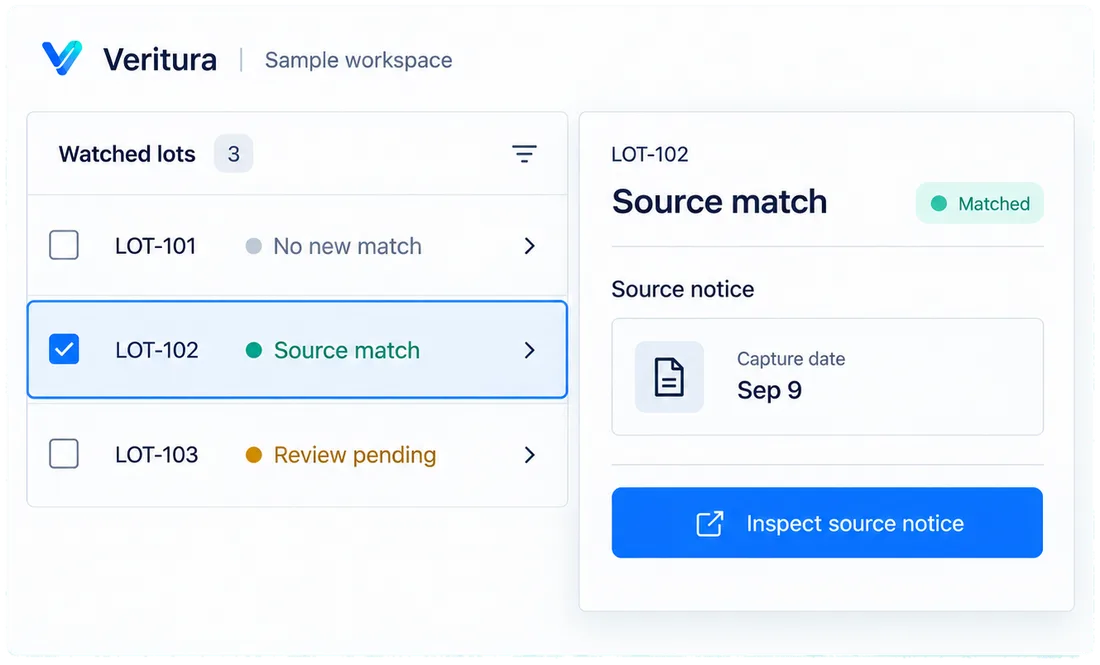
Everything you received stays matched against live FDA recall and enforcement records, automatically, for as long as you hold it. A matched signal flags the lot in your inbound portfolio and every released record minted from it, so you learn about a problem from the record rather than from a patient or a headline.
A signal lands on the lot in your portfolio and on every released record minted from it, so you learn about a problem from the record rather than from a patient.

03
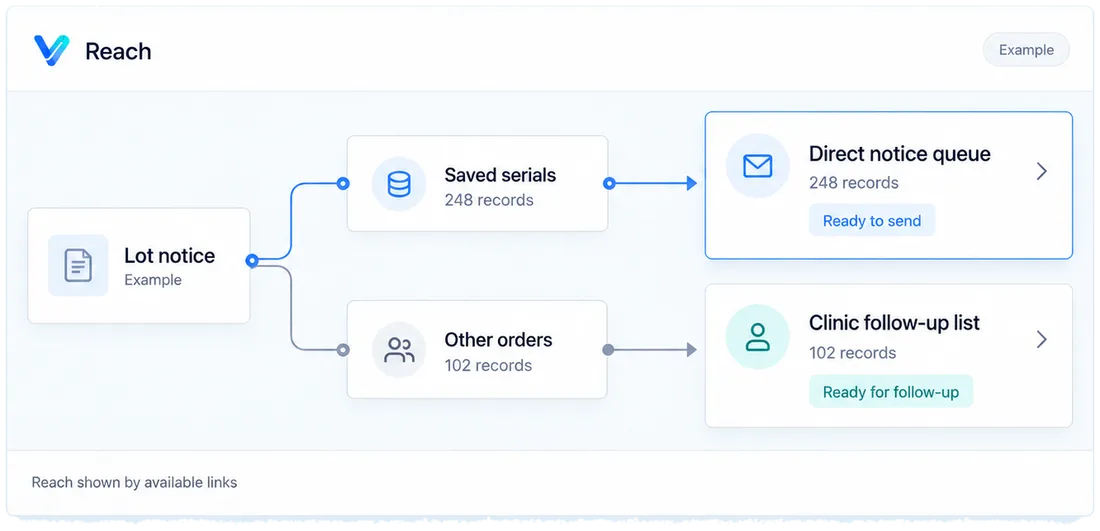
If a lot is recalled, Veritura notifies the patients who saved their vial, directly and PHI-free, and returns the order list for the ones only you can call. A recall that reaches the pharmacy but never the patient is not a recall that worked, and nothing about the patient ever enters Veritura to make it work.
The vial is the join. A patient who saved theirs is reached directly and PHI-free, and the order list covers everyone else, without a name ever entering the clinic’s record.

04
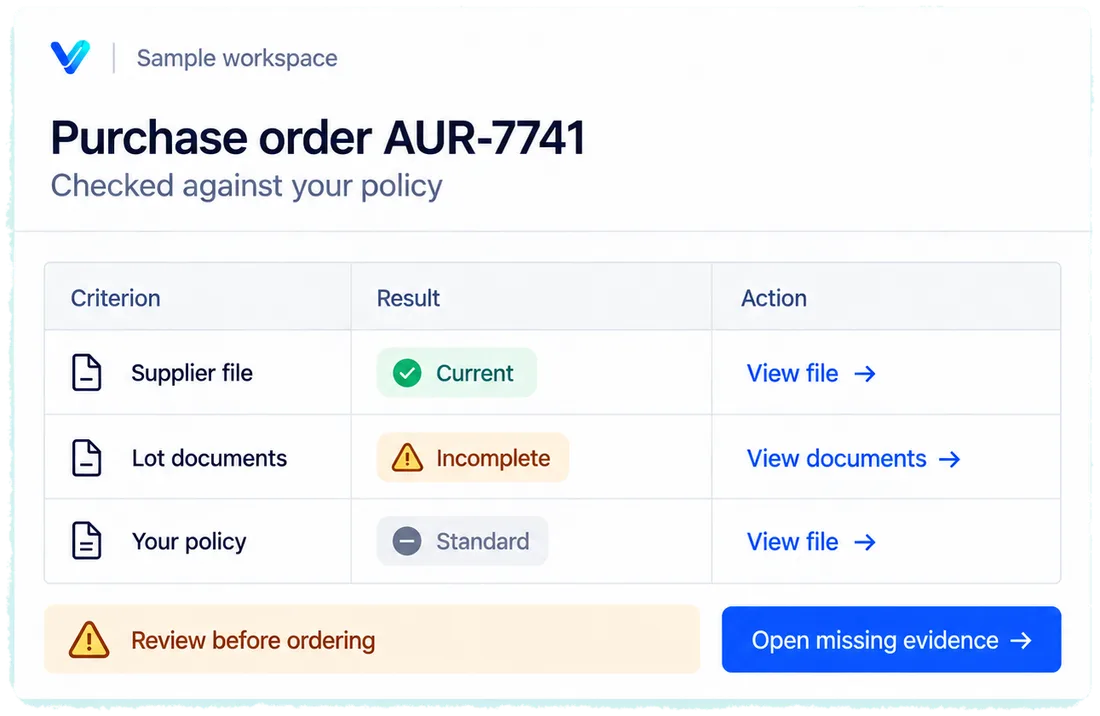
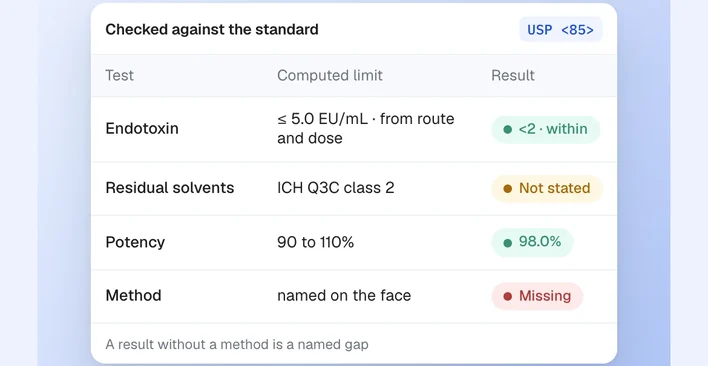
One order or lot is read against the policy you wrote, and the decision comes back Allow, Review, or Hold with every reason naming the rule that fired. You set the bar for what you will dispense; Veritura keeps the record of every decision, signed, so the reasoning is there when someone asks.
You set the bar for what you will dispense once, and every order is screened against it the same way, with the reasons kept for the day someone asks.

05
The Clinic Desk is free. A box arrives with a release slip; scan the code on it once and every vial lands on your desk with the pharmacy's certificate attached, and the desk shows accept or hold with the reasons stated: the record on file, the use-by, whether a recall is recorded. At the chair, one scan of the vial writes the administration line, lot and use-by, against the visit reference you type.
The pharmacy released the box and its record. The desk is where your half of that record gets written: which vial, from which lot, reached which visit, and when.

Why this exists
Federal law requires that bulk substances used in compounding be accompanied by a valid certificate of analysis, and names no method for establishing that a certificate is valid. Every pharmacy, facility, clinic, and platform in the chain is left to decide for itself. That gap is the whole reason an independent evidence layer exists.
The requirement appears in the federal compounding provisions for both 503A pharmacies and 503B outsourcing facilities. Validity is required. A way to establish it is not described.
In 2026 the FDA published a warning letter to a bulk supplier on its own published lists, describing relabelled active ingredient and altered manufacturing and retest dates. A buyer who checked the list and received a certificate still held a document that did not say what it appeared to say.
A large telehealth provider ran a per-batch certificate lookup from a code in each shipment for over a year and reported thousands of subscribers opening it every month. The demand for the record is not the question. Who checks it is.
Where the patient’s contact lives
Two records, one join. The clinic’s administration line carries the unit, the lot, the date and the clinic’s own visit reference, and nothing else. A patient who scans the vial can save it to their own space with an email they type themselves. That email lives in the patient’s account, never in the clinic’s record, and Veritura never joins the two.
No name, chart or contact. The reference is yours, and Veritura never asks what it means. The log a board asks a clinic to produce is this line, per vial, per visit.
Scanning the vial and saving it creates the patient’s own space. The email is held there, for their notices, and is never written to the clinic’s or the pharmacy’s record.
Saved vials are reached through the patient’s own account. Everyone else is reached through the order list your clinic already holds. Nothing about a patient is stored to make the first path work.
What changes
The patient's exact lot, independently checked, in plain words on their phone.
Saved vials notified directly and PHI-free, and the order list for everyone else.
A source's sourcing and a recent passport, seen before the order.
The API-sourcing desk is not yours. This is the documentation layer for medicine you dispense but did not make.
Choosing a compounder on a sales call is choosing blind. Check a source's sourcing and see a recent passport before you order.
The lots you received live in a dozen inboxes and packing slips. Veritura keeps them in one place, watched.
A supplier's standing can change the week after you buy. Every source you use is re-checked against live FDA enforcement records.
Before you open an account, check whether a substance is on the lists that govern whether it can be compounded.
Scan the code on the release slip and every vial is on your desk with its paperwork. Accept or hold with reasons, administer by scan, read a recall the moment it lands. No card, no agreement.
The complete text, for the reader who wants the whole story before a call.
The patient trusts your name on it, but you cannot show them the documentation behind it, because it lives with the compounder, if it exists at all.
And if that lot is ever recalled, you have no way to reach the specific patients who received it. The net everyone assumes is there simply is not.
Veritura gives you a record to show the patient, and a way to notify the reachable patients if a lot is recalled, with the call list for everyone it cannot address.
How it works for you
Hand the patient their exact lot's independently checked documentation.
Everything you received stays matched against live FDA recalls, automatically.
If a lot is recalled, Veritura notifies the patients who saved their vial, PHI-free, and returns the order list for the ones only you can call.
One order or lot is read against the policy the customer wrote, and the decision comes back Allow, Review or Hold with every reason naming the rule that fired.
The Clinic Desk is free. Scan the code on the release slip once and every vial in the box is on your desk with the pharmacy's certificate attached; the desk shows accept or hold with the reasons stated. One scan of the vial at the chair writes the administration line, lot and use-by, against the visit reference. A declared recall reaches the desk, and the patient's phone shows the chain.
You set the bar once, from three presets.
Everything must be complete, current and human-reviewed; any hard signal holds; a supplier with no qualification file at all is a hard hold rather than a soft review.
Cleared lot, current file, no hard signals. Gaps drop to review rather than hold.
Only the hardest public-record signals hold; everything else allows.
All three re-run automatically when new evidence arrives. Only Strict withholds the release: Standard and Lenient release a passport the moment the policy allows it, Strict keeps that click with a person.
An order is screened, a check is saved, or a shipment is received.
ClearGate evaluates. When the policy has auto-decide on, no one has to click Run; the trigger is recorded but the record produced is identical to a manual run.
The supplier qualification file and the lot are read against the policy. Hold beats review beats allow. Every reason carries the policy rule code that produced it.
The decision is signed and hash-chained to the one before it, with the policy version pinned inside the record.
The decision is stored.
A hold stamps clearGateHold on the lot, which blocks the passport on its own. A later allow or review clears that hold; the signed record itself is never mutated.
One decision comes back
No hold rule and no review rule fired.
At least one review rule fired and no hold rule did.
Does not meet policy
At least one hold rule fired.
Someone questions a decision. The stored evidence and the pinned policy snapshot are fed back through the same evaluator. A correct decision replays to the identical decision, label and reasons.
ClearGate reports documentation conformance against the policy the customer wrote. The customer owns the policy; Veritura owns the verification. A decision is never a product pass, a safety statement, or an approval.
Choosing a compounder on a sales call is choosing blind. Veritura lets you check a source's sourcing and see a recent passport before you order.
De-risk the purchase at the moment you spend.
The lots you received live in a dozen inboxes and packing slips. Veritura keeps them in one place, watched.
Always current, without a spreadsheet.
A supplier's standing can change the week after you buy from them. Veritura re-checks every source you use against live FDA enforcement, on its own.
A supplier's trouble reaches you as an alert, not a surprise.
Before you even open an account, you can check whether a substance is on the FDA lists that govern whether it can be compounded.
A free first look, no account, no card.
Evidence Passport per lot
Veritura shows the patient their exact lot's independently checked documentation. Trust that closes the visit and keeps the patient.
The document set met the configured policy. It describes the paperwork, not the medicine.
The issuing laboratory confirmed issuance through the recorded verification route.
OrderPO-DEMO-0413
LotLOT-7741-A
SupplierAurora Pharma Supply
Quantity250 g
ReceivedJuly 22, 2026
ReleasedJuly 23, 2026
Passport issuedJuly 23, 2026
Methodologyv1.0 · April 30, 2026
COA-7741-A.pdf · Issuing laboratory confirmed issuance through the recorded route
CoC-7741.pdf · Required identity, lot, and date fields present
SDS-SEMA-04.pdf · Current revision on file
GMP-AUR-2026.pdf · Supplied by the operator
Recorded in workspace · Container and label checked at receipt
LBL-7741-A.jpg · Lot identifier matches the certificate of analysis
A COA check or Passport records whether the documents are complete and consistent. It is not a safety, quality, efficacy, legality, or FDA-approval claim.
Veritura maps a recalled lot to every released record that put it in a patient's hands, PHI-free through the vial. The patients who saved their vial are notified directly, every other order comes back as a call list for you, and each of those passport pages flips to recalled the moment the recall is declared. Something no compounder or pharmacy system can do.
BlueRiver API Co · the published verify link for LOT-BR-0816 did not answer on three attempts. A corrected source route has been requested.
MON-DEMO-18·1 supplier · 1 lot · 1 order
Keystone Peptide Labs · LOT-KP-2407 carries no sterility or endotoxin result. Missing evidence is not a failed test; the lot stays in review until it lands.
MON-DEMO-21·1 supplier · 1 lot
openFDA enforcement and recall records re-captured for 4 suppliers. No match in the captured sources. Disposition unchanged.
Aurora Pharma Supply · ongoing review is due July 30, 2026. Five of six elements remain on file with current dates.
A monitoring signal maps a captured public record to the suppliers, lots, and orders it touches. It never changes a disposition on its own, and no match in a captured source is not proof of absence.
What you can skip
You do not run a receiving dock or a cGMP line, so the API-sourcing desk is not yours. This is the documentation layer for the compounded medicine you dispense but did not make.
Veritura does not test medicine, approve suppliers, recommend purchases, or make medical, legal, product-safety, or FDA-approval determinations. There is no paid or subjective placement: suppliers cannot pay for a better result or a better position, no listing fee, no subscription, and no pay-to-rank. Where results are ordered rather than filtered, the order is set by a published documentation-coverage grade, and that grade is never a recommendation, a preference, or a statement about any product.
No. The seal on the vial is the join. A patient who saves a vial does so with an email, and nothing about the patient enters Veritura.
Everyone who saved a vial from the lot is notified directly and PHI-free, and you get the order list for the ones only you can call.
No. A work email opens it, with no card and no agreement. Receiving by code, the door decision, administration by scan and the recall notice are all on the free desk. The pharmacy that released the box carries the record; you write your half of it.
Yes. Check a source's sourcing and see a recent passport before you order, and keep every source you use re-checked against live FDA enforcement records.
Still have questions? Talk to a person.