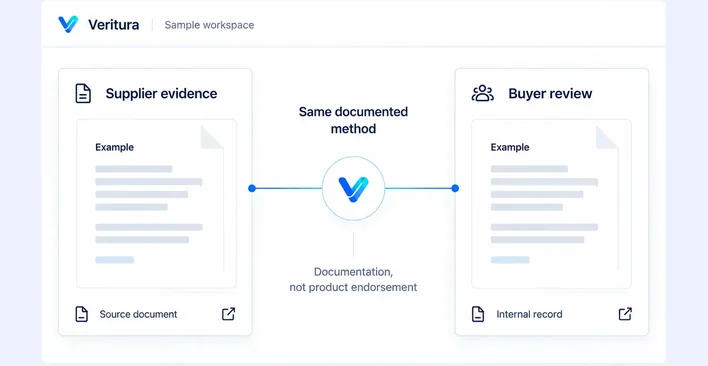
Underneath all six the same thing runs: the document is read, the gates evaluate what is actually on the record, and the decision is signed against the policy you wrote. What changes is which surface you work in and what you hand to whom.

01
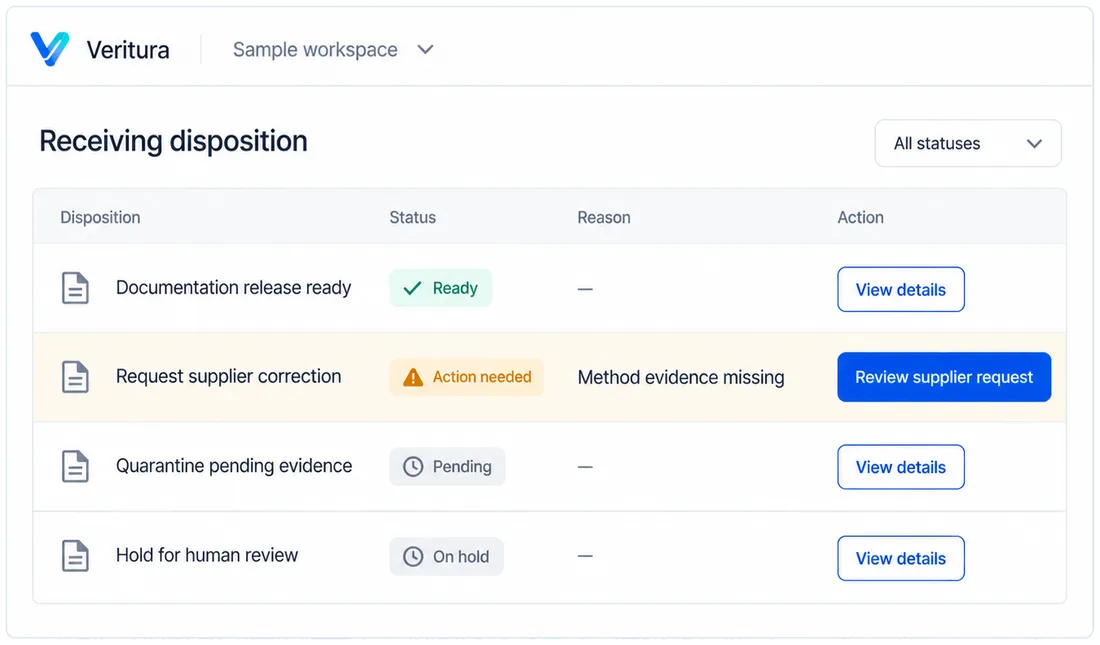
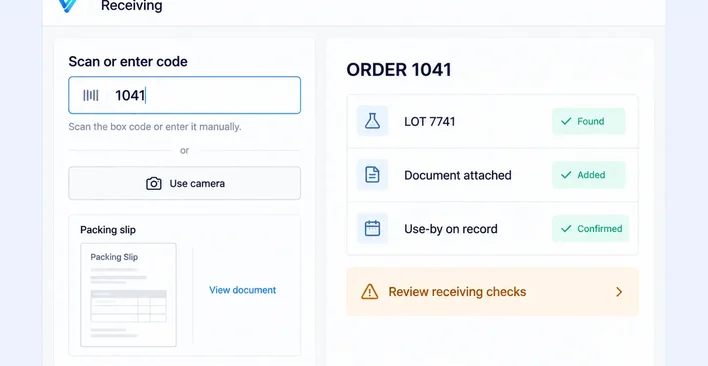
Every incoming lot arrives with paperwork. It is read on arrival, gated on what is actually on the record rather than what was ticked, and written to the lot with the reason attached. Seven gates evaluate the packet, a panel out of scope for the preparation is not counted as a gap, and one of four dispositions is written to the lot.
Reading on arrival and gating on the record, not on what was ticked, is what makes the receiving examination repeatable across techs and shifts.

02
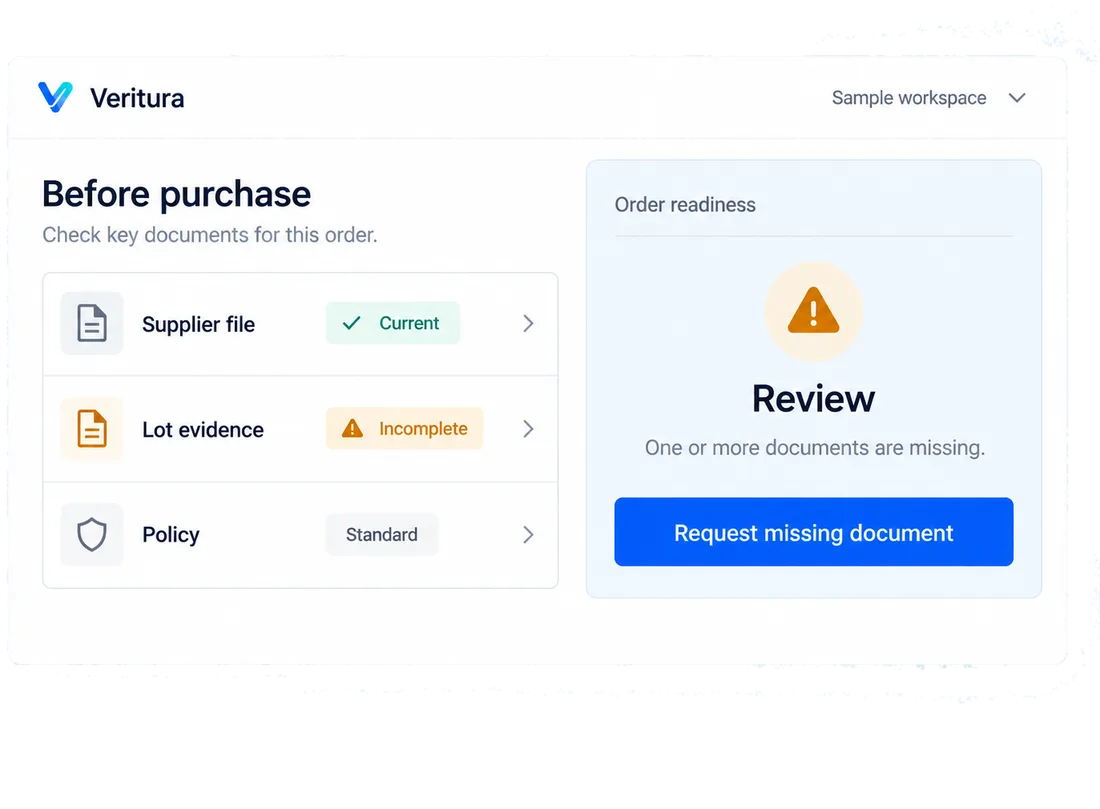
ClearGate reads the supplier's qualification file and the lot against your policy before the purchase. The answer comes back Allow, Review, or Hold, and every reason names the rule that fired. Keep the record after it arrives, and a matched enforcement record later flags the lot without rewriting the decision you already signed.
Screening before the purchase means the paperwork question is answered when it costs the least, and the signed decision is already on the record when the shipment arrives.

03
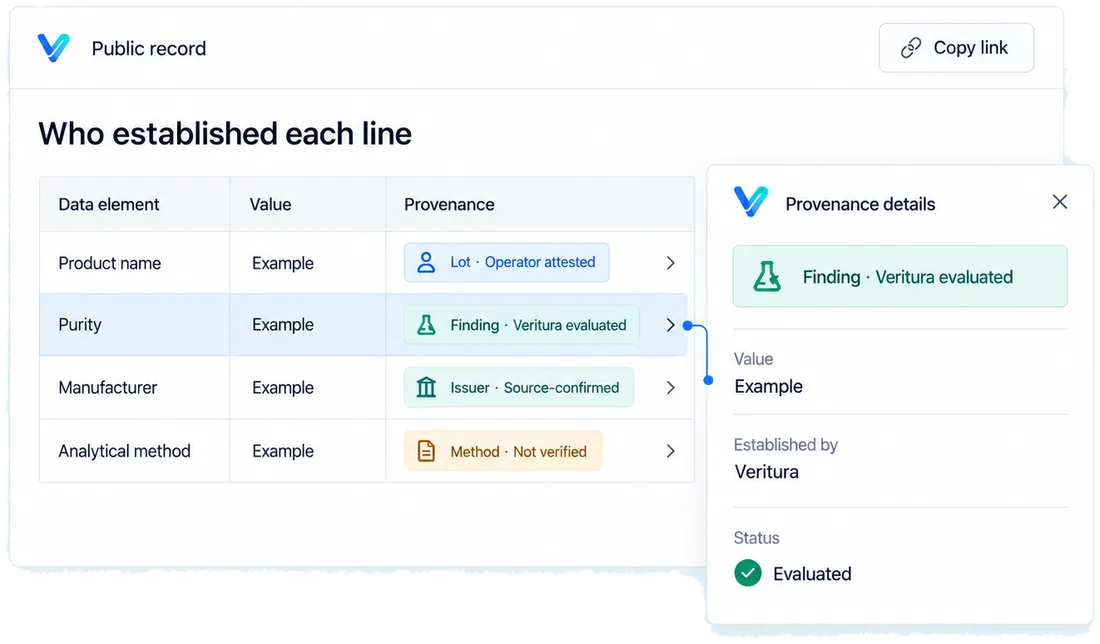
Give your customers a dated, independent record of every lot you ship. Represented identity and documentation elements are published with the label that says who established each one: Veritura evaluated, operator attested, or source-confirmed. A passport mints from a cleared lot or not at all, and every refusal names what is unmet.
Publishing with an origin label on every line is what lets a customer trust the record without trusting you, which is the point of an independent layer.

04
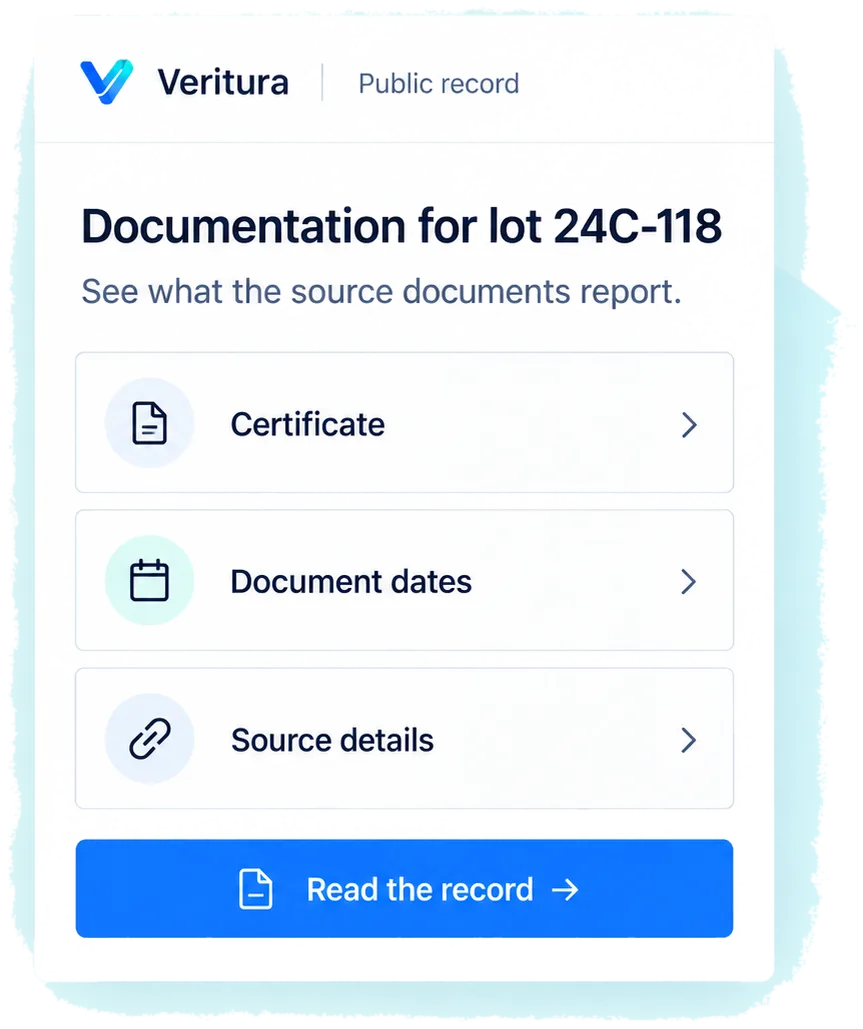
A patient scans the vial and reads the record for their exact lot: product, lot, what the certificate reports, and who established each line, in plain words with no score. If a notice ever matches that lot, the people who saved their vial are reached directly and PHI-free, and you get the order list for everyone else.
Reaching the patient through the vial, PHI-free, is the part no supplier portal can do, because it requires an independent record bound to the lot.

Why this exists
Federal law requires that bulk substances used in compounding be accompanied by a valid certificate of analysis, and names no method for establishing that a certificate is valid. Every pharmacy, facility, clinic, and platform in the chain is left to decide for itself. That gap is the whole reason an independent evidence layer exists.
The requirement appears in the federal compounding provisions for both 503A pharmacies and 503B outsourcing facilities. Validity is required. A way to establish it is not described.
In 2026 the FDA published a warning letter to a bulk supplier on its own published lists, describing relabelled active ingredient and altered manufacturing and retest dates. A buyer who checked the list and received a certificate still held a document that did not say what it appeared to say.
A large telehealth provider ran a per-batch certificate lookup from a code in each shipment for over a year and reported thousands of subscribers opening it every month. The demand for the record is not the question. Who checks it is.
What changes
The same read, gates, and signed decision, seen from the surface each operator works in.
Internal notes, pricing, and supplier language never reach a customer surface.
Your pharmacy, ordering, and inventory systems stay the source of truth.
One layer over the whole supplier base, whichever seat you sit in.
Receiving becomes one scan, the record stays inspection-ready, and every cleared lot stays watched.
A neutral, independent record of every lot you ship, from someone who is not you.
The paperwork behind what you dispense, shown to the patient from the vial in their hand.
Proof on every order at API scale, and a live view of every partner's sourcing.
The complete text, for the reader who wants the whole story before a call.
Every incoming lot arrives with paperwork. It is read on arrival, gated on what is actually on the record, and written to the lot with the reason attached.
Incoming API and component evidence is split across PDFs, inboxes, spreadsheets, and binders.
Supplier, product and lot number open the record, and the COA and a photo of the container label go with it. The file is hashed and read, and the photo is matched against the paperwork's product, strength and lot server side.
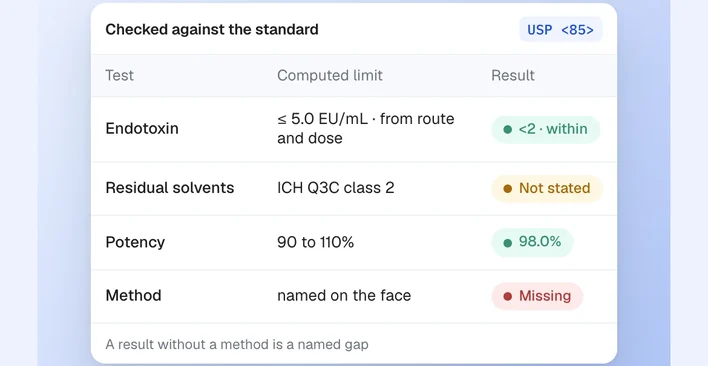
Seven gates evaluate what is on the record rather than what was ticked, and a panel out of scope for the preparation is not counted as a gap. One of four dispositions is written: documentation release ready, request supplier correction, quarantine pending evidence, or hold for human review.
The lot re-derives from its whole document set, and when your policy has auto-decide on, ClearGate re-runs on the lot and stores a signed decision. A recall published months later lands on that same lot.
Six-document packet complete; issuing lab confirmed the COA
Sterility and endotoxin evidence not supplied
COA lot and shipment label do not match; route unreachable
Six of six qualification elements on file; packet complete
Packet complete; no indexed reuse signal
Packet complete; residual solvents within the printed specification
Undisclosed salt form on the COA; net peptide content unstated
Packet complete; certificate of conformance on file
A faster, more consistent evidence record, without replacing the receiving decision.
A COA check or Passport records whether the documents are complete and consistent. It is not a safety, quality, efficacy, legality, or FDA-approval claim.
Give your customers a dated, independent record of every lot you ship.
A supplier’s own portal cannot provide a record of what was checked that the supplier did not write, or say what stays outside scope.
Represented identity and documentation elements are published with the label that says who established each one: Veritura evaluated, operator attested, or source-confirmed. Every dated document carries its own current, due, or overdue state.
A passport mints from a cleared lot or not at all. Every refusal names what is unmet: the lot is not cleared, a ClearGate hold stands, a recall signal stands, or your policy requires a human-reviewed lot.
A later enforcement match stamps a post-release signal on every passport minted from that lot, without rewriting the decision that released it. Corrections, credential state and source refreshes stay dated and inspectable.
Stated in words, with no numeric score. A paperwork-completeness read, never a product-quality or safety determination.
The issuing laboratory confirmed issuance through the recorded verification route.
OrderPO-DEMO-0413
LotLOT-7741-A
SupplierAurora Pharma Supply
Quantity250 g
ReceivedJuly 22, 2026
ReleasedJuly 23, 2026
Passport issuedJuly 23, 2026
Methodologyv1.0 · April 30, 2026
COA-7741-A.pdf · Issuing laboratory confirmed issuance through the recorded route
CoC-7741.pdf · Required identity, lot, and date fields present
SDS-SEMA-04.pdf · Current revision on file
GMP-AUR-2026.pdf · Supplied by the operator
Recorded in workspace · Container and label checked at receipt
LBL-7741-A.jpg · Lot identifier matches the certificate of analysis
Customer-safe documentation proof, without product approval or certification.
Veritura verifies the completeness and consistency of documentation and sourcing, not product quality, safety, efficacy, legality, or FDA approval. A "Verified by Veritura" profile or check means the submitted paperwork was read for documentation completeness, consistency, and evidence status; it is not a certification, an approval, or a representation that any product is safe.
Screen it before you order. Keep the record after it arrives.
A clinic relies on documentation created across suppliers, laboratories, and dispensing partners.
ClearGate reads the supplier's qualification file and the lot against your policy before the purchase. The answer comes back Allow, Review, or Hold, and every reason names the rule that fired.
The record you hand someone prints the substance, the lot, the order reference, what the certificate stated, the lab and the date. Documentation completeness is stated in plain words, never as a score.
A matched enforcement record flags the lot in every account that logged it and appends a post-release signal to the passports minted from it. The signed decision you already made stays exactly as it was.
The evidence, the questions, and the decision receipt stay connected to the order.
A COA check or Passport records whether the documents are complete and consistent. It is not a safety, quality, efficacy, legality, or FDA-approval claim.
A patient scans the vial and reads the record for their exact lot.
Patients see strong product claims but cannot inspect the documentation record or its limits.
The QR on the vial carries a serial in the shape VS-XXXX-XXXX, printed from a 30-symbol alphabet with every ambiguous character removed. Scanning it, or typing it, opens the record for that exact lot.
The page shows the substance, the lot, what the certificate stated, the lab and the date, and states documentation completeness in plain words with no score. No report IDs, no file names, no hashes: the certificate stays with the pharmacy.
Saving a vial stores an email, the serial and the notice history, so one button can reach that person if the lot's documentation record changes. Care questions stay with the dispensing clinician or pharmacy, and record corrections route to Veritura.
Sample data · not a live account
SupplierAurora Pharma Supply
OrderPO-DEMO-0413
ReleasedJuly 23, 2026
Plain-language provenance instead of a numeric score a patient could mistake for a safety rating.
A COA check or Passport records whether the documents are complete and consistent. It is not a safety, quality, efficacy, legality, or FDA-approval claim.
Proof on every order, by API, across every partner you route to.
A platform routes orders across multiple partners while the documentation record stays fragmented.
POST the document to /v1/check with a Bearer key and the order is read against your configured policy. The answer carries its reasons and the policy version, and over the per-key concurrency limit you get a 429 with Retry-After rather than a silent queue.
A passport releases from a cleared lot or not at all. An order that arrived before its lot cleared parks at source_review, so nothing is lost and nothing is published early.
passport.issued, lot.recall_hit and supplier.alert are the three subscribable events, each signed with an HMAC over the body. A matched notice reaches every linked lot, order and passport without rewriting the earlier decision.
Plain mean of the five factor values below. It measures the documentation on file, not the medicine, the supplier, or the outcome.
Identity and lot alignment
Submitted documents whose identity, lot, and date fields agree with the shipment record
Lots whose packet carries every test the workspace policy requires
Certificates whose published verification route answered when it was called
Suppliers with a dated openFDA enforcement and recall capture on file
Qualification elements on file and within their review date
This panel measures the documentation on file. It is not a safety, quality, or product-performance measure, not a supplier ranking, and not an approval. An element shown as not supplied is a gap in the paperwork, not a finding about the medicine.
ClearGate, Passport, and notice events fit the order workflow you already run.
A COA check or Passport records whether the documents are complete and consistent. It is not a safety, quality, efficacy, legality, or FDA-approval claim.
Get your documentation read by a party that does not sell the product.
Every supplier says their paperwork is complete. Buyers have no independent way to confirm it.
Your documents go through the same four lanes a buyer's do: the issuing lab, the standard, the file's own internals, and every other document on record. Each element is published with the label that says who established it.
Use the credential and its link on your site, in a diligence request, or with existing customers. A buyer opens it and reads what was checked, what is still could-not-verify, and the date each element was captured.
Optional monitoring runs two sweeps on a cycle: FDA enforcement queried by firm name, and a broader net that scans recent enforcement records for lot numbers already on record. Only a lot-level match, or a confirmed or strong firm-name match, sends an email; a weak name-only match surfaces for review instead.
Ongoing review due Jul 30
Corrected source route requested
The score grades the documentation evidence on file only. It is not an approval, a ranking, a certification, or a statement about any product.
Independent and portable. It works with any buyer, with or without a partner network.
A "Verified by Veritura" profile or badge means an automated documentation profile checked submitted paperwork for completeness, consistency, field identity, forensic signals, FDA-registration evidence status, and an active public verify link, by a party that does not sell the product. It is not a certification, an approval, a human review, or a claim that any product is safe, effective, legal, or FDA-approved, and it may not be presented as one.
Veritura does not test medicine, approve suppliers, recommend purchases, or make medical, legal, product-safety, or FDA-approval determinations. There is no paid or subjective placement: suppliers cannot pay for a better result or a better position, no listing fee, no subscription, and no pay-to-rank. Where results are ordered rather than filtered, the order is set by a published documentation-coverage grade, and that grade is never a recommendation, a preference, or a statement about any product.
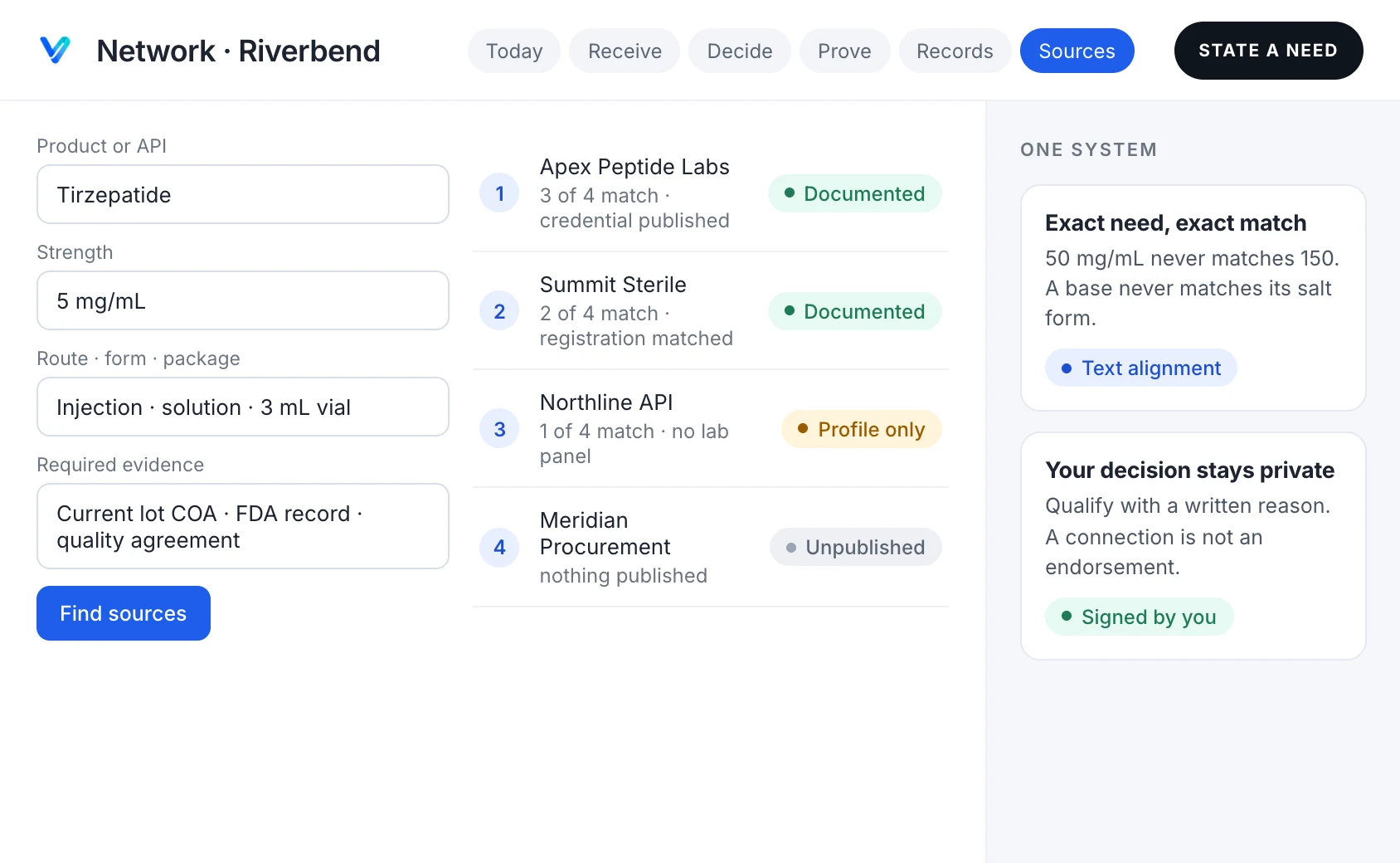
Send a note, whether it is one document or a whole supplier base. We run your own paperwork through the check and show you what is present, what is missing, and where the trail is exposed.
Yes. The document is read, the gates evaluate what is on the record, and the decision is signed against the policy you wrote. What changes is which surface you work in and what you hand to whom.
No. Clinics, med spas, and telehealth platforms use the documentation layer for medicine they dispense but did not make. Pharmacies and 503B facilities use receiving and release.
Operators see the full record. Customers and patients see only the cleared, customer-facing part, with internal notes, pricing, and supplier language filtered out.
Still have questions? Talk to a person.