Med spas and wellness clinics

Show the patient the paperwork behind their vial.

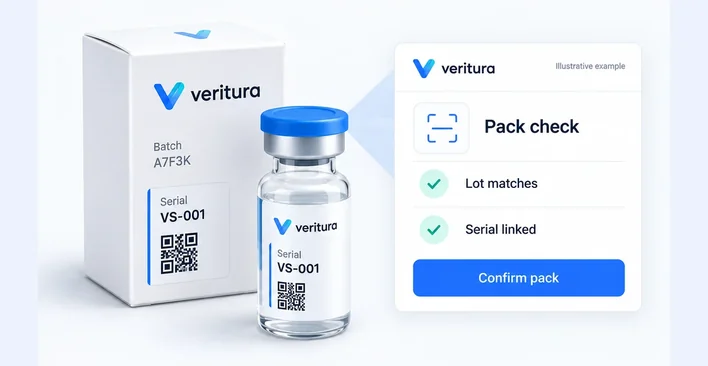
Your patients have read the headlines about counterfeit and contaminated GLP-1 and peptide product. They walk in already suspicious. A scan on the vial opens the documentation record for that exact lot, read by a party that does not sell it.

One COA check, no account, no card.

The problem

Patients walk in already suspicious.

They are not asking you to be more confident. They are asking to see something.

Your patients have read the headlines about counterfeit and contaminated GLP-1 and peptide product. They walk in already suspicious, and the gray-market seller down the road undercuts you on price.

You keep the paperwork on file. You have no way to show it in the moment, and "trust me" is exactly what a counterfeit seller says too.

Veritura puts an independent documentation record for the exact lot in the patient's hand, issued by a party that does not sell, source, or distribute the product.

How it works for you

Three steps, then it runs itself.

  1. 01

    Patient scans the vial

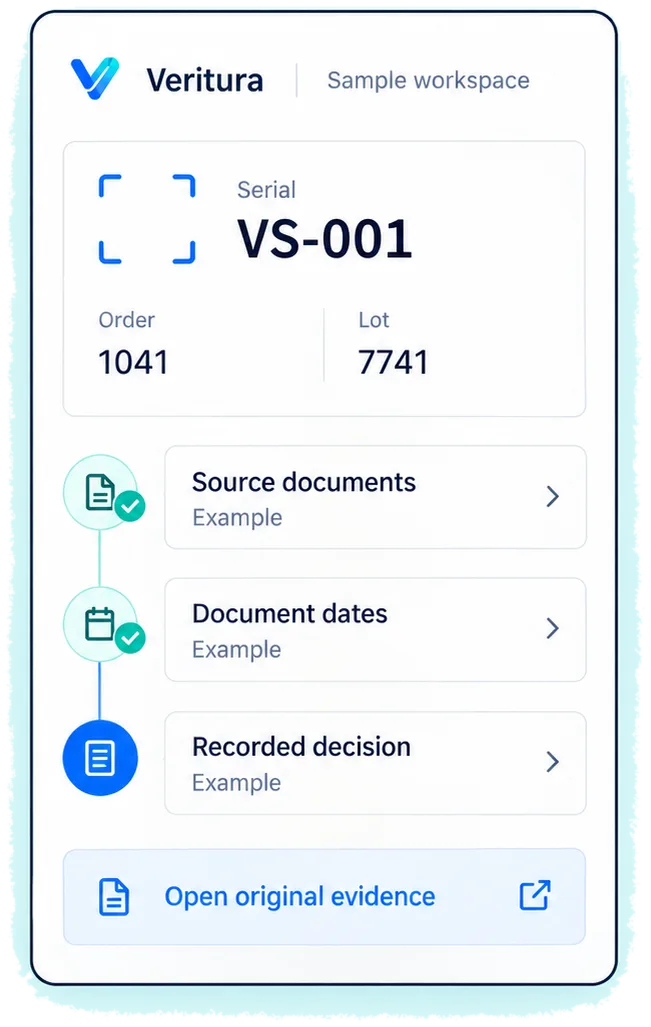
    A QR on the released seal opens the customer-safe Evidence Passport for their exact order and lot.

  2. 02

    They read the record

    Product, lot, what the certificate reports, and who established each line, on their phone before the injection.

  3. 03

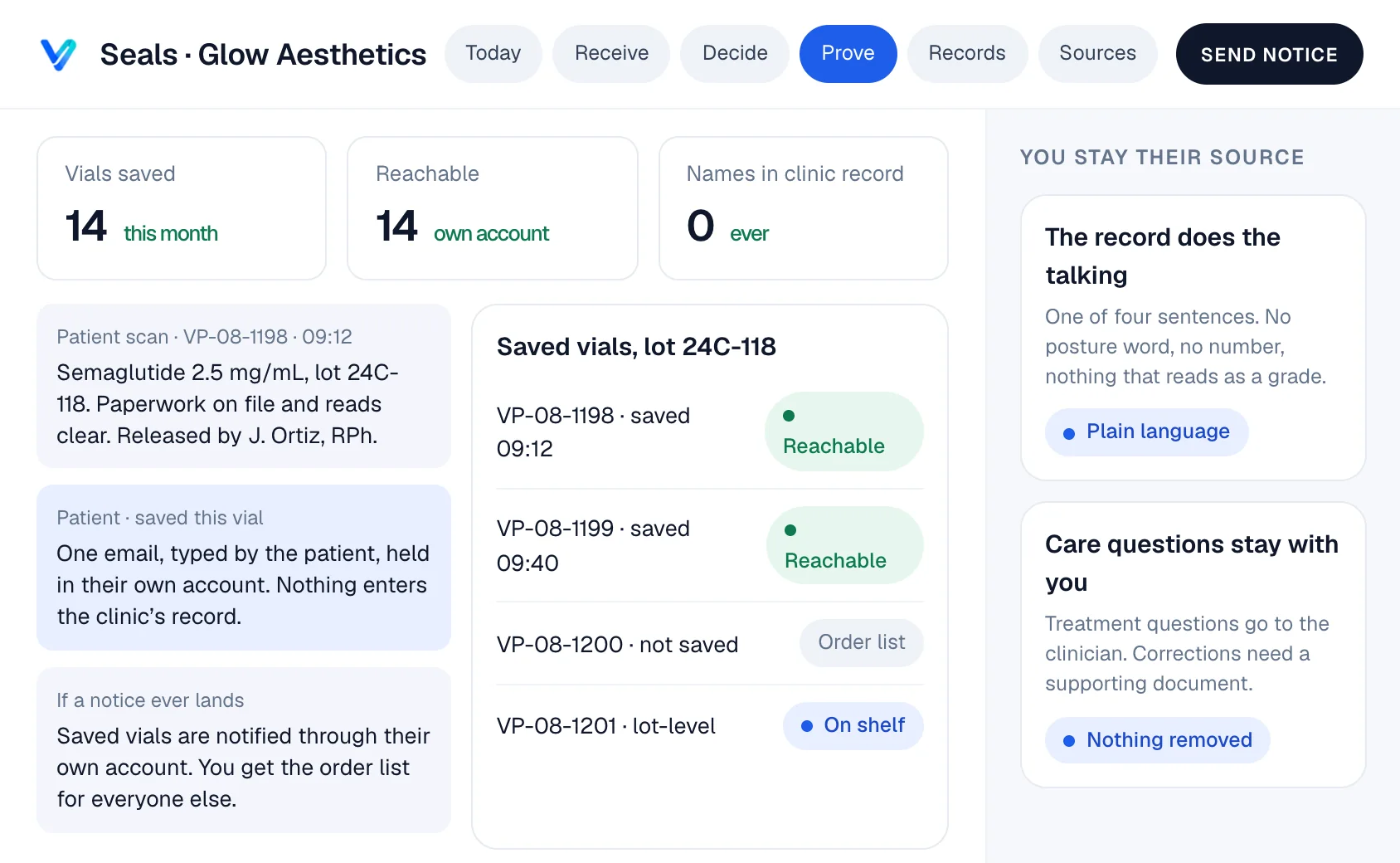
    You stay their source

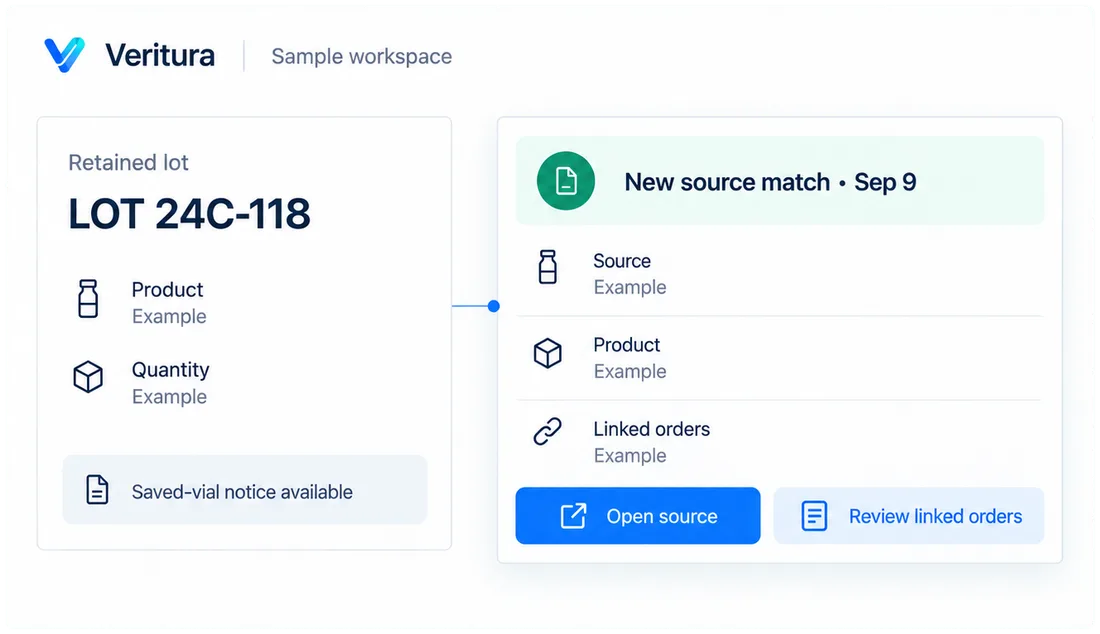
    Every lot you carry is watched against live FDA recall and enforcement records, so a later notice reaches you and every linked record.

The vial, from the lot to the scan.

Serialized labels are minted against a lot, printed, applied to the vial, and scanned by whoever holds it. One button then reaches every person who saved one.

  1. Operator

    A lot is ready to go out the door.

    Serials are minted against that lot in the shape VS-XXXX-XXXX, collision-checked against every serial already issued and against the batch's own output. When order references are supplied, each serial is bound one-to-one to one order at mint time.

    Record state: Seal batch created
  2. Operator

    The batch exists.

    Labels print as an Avery sheet, as single thermal labels, or as raw ZPL fed straight to the printer. The QR is the printer's own symbol at a magnification that clears the quiet-zone requirement on all four sides.

    Record state: Labels in hand
  3. Operator

    Packing.

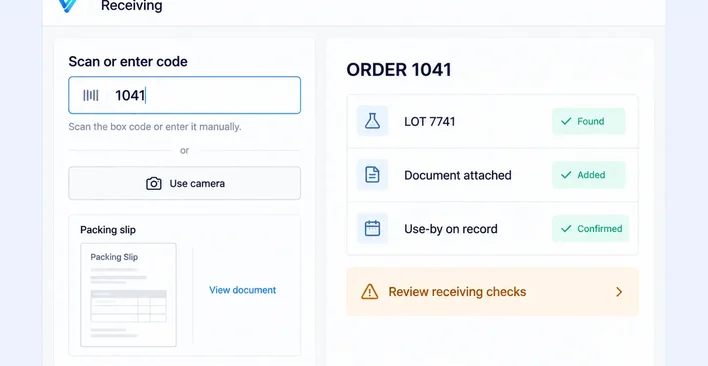
    The label goes on the vial. Where serials were bound to orders, packing becomes the same label-to-packing-slip match the pharmacy already performs for addresses.

    Record state: Vial sealed
  4. Patient or buyer

    The person holding the vial scans the QR or types the serial.

    The public page at /u/<serial> shows the substance, the lot, what the certificate stated, the lab and the date, plus the verify link when the lot has a released production passport. Values and provenance labels only: no report ids, no file names, no hashes. The certificate stays with the pharmacy.

    Record state: Scan page shown
  5. Patient or buyer

    The person chooses to save the vial.

    An email is entered. The claim starts at pending_confirm and only the emailed link activates it. Two or more simultaneously active claims on one serial is surfaced as the same-seal-claimed-twice signal.

    Record state: pending_confirm -> active, or removed on opt-out
  6. Operator

    Something changes on the lot's documentation record.

    One button reaches every active claimant across every seal batch of that lot, deduped so one address gets one notice, each deep-linked to that person's own vial page. One notify per lot per hour.

    Record state: Notice sent and written to the vial's history

A claim stores an email, a serial, a status and timestamps. There is no field for a name, an address, a condition or a prescriber, so there is nothing to leak.

At most five live claims on one serial, at most ten claim requests from one address per day, and a global daily ceiling on confirmation emails.

A notice says the documentation record changed. It is not a safety or quality determination, and the notice tells the reader to contact their pharmacy or provider with any medication question.

What the patient sees
One record, one lot, in plain language.

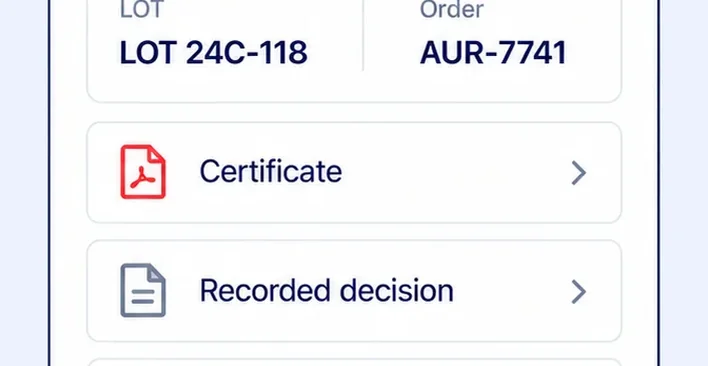
The scan opens the customer-safe Passport for the represented order and lot. It shows what the paperwork reports, where each status came from, the notice state, and the explicit limits.

Sample data · not a live account

Evidence Passportveritura

Semaglutide (base) API

LOT-7741-A

Documentation

Reads complete

Origin

Source-confirmed
Supplier
Aurora Pharma Supply
Order
PO-DEMO-0413
Released
July 23, 2026

Documents

6

  • Certificate of analysis

    Source-confirmed

  • Certificate of conformance

    Veritura evaluated

  • Safety data sheet

    Veritura evaluated

Evidence Passport · Local sample data. Not a live account. Every supplier, lot, order, and document shown here is fictional.

The patient scans the label and sees this, before the injection.

Product and lot
As represented on the paperwork for that exact vial
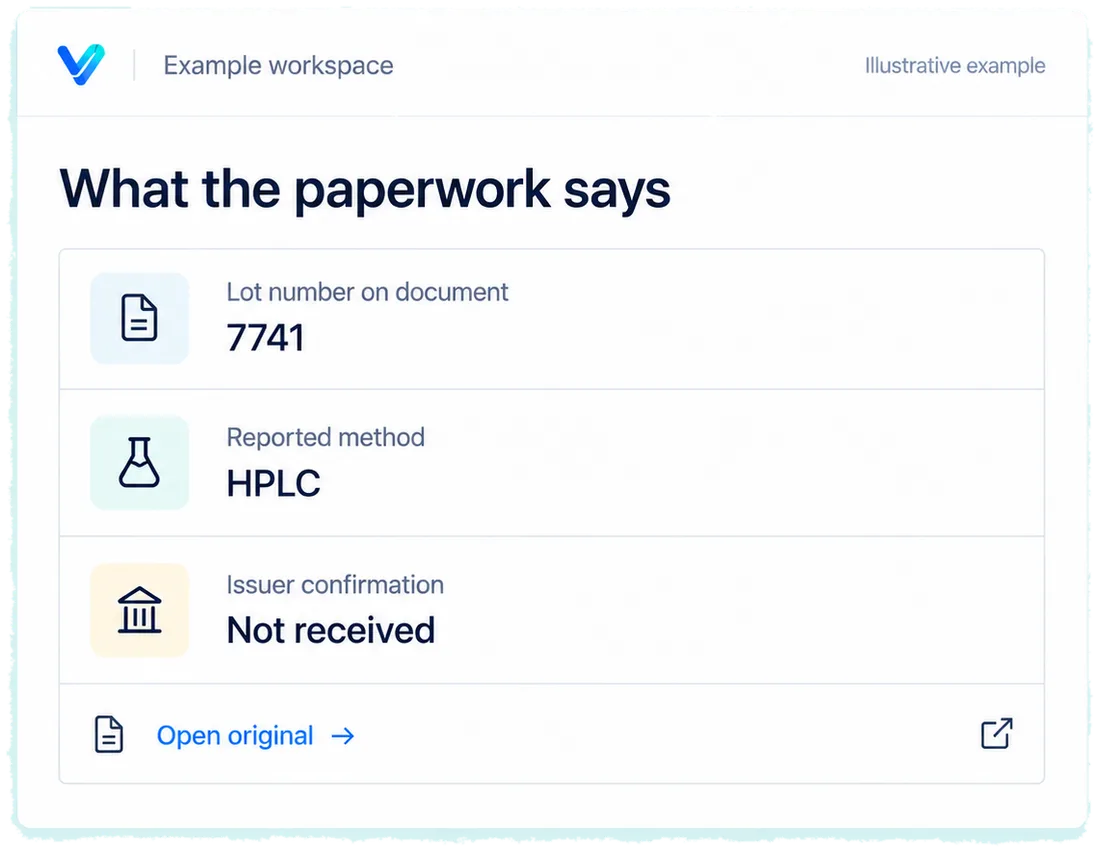
What the certificate reports
The documented result, shown as the document states it
Evidence origin
Veritura evaluated, Operator attested, Source-confirmed, or Human-reviewed
Documentation completeness at issue
Stated in words, for example documentation reads complete
Notice state
Whether a later public FDA signal has matched the lot
What it does not establish
Not a safety, quality, efficacy, legality, or FDA-approval claim

The words on that screen, in full.

Documentation completeness reaches the patient as one of four sentences. There is no posture word on that page and no number.

  • Shown to the patient or buyer: Documentation reads complete
  • Shown to the patient or buyer: Documentation has gaps
  • Shown to the patient or buyer: Largely undocumented
  • Shown to the patient or buyer: Could not read this document

A paperwork-completeness read, never a product-quality or safety determination.

The patient page prints the band in words and no numeric score. A number beside the name of someone's medicine reads as a quality grade, which it is not.

  • Care questions

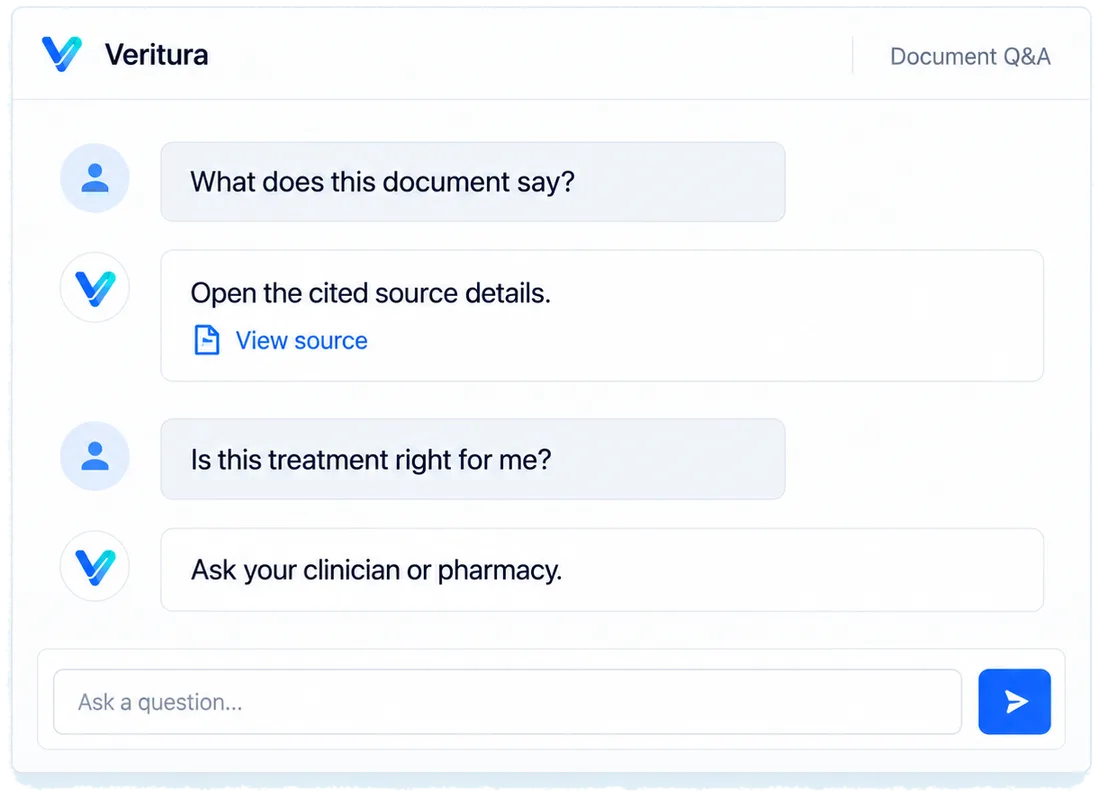
    Anything about treatment stays with the dispensing clinician or pharmacy. The record answers what the documentation says, and nothing about a patient's care.

  • Record corrections

    Corrections route to Veritura with the report ID, the observation at issue, and the document that supports the change. A supported observation is never removed for being unfavorable.

What suits you

Every feature closes a gap you have today.

  • Scan-the-vial Passport

    "Trust me" is what a counterfeit seller says too. Veritura lets the patient scan the vial and read the documentation record for their exact lot. The trust moment at the point of care, in their hand.

  • Independent per-lot record

    Your own word is worth what any other seller's word is worth to a nervous patient: nothing. Veritura does not sell, source, or distribute product, so the record does not rest on your say-so.

  • Recall watch

    Selling the vial is not the end of your duty to the patient. Veritura watches every lot you carry against live FDA recall and enforcement records, and a matched signal flags the linked lots, orders, and Passports.

  • Screen your source

    Stocking on a relationship is stocking on hope. Read the compounder's documentation before you buy, against a 6-element supplier qualification file that carries a living status of Current, Due, Overdue.

  • Start on the Free plan

    Unsure about a vendor's certificate before you commit? The Free plan reads one Certificate of Analysis with no account and no card, and shows what a documentation read turns up.

What you can skip

No cGMP paperwork, no API bench. This is the trust layer for the product you carry.

What the record does not establish

The limits are on the record, not under it.

A patient reads these on the same page as the evidence. They are part of the record, never fine print beneath it.

Boundary

A COA check or Passport records whether the documents are complete and consistent. It is not a safety, quality, efficacy, legality, or FDA-approval claim.

Limitation

A result is a documentation posture of Clear, Review, or Hold on the document set. A ClearGate decision of Allow, Review, or Hold is a separate axis, resolving one order against the policy you configure. Both describe the paperwork, not the medicine.

Limitation

Authenticity limits. A report may identify metadata, repeated file signals, links, and inconsistencies. It cannot prove document provenance unless an issuing lab or source independently confirms it.

Limitation

No purchase recommendation. Reports do not recommend, endorse, discourage, rank, or facilitate purchases from any vendor.

Before you send documents

Limitation

Users should redact patient data, protected health information, patient identifiers, prescription records, nonessential pricing terms, and unrelated commercial information before submitting materials for review.

See it on your own documents.

Independent documentation diligence. No safety, quality, legal, or FDA-approval claims.