This page is how the work is governed and where its limits are. Veritura checks paperwork. It never tests the product.

Checked against named public sources
A mechanical, repeatable process, so two reviewers reach the same record and an inspector can follow it. Every material observation points back to a source file, a field, a hash, or an explicit limitation. Findings are tied to evidence, not opinion, and if the evidence changes the record is corrected transparently with the basis for the change preserved.
A mechanical, repeatable process, so two reviewers reach the same record.
01
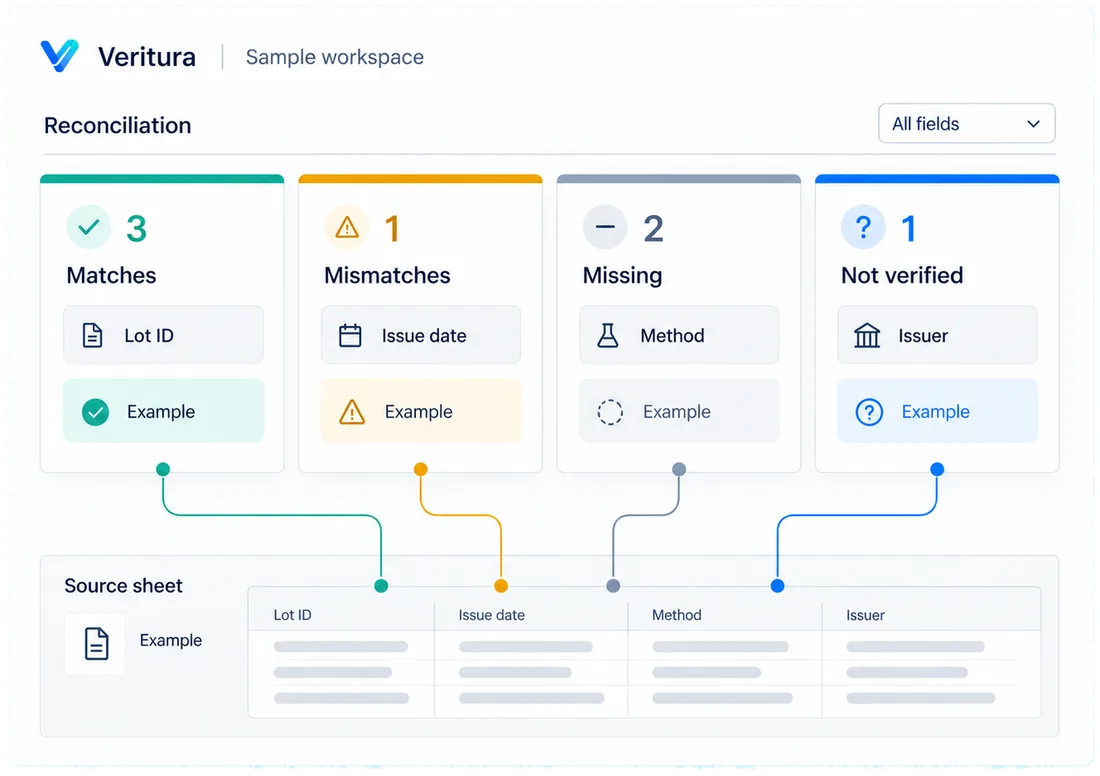
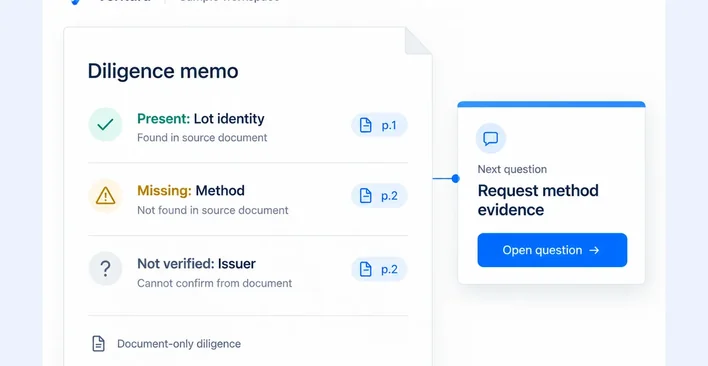
Every reviewed document lands in one of four buckets: matches, mismatches, missing documentation, or could not verify. There is no subjective or paid ranking, no vendor scoring, and no certification of product quality anywhere in the method, and the published check catalogue lists every row as a signal for a person's review.
The four buckets are the whole vocabulary of a finding, which is why an inspector can follow a record months later and reach the same conclusion without a briefing.

02
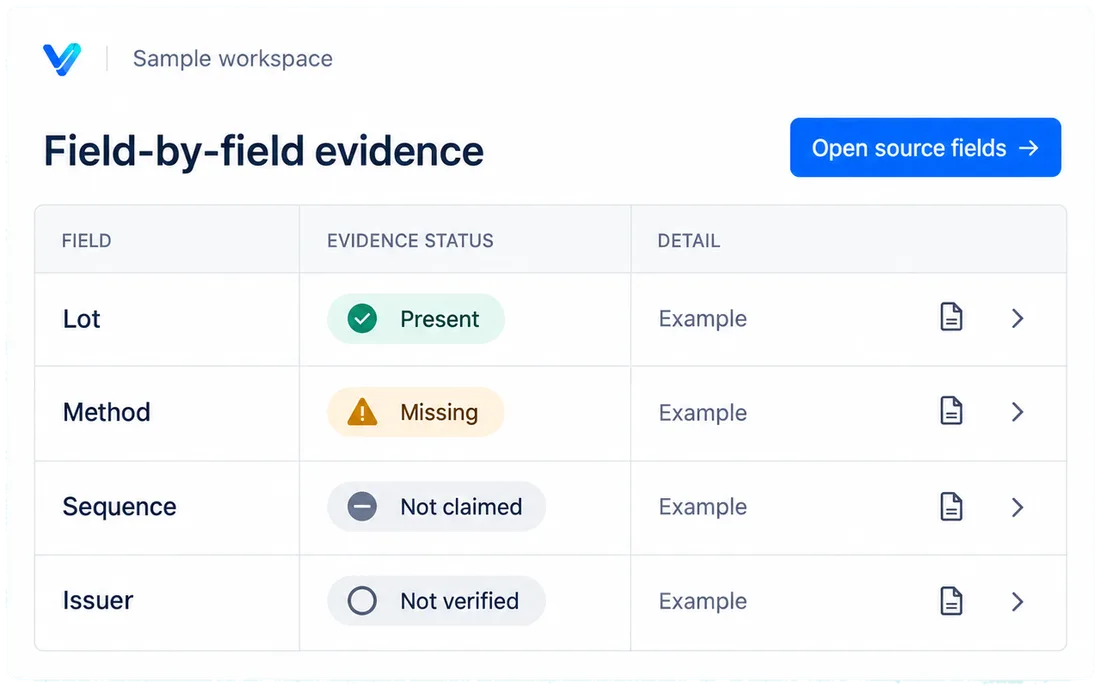
Certificate, lot, laboratory, method, purity, mass-spectrometry and sequence evidence, sterility, endotoxin, strength, address, and disclaimer language. Presence or absence is recorded mechanically, and a field the document does not claim to state is recorded as not claimed rather than as missing, so the record never overstates a gap.
Not claimed is distinct from missing on purpose. A document that never claimed to state a field is not penalised for it, and the record never overstates a gap.

03
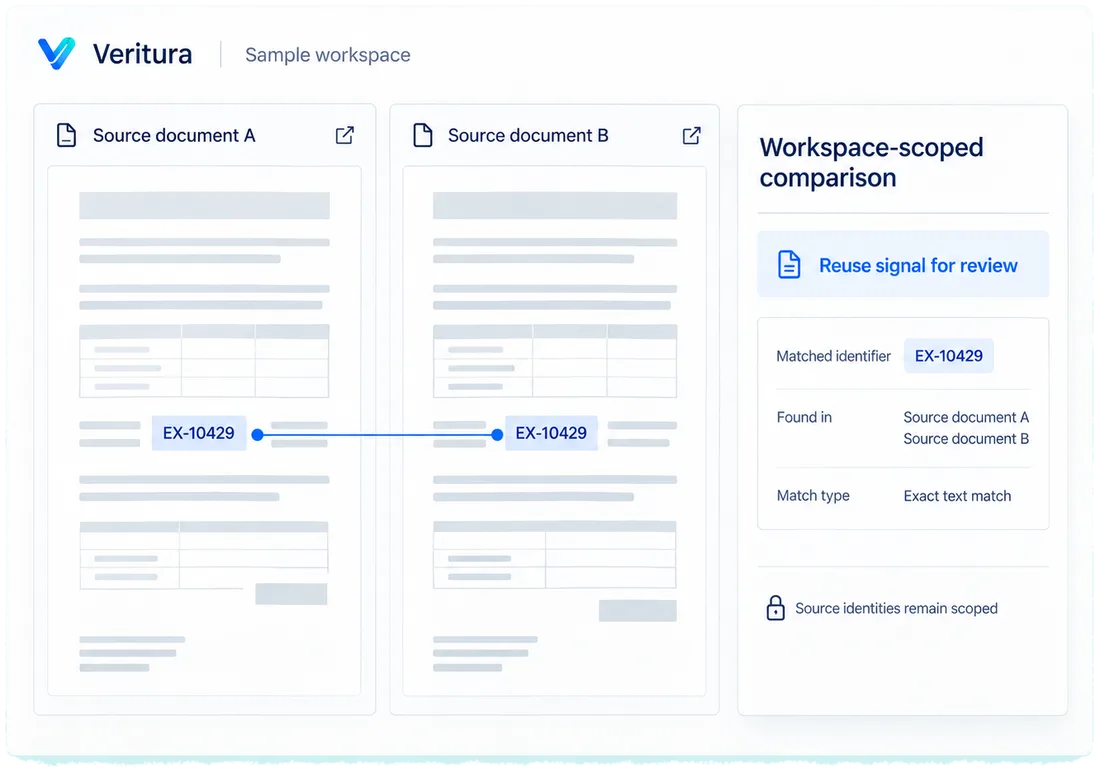
Cross-document forensics surface reused certificates and duplicate-report signals across the entire index. The specific detection signals are deliberately unpublished, because publishing them would teach document forgers what to avoid. What is published is how a reused signal is raised and what a reviewer sees when it is.
Publishing how a reused signal is raised, while keeping the detection signals private, protects the check from the people it is meant to catch.

04
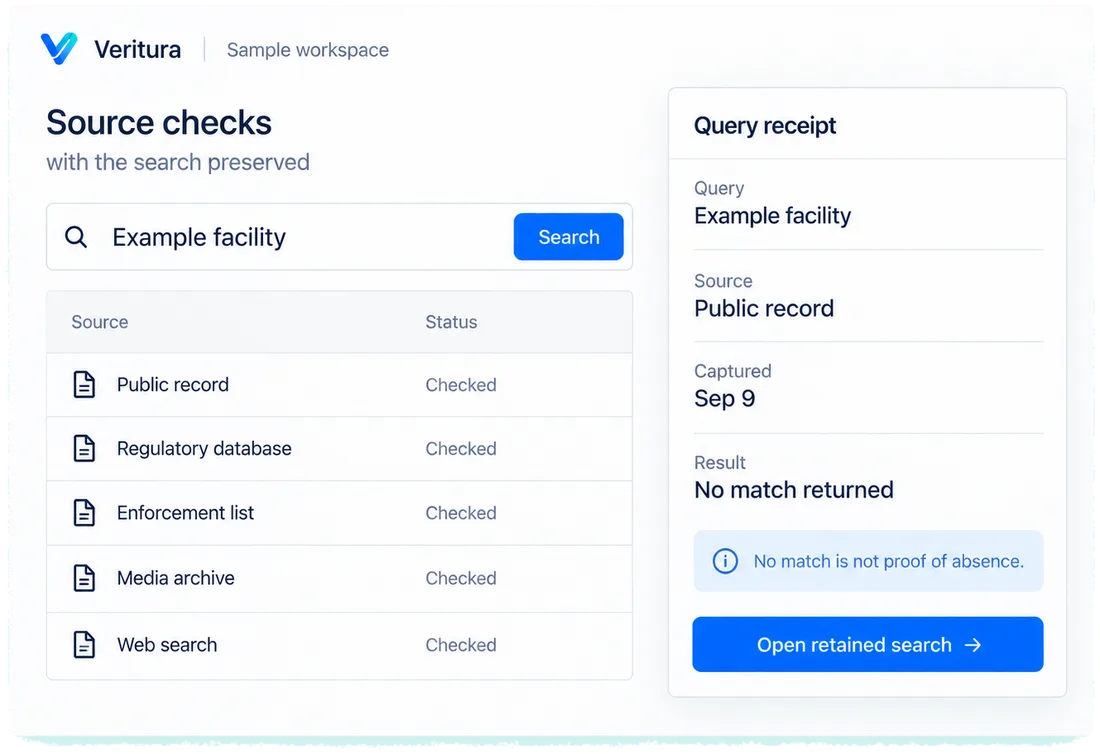
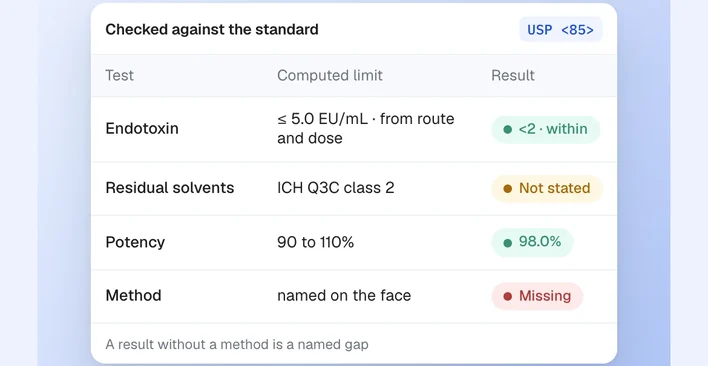
FDA, openFDA, import-alert, NDC, and laboratory-verify lanes preserve the search that was run, the source URL, the capture date, and the reviewer context. Absence of a public-source match is recorded as absence of a match, not as proof of absence, and the record says so in those words.
Absence of a match is recorded as absence of a match, in those words, because a public source that returns nothing is not proof that nothing exists.

05
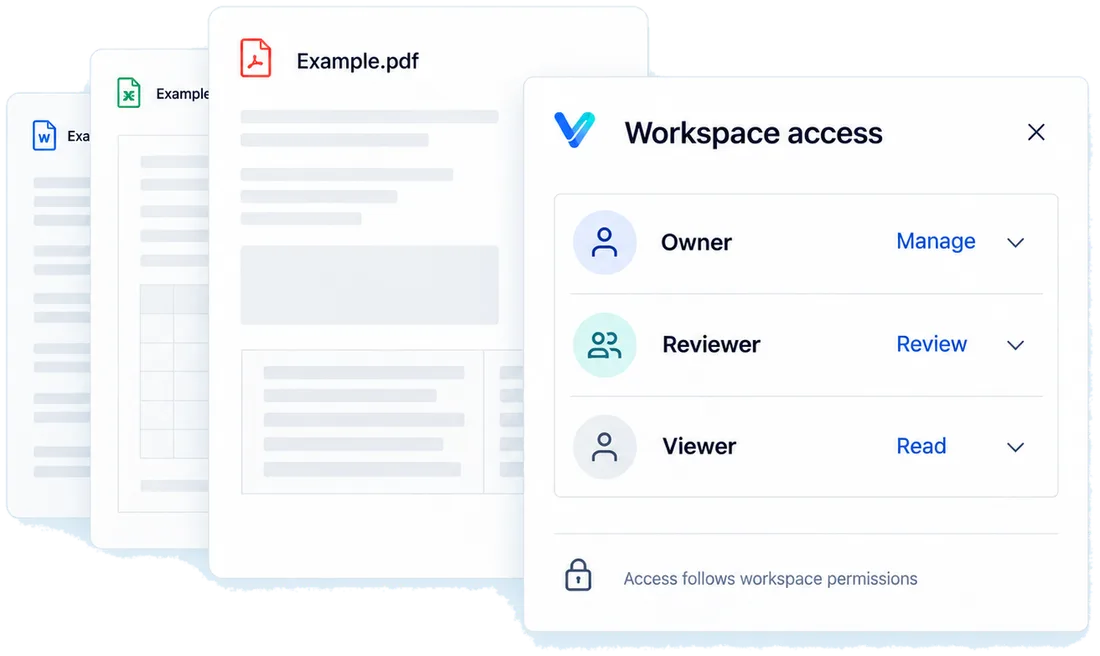
Documents and evidence records are encrypted in transit and access-scoped to your workspace, handled through provider-backed storage controls when production storage is configured. Every output excludes product-approval, medical, and purchase language, and the risk boundary is printed on the record itself, next to the evidence.
The boundary is printed on the record next to the evidence, so a reader never has to find a policy page to learn what the output does not claim.

What changes
Mechanical and repeatable, so two reviewers reach the same record and an inspector can replay it.
No product-approval, medical, or purchase language, printed on the record itself.
If evidence changes, the record changes and says so, with the basis preserved.
What backs the work, and what it does not convert into.
Every reviewed output stamps the methodology version, dated April 30, 2026. Material changes require a new version and a visible record here.
Every reviewed document is hashed and assigned an evidence ID, preserved in the report so the file can be reconstructed at inspection time.
AI assists first-pass extraction and drafting. A person reviews the final language on delivered diligence memos. Automated checks and Passports claim no human sign-off.
Errors-and-omissions coverage supports the documentation-diligence work. It does not convert any report into approval or regulatory sign-off.
If evidence changes, the record is corrected and says that it changed. Supported observations are never removed for being unfavourable.
Questions about the method, the boundary, or the record go to the people who wrote them.
The complete text, for the reader who wants the whole story before a call.
Every reviewed output stamps the methodology version (v1.0 . 2026-04-30). Material changes require a new version and a visible record on this page.
Every reviewed document is hashed and assigned an evidence ID, preserved in the report so the file can be reconstructed at inspection time.
AI assists first-pass extraction and drafting. A human reviews the final language on delivered diligence memos. Automated checks and Passports claim no human sign-off.
Professional liability / errors-and-omissions coverage supports the documentation-diligence work. It does not convert any report into approval, safety coverage, legal advice, or regulatory sign-off.
Documents and evidence records are encrypted in transit, access-scoped to your workspace, and handled through provider-backed storage controls when production storage is configured. Practice and sample packets are isolated from billing and delivery.
If evidence changes, the record is corrected transparently, with the basis for the change preserved. Findings are tied to evidence, not opinion.
A mechanical, repeatable process, so two reviewers reach the same record and an inspector can follow it.
The record opens with the posture a human can act on, not a hidden conclusion.
Material observations point back to source files, fields, hashes, or explicit limitations.
Matches, mismatches, missing documentation, and could-not-verify. No subjective or paid ranking, no vendor scoring, no certification of product quality. Published Verified Supplier profiles carry an objective grade of the documentation evidence only.
COA, lot, lab, method, purity, MS and sequence evidence, sterility, endotoxin, strength, address, and disclaimer language. Presence or absence recorded mechanically, and a field the document does not state is recorded as not stated on the document rather than inferred.
Cross-document forensics surface reused certificates and duplicate-report signals across the entire index. The specific detection signals are deliberately unpublished: publishing them would teach document fraud how to evade them.
FDA, openFDA, import-alert, NDC, and lab-verify lanes preserve the search, source URL, capture date, and reviewer context.
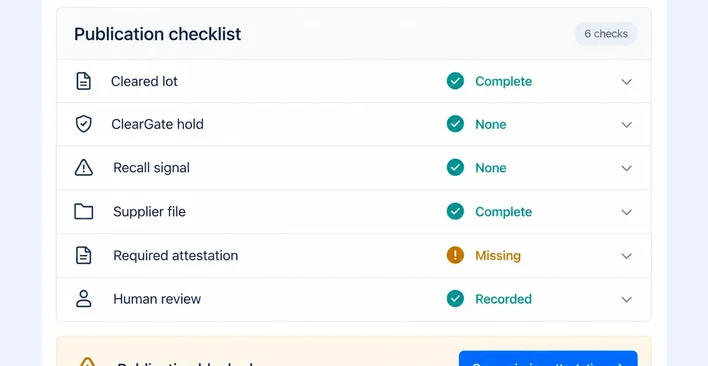
The six-element file is built with honest tiers. Each item is labeled Veritura evaluated or Operator attested, with a living current, due, or overdue status on every dated document.
Every output excludes product approval, safety, legal, medical, or purchase language.
The client sees the supplier ask, hold, review, or release step tied to the evidence. At receiving that ask is drafted for them, composed from the specific gaps the gates found.
The output becomes a reliance hold, a supplier question, an evidence memo, or an Evidence Passport. Never supplier approval or product certification.
methodologyv1.0 . 2026-04-30
reconciliation4 buckets
completenessfield-by-field
evidence_idE1 . SHA-256 recorded
forensicsreuse / producer signals
source_lanesopenFDA . NDC . lab
qarelease-gated
determinationnone, signals only
AI may assist extraction and drafting. Delivered written diligence memos receive human QA. Self-serve checks, ClearGate decisions, and Passports are automated unless the record explicitly says otherwise, and no human sign-off is claimed on them.
Every lane preserves the search, the source URL, the capture date, and the reviewer context.
The issuing lab is resolved against a verify-portal registry with a ready-to-send confirmation email, and only a recorded lab reply flips a document to source-confirmed.
What is checked, and the public sources it is checked against, are published. The detection heuristics themselves are not, because publishing them would help fraudulent documents evade them and because they change faster than any page.
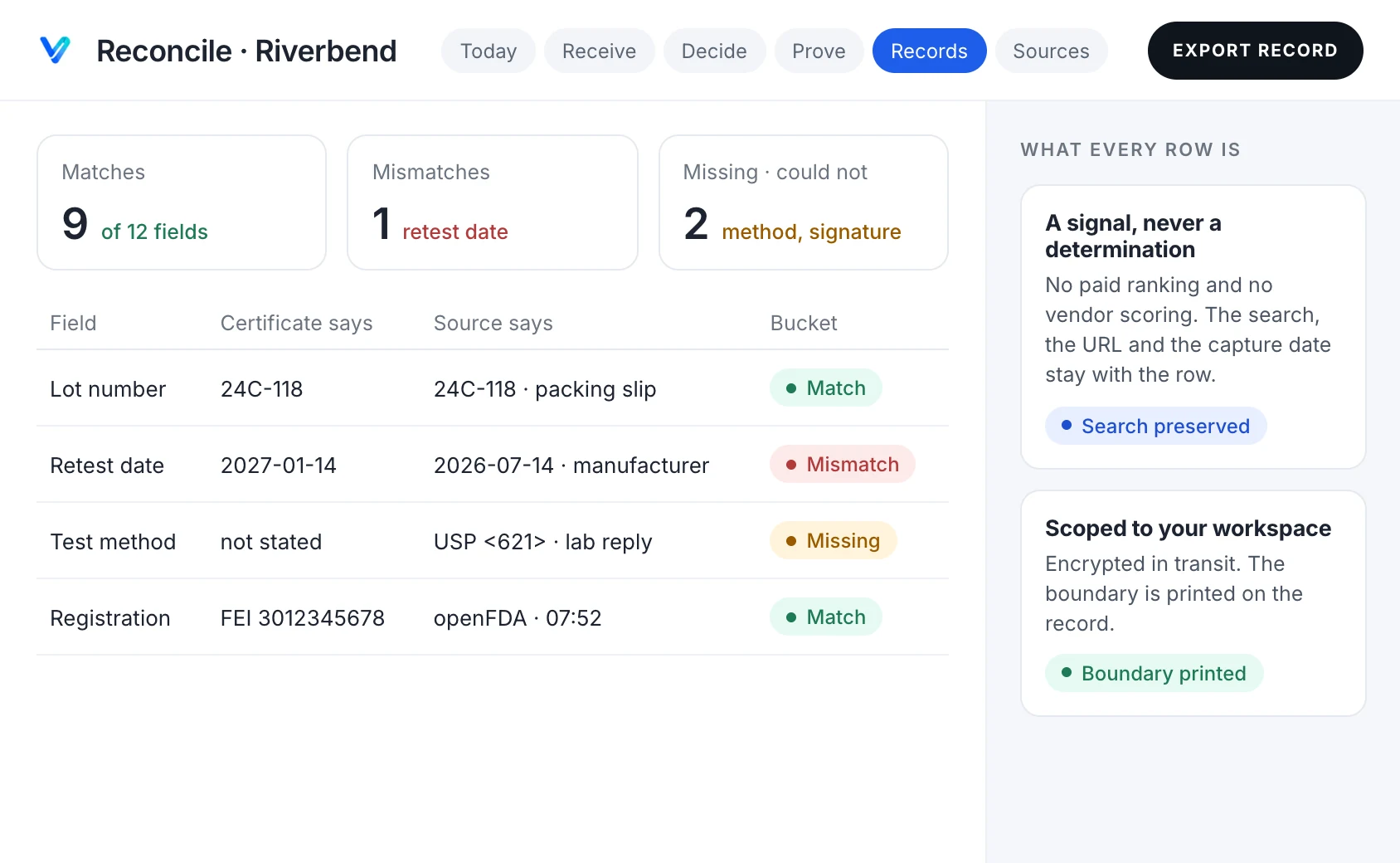
Each document is reconciled against the lab that issued it, the standard it has to meet, the file's own internals, and every other document we have seen. Each lane returns one of three states with its reason, ran, not applicable, or could not verify, and no lane is allowed to disappear. Findings are signals for human review, never approval or safety claims.
How each lane runs, and the full published check catalog, is on the evidence engine.
Lots and firms are matched against open enforcement and recall data in real time.
Manufacturer identity is checked against a dated registration snapshot, and unmatched names are surfaced for review.
A dated capture of the FDA outsourcing-facility list, shown with both its source date and its capture date.
503B snapshot: FDA's list current as of June 23, 2026, captured June 30, 2026
Not found in the snapshot never means not registered. It means the name did not match the captured list.
A result is a documentation posture of Clear, Review, or Hold on the document set. A ClearGate decision of Allow, Review, or Hold is a separate axis, resolving one order against the policy you configure. Both describe the paperwork, not the medicine.
A ClearGate decision always means the documentation meets your policy. It never means Veritura approves the supplier. Customer-facing phrasing: Meets your policy, Needs review, Does not meet policy.
Absence of a public match is not proof of absence. A missing document is not a failed test. A similarity indicator is not a fraud determination.
The document set met the configured policy. It describes the paperwork, not the medicine.
The issuing laboratory confirmed issuance through the recorded verification route.
OrderPO-DEMO-0413
LotLOT-7741-A
SupplierAurora Pharma Supply
Quantity250 g
ReceivedJuly 22, 2026
ReleasedJuly 23, 2026
Passport issuedJuly 23, 2026
Methodologyv1.0 · April 30, 2026
COA-7741-A.pdf · Issuing laboratory confirmed issuance through the recorded route
CoC-7741.pdf · Required identity, lot, and date fields present
SDS-SEMA-04.pdf · Current revision on file
GMP-AUR-2026.pdf · Supplied by the operator
Recorded in workspace · Container and label checked at receipt
LBL-7741-A.jpg · Lot identifier matches the certificate of analysis
Joey Soto, founderAccountable for the methodology
PharmD and sterile-compounding advisorsInput on the methodology
Regulatory affairs and 503B quality advisorsInput on the methodology
Final operational decisions stay with the customer.
Advisors appear as roles. A named advisor quote may only be published if that person actually gave it in writing.
Rank vendors by preference, payment, or judgment, recommend purchases, test physical material, certify products, provide medical, legal, or regulatory advice, determine legality, or confirm FDA approval, clearance, or registration.
Document what is present, conflicting, missing, changed, or not verified in reviewed materials, with cited evidence, hashes, limits, and the next supplier question, for a human to decide.
Veritura does not test medicine, approve suppliers, recommend purchases, or make medical, legal, product-safety, or FDA-approval determinations. There is no paid or subjective placement: suppliers cannot pay for a better result or a better position, no listing fee, no subscription, and no pay-to-rank. Where results are ordered rather than filtered, the order is set by a published documentation-coverage grade, and that grade is never a recommendation, a preference, or a statement about any product.
Security and data handling
Veritura is built around document evidence, business contact information, source records, and report boundaries. It is not designed to collect patient information, intended use, clinical outcomes, or medical histories.
PostureData minimization first
Patient dataNot requested
File recordName, size, metadata, SHA-256 hash
E&O coverage$1M professional liability (E&O) coverage in place
ContactJoey@veritura.co
Intake asks for business contact details, supplier identifiers, document context, and decision context. It does not ask what a patient is taking, why a product might be used, or what outcomes are expected.
For browser-submitted files, Veritura records name, type, size, last-modified time, and a browser-side SHA-256 hash, so the submitted document identity is preserved.
Structured records go through Supabase, email confirmations through Resend, and checkout through Stripe. Veritura does not store card numbers or card security codes.
Administrative surfaces are separate from public pages and require administrator authorization. Public static access is restricted to an explicit server allowlist.
Reports are documentation diligence records only. They do not approve suppliers, verify product quality, certify purity, determine legality, or replace supplier qualification and wet-lab testing.
Users, suppliers, vendors, and labs can submit factual corrections or supplemental evidence through the correction process or by contacting Joey@veritura.co.
Partners can send clients to Veritura without collecting the packet themselves.
The intake is designed for supplier documents, business context, and redacted source material.
AI-assisted review is usage-capped, logged, and positioned as a draft layer before final delivery.
No supplier approval, product certification, clinical guidance, or purchase facilitation.
Users should redact patient data, protected health information, patient identifiers, prescription records, nonessential pricing terms, and unrelated commercial information before submitting materials for review.
Data minimization first. Patient data is not requested, and where Veritura declines to collect something, no field for it exists.
Every vial claim is patient-initiated from a printed seal and confirmed by email, and deletion is self-serve: the Delete my space control removes the account and stops all notices.
Reports are not safety assessments, quality assessments, legal determinations, or purchase recommendations. There is no paid or subjective placement; where results are ordered, they are ordered by the disclosed documentation-coverage grade published above.
Not a safety assessment. Veritura does not determine whether any product is safe, sterile, effective, pure, legal, or appropriate for any use.
Not product testing. Reports are based on submitted documents, public pages, metadata, and snapshots. Veritura does not test physical material.
Authenticity limits. A report may identify metadata, repeated file signals, links, and inconsistencies. It cannot prove document provenance unless an issuing lab or source independently confirms it.
No purchase recommendation. Reports do not recommend, endorse, discourage, rank, or facilitate purchases from any vendor.
The current standard documents operating controls, boundaries, and buyer-visible safeguards.
We collect what is needed to provide the diligence record, and nothing about who you are or what you intend to do.
No intended-use collection. Veritura does not ask what a user intends to do with any product, what conditions they have, what they are taking, or what outcomes they seek.
Report data. Submitted URLs, uploaded document metadata, extracted fields, hashes, evidence records, and account details may be used to provide saved reports and monitoring.
Documents. Uploaded documents are processed to extract documentation signals. Users should avoid submitting private health information or unnecessary personal data.
Patient vial records. When a patient saves a vial from its scan page, Veritura stores the email address, the saved vial serials, and the notice history for those serials, and nothing else. It never stores a name, an address, or any health information, and no field for them exists. Every claim is patient-initiated from a printed seal and confirmed by email, and deletion is self-serve: the Delete my space control removes the account and stops all notices.
Contact. Privacy requests and correction requests should reference the relevant report ID, account email, or submitted source, and can be sent to Joey@veritura.co.
Boundary. Veritura is document diligence only. It does not provide medical, legal, pharmaceutical, or purchase advice, and does not make safety, quality, or FDA-approval claims.
Service scope. Veritura evaluates documents, public page text, metadata, source references, and historical changes using fixed documentation checks.
No professional advice. Reports are not medical, legal, pharmaceutical, regulatory, laboratory, or purchasing advice, and are not supplier approval or product certification.
User responsibility. Users are responsible for the materials they submit and for independently evaluating any decisions outside the report scope.
Corrections. Veritura may update, annotate, or preserve reports based on correction requests, supplemental evidence, methodology changes, or operational requirements.
Service contact. Questions about accounts, reports, corrections, or access can be sent to Joey@veritura.co.
Keep the review focused on supplier evidence, and keep medical, legal, and patient details outside the workflow.
Do not submit health details. Do not submit personal medical histories, outcomes, dosing information, or intended-use details.
No false or misleading submissions. Do not upload altered documents, impersonate vendors or labs, or submit correction requests without evidence.
No purchasing facilitation. Do not use Veritura to coordinate purchases, sales, shipping, sourcing, or transactions involving regulated or unapproved products.
No abuse. Do not scrape excessively, attack the service, harass vendors or users, or use generated reports out of context.
The redaction rule that goes with these rules is published above. Security and data handling
Nothing is silently rewritten, and nothing supported is removed because it is unwelcome.
Who can submit. Users, vendors, labs, or other relevant parties may submit factual corrections, supplemental documents, or responses tied to a report ID.
What we review. Correction requests are reviewed against the underlying source material and the methodology version used for the report.
What we do not remove. Veritura does not remove supported observations because they are unfavorable. Reports are corrected when a factual error or missing source is demonstrated.
Vendor responses. Where appropriate, a response or supplemental document may be attached to a report without changing the original observation.
Correction contact. Correction requests should include the report ID, the specific observation at issue, and the document or source that supports the correction. Send requests to Joey@veritura.co.
Send requests to Joey@veritura.co.
Evidence-backed corrections can update factual records without rewriting the methodology trail.
Follow one lot end to end, from the read to the record you hand someone, or talk to us about covering your supplier base.
Veritura reads and connects the paperwork behind an order. It never tests, grades, or endorses the medicine itself, and it never releases anything on its own.

A person reviews the final language on delivered diligence memos. Automated checks and Passports state that they claim no human sign-off.
Product-approval, medical, and purchase language. The risk boundary is printed on the record itself, next to the evidence, with the methodology version that produced it.
The record is corrected and says that it changed, with the basis preserved. Supported observations are never removed for being unfavourable.
Still have questions? Talk to a person.