 Veritura
What you get
Your sentences beside the sentences the FDA has cited.
The pictures show the same review on Northway Health, a sample telehealth platform on the demo workspace. Its pages, partners and figures are invented.
Every sentence that matches a cited claim type.
We set the sentences on your public pages against 17 claim types drawn from the FDA's warning letters to telehealth companies. For each match: the claim type, how many letters cited it, what the FDA said was wrong in its own words, and a corrected sentence beside it.
- A fact we do not have, such as the pharmacy's name, shows in square brackets, never guessed
- "FDA-registered" alone is marked as a caution: no letter has cited it by itself
- No match says only that no sentence matched
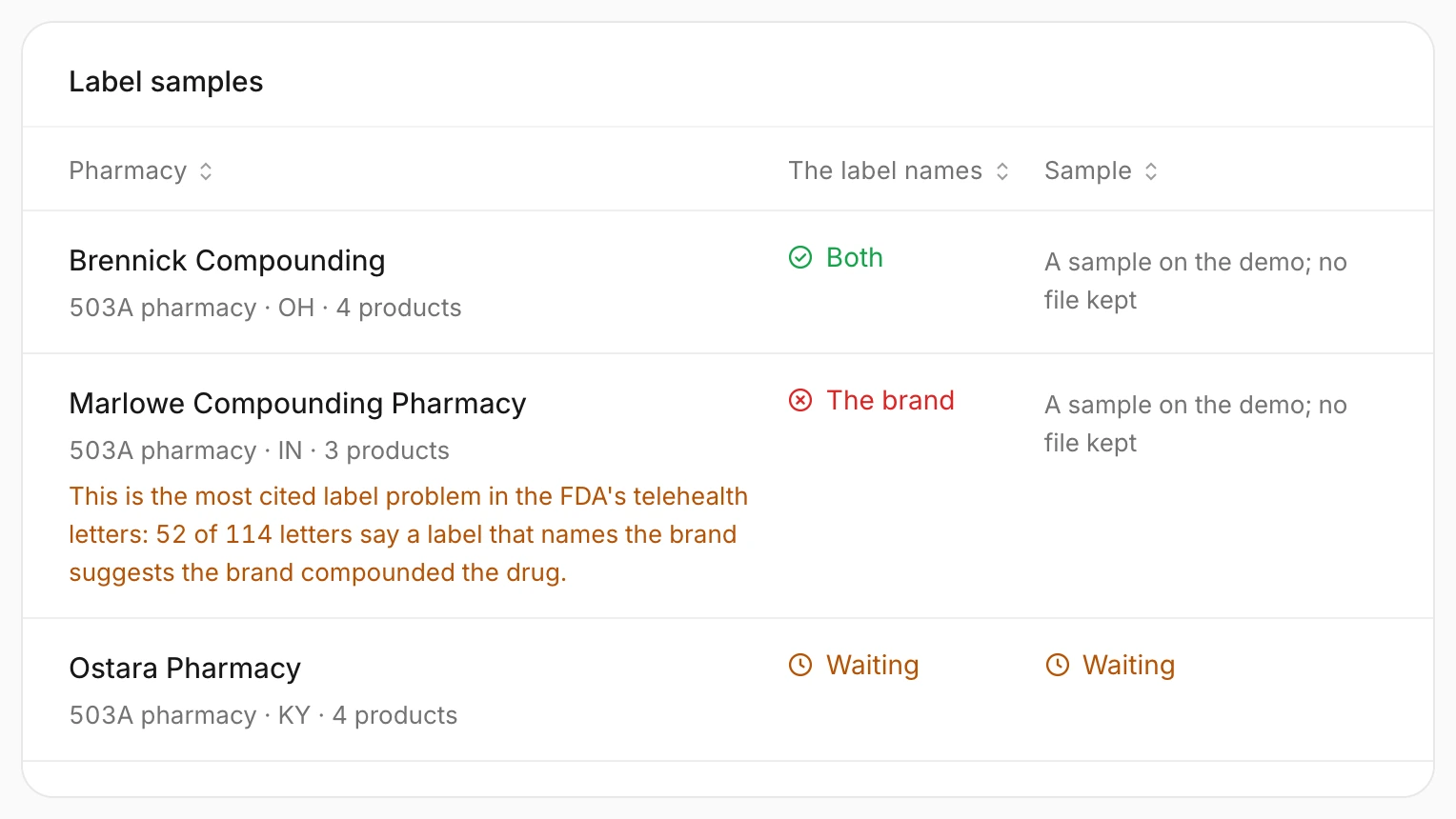
What your label names.
If you send a photo of a vial label, we say whether it names your brand, the pharmacy that compounded the drug, or both. 52 of the 114 letters cite a label that names the brand and not the pharmacy that compounded the drug. With no photo, this part is left out, and the document says so.
- The FDA's reason: "suggesting [brand] is the compounder... when in fact it is not"
- One label from each pharmacy you name is enough
- Cover any patient's name before you send it
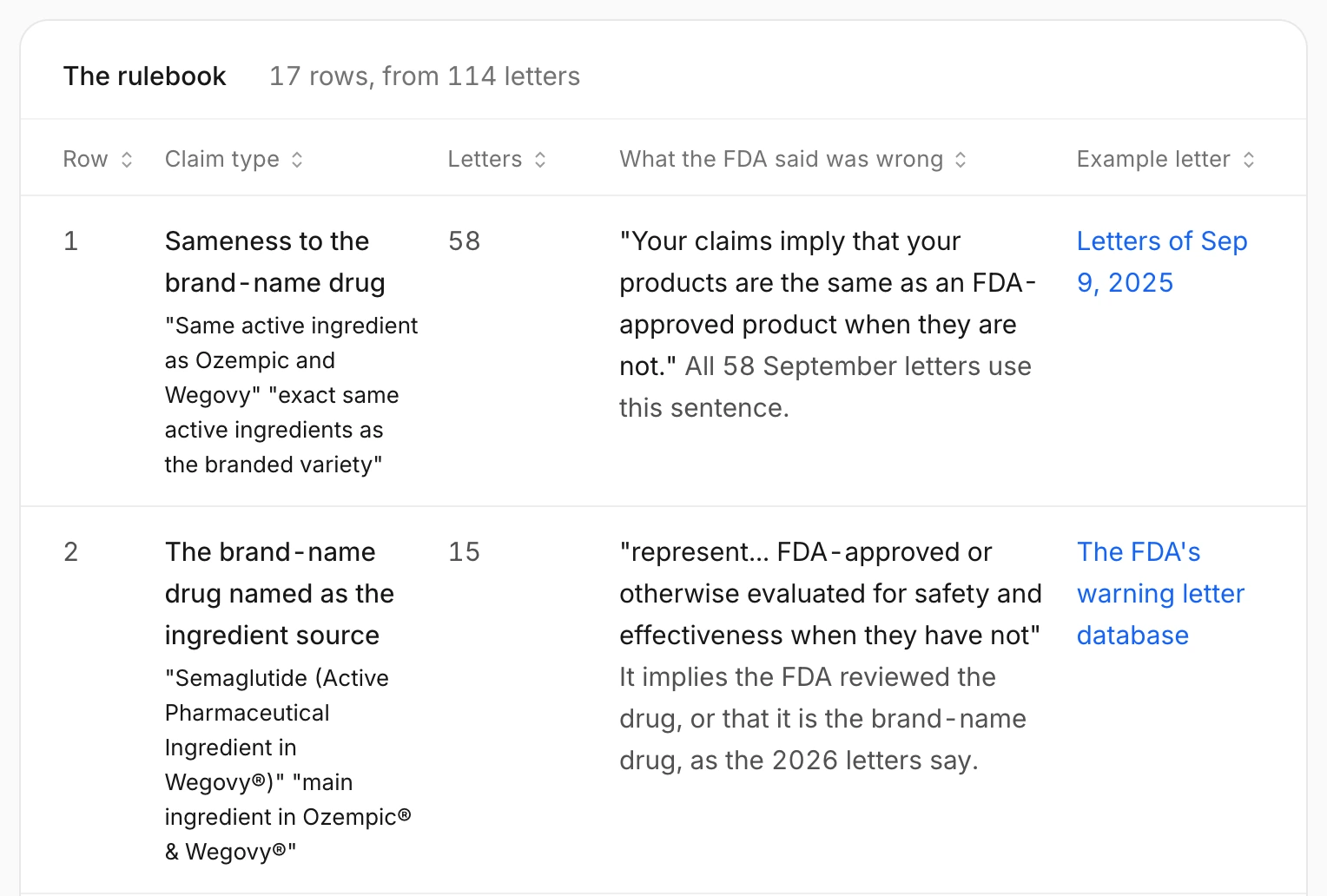
Three of the 17 claim types
The type, how many letters cited it, and the FDA's reason.
Veritura's count of the FDA's posted warning letters to telehealth companies, September 2025 to October 2026. One letter can cite several types.
- Every letter the FDA's database tags Telehealth, dated September 9, 2025 to October 30, 2026
- "Your claims imply that your products are the same as an FDA-approved product when they are not."
- "Overstatements of efficacy or minimization of risk are of particular concern."
- "are not 'FDA-approved' or 'FDA-licensed' entities"
The pharmacies behind your products
The public record of each pharmacy we can identify.
For each pharmacy your website or your label names, its state license and the FDA's records of inspections, warning letters and recalls, each with its source and the date we looked. A pharmacy we cannot identify from public pages is listed as not identified. An FDA warning letter to a telehealth company, June 2026, asks the firm to respond "within fifteen (15) business days of receipt of this letter", and names among the steps a response may include "Identifying the entities that produce the compounded drug products offered on your website". Read on the FDA's warning letters page on November 17, 2026.
What we need from you.
The public site where you offer compounded drugs. We read its pages as they stand on the day.
One vial label from each pharmacy, with no patient's name on it. Without it, the label part is left out.
No account, no orders and no patient data. Everything in the document is public.
What it is not
We review documents. We do not test material.
It says which sentences match a claim type the FDA has cited. It never says that no letter will come.
It sets your words beside the FDA's. What you change is your decision.
It reads your public web pages on the day. It does not read ads.
Questions telehealth companies ask.
What does it cost?
Nothing. The claims review of your website is free, and you send nothing but the address.
If no sentence matches, are we clear?
No. A page with no match says only that no sentence matched one of the 17 claim types. It says nothing about whether a letter will come, and we never promise that none comes.
Where do the claim types come from?
From the FDA's posted warning letters to telehealth companies, September 2025 to October 2026, as Veritura counted them: 114 letters, coded by the claim each one quotes. Each type keeps the FDA's stated reason, in its own words.
What happens after we get it?
The document is yours to keep. The same review runs in the Veritura workspace for telehealth platforms, where each saved page is reviewed again every week. See the telehealth page.